Ask the treasuryXL expert #1 How might digital trade transactions reduce the threat of fraud and money laundering?​

04-07-2022 | treasuryXL Vincenzo Masile | LinkedIn |

treasuryXL is the community platform for everyone with a treasury question or answer!

Today, we discuss a question that treasuryXL expert Vincenzo Masile often gets to hear within his treasury network about digital trade finance.
This edition, the following question will be answered:


“How might digital trade transactions reduce the threat of fraud and money laundering?”



Vincenzo Masile

“That is a question I think is very relevant right now, especially after Covid. Firstly, let me look back at trade finance over the past few years. In 2019 and 2020, trade finance came under scrutiny following a number of high-profile defaults, suspected frauds and double financings and, in some cases, the failure to provide proper collateral for goods.

While legislation to recognize electronic trade documents will not bring about an overnight change in financier confidence, it is likely to do so in the medium term.

A game-changer for digital trade

The availability of fully enforceable electronic trade documents recognized by the most widely used trade jurisdiction will in itself have a major impact on the approach of both companies and financiers towards digital trading solutions.

Transferable records, such as bills of lading, are the most important commercial documents in trade and currently, less than 1% of bills of lading are in electronic form. This is a huge missed opportunity, given that electronic transferable records will make trade safer, paperless, easier, cheaper, faster, and greener for companies.

Implications for the security in trade transactions and regulatory treatment of trade finance: URDTT

The Uniform Rules for Digital Trade Transactions (URDTT) version 1.0 are the result of the mandate given by the ICC (International Chamber of Commerce, Paris) Banking Commission to develop a high-level structure of rules, obligations, and standards for the digitalization of trade transactions.

The ICC Uniform Rules for Digital Trade Transactions (URDTT) are intended:

1. For a fully digital environment;

2. To be neutral with regard to technology and messaging standards; and,

3. To extend into the corporate space, including commercial transactions and the growing community of non-bank providers of financial services.

The URDTT are designed to be compatible with UNCITRAL (United Nations Commission on International Trade Law) Model Laws, including those Electronic Commerce, Electronic Signatures and Electronic Transferable Records.

The rules will serve as an overarching framework for digital trade transactions thereby providing global standardization, consistency and conformity, providing a collective understanding of terms and definitions, whilst promoting and supporting the usage of electronic records/documents/data.

Various technology service providers have already publicly stated their intention to work with the URDTT, in fact, a number have already incorporated the URDTT into their platform rulebooks and are actively looking at developing trade products based upon the URDTT.

Conclusions            

Trade finance functions that adopt appropriately targeted automation and advanced analytics as integral parts of their compliance operations will be more important than ever in this uncertain international environment. With such high volumes of transactions and increasing complexity, efficient trade financing is key to ensuring that warehouses, harbors and supply chains are running smoothly – thus keeping the age-old business of  international trade firmly afloat.”


Do you also have a treasury-related question? Feel free to leave your question on our treasuryXL Panel. The panel members are willing to answer your question, free of charge, with no commitment.
What is the expected conclusion of crypto volatility for Corporate Treasury?

08-06-2022 | treasuryXL | LinkedIn |

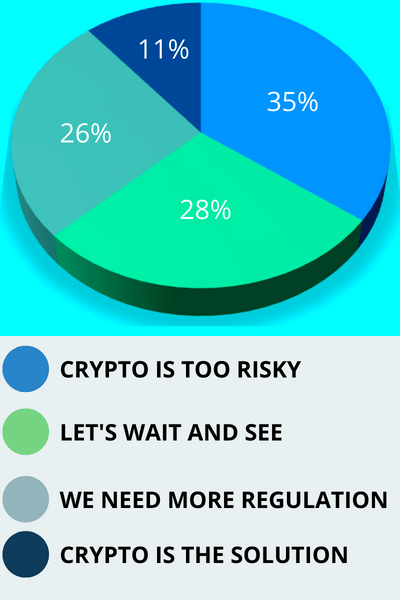
A couple of weeks ago we launched a poll on our LinkedIn page about the impact of crypto volatility on corporate treasury. The poll received 72 votes in total, which is a great number! Thanks to everyone who joined the poll.

We thank François de Witte, Pieter de Kiewit and Carlo de Meijer for sharing their views with us.


What is the expected conclusion of crypto volatility for Corporate Treasury?

The votes which were given by Treasurers


View of treasuryXL experts


Francois De Witte

“There is a clear need for more regulation”


It is quite clear that cryptos present a high-risk profile. The volatility is high, and it is not easy to hedge these risks. In addition, payment transactions in cryptos take more time and energy than existing payments systems like the instant payments.

Currently, cryptos are held within the blockchain and are based upon a consensus. As a corporate, you do not have a control over these assets. In addition, you do not have the stringent KYC and AML checks which you have in the classic payment systems. The KYC and AML controls occur only on the moment that an individual or a company buys cryptocurrencies with its bank account or card, or when the proceeds of the sales of cryptocurrencies are paid to their bank account.

For this reason, there is a clear need for more regulation. Although the 5th AML Directive covers certain crypto assets under the term “virtual currencies”, it does not provide a harmonized approach. This problem will be addressed by the proposal of the EU Commission for the Regulation of Markets in Crypto Assets (abbreviated as MiCAR), which aims to create an EU framework for crypto assets falling outside the scope of other existing EU financial regulation and is expected to enter into force by end 2024. Let’s hope that this will bring more clarity in this complex topic.


Pieter de Kiewit

“Let’s see what will happen”


Rejecting crypto currencies or even blockchain before fully understanding the concept is like holding on tohorse and wagon when seeing the first cars. And current inflation following the QE strategy of the ECB shows that stability is not guaranteed in the traditional system. At the same time, treasurers are there to manage risk and the current crypto landscape seems very risky. So let’s see what will happen.


Carlo de Meijer

“Without well thought-out regulation, the inherent volatility of cryptocurrencies will continue to make stablecoins vulnerable to various risks”


Regulation of stablecoins has long been on the agenda of regulators worldwide. To date, however, the crypto sector in general and the stablecoin segment in particular remain largely unregulated.

Stablecoins continue to come under scrutiny from regulators, given the rapid growth of the $130 billion market and its potential to impact the broader financial system. As stablecoins are deemed increasingly important to the system by regulators, with the potential to disrupt payment and settlement transactions.

The recent collapse of stablecoin TerraUSD (UST) and the resulting fall of Bitcoin below the $28.000 level have provided an additional argument for speeding up the regulatory process and coming up with adequate regulatory measures.


With a growing number of traditional financial institutions, investors and also companies entering the Crypto and DeFi market, regulation becomes urgent to prevent such collapses in the future. Buyers need to understand the risks of these algorithmically stablecoins in particular. Therefore, standards are needed.

Without well thought-out regulation, the inherent volatility of cryptocurrencies in general but also of some types of stablecoins, will continue to make these stablecoins vulnerable to various risks, and make using these instruments for treasury purposes a difficult activity. The lack of transparency about what assets are being used and whether they have enough dollars to support all the digital coins in circulation also amplifies this consequence.

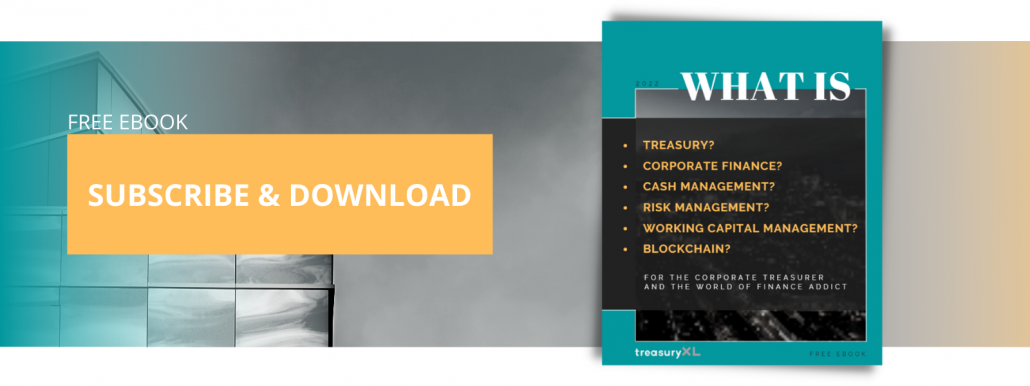
Subscribe and receive your 41 pages ‘easy-to-read’ eBook, What is Treasury?

16-05-2022 | treasuryXL | LinkedIn |


Treasury, Corporate Finance, Cash Management, Risk Management, Working Capital Management and Blockchain. What are the purposes of these treasury functions?

treasuryXL created this eBook based on the most relevant best practices that Treasury experts provided over the last years. We bundled the most important information for you and created easy to read and understand articles about the main subjects within the World of Treasury.

We took a deeper dive into each of the above-mentioned treasury functions and highlight:

  • The purpose of each named Treasury function (What is?)
  • What specialists do
  • Examples of Activities
  • Summary of Frequently Asked Questions and answers
  • Conclusion

How to receive the eBook ‘What is Treasury’ for Free?

We simply giveaway two presents for you! By signing up for our newsletter you will automatically receive the following in your inbox:

  1. On Fridays, our Coffee Break weekly newsletter will land in your inbox. In this weekly newsletter, we will highlight the whole week full of the latest treasury news within our community.
  2. The 41 pages eBook, What is Treasury?


Subscribe, Join, Download and Relax.

Welcome to our community and have fun reading!


Director, Community & Partners at treasuryXL


Your free eBook, What is Treasury?

13-04-2022 | treasuryXL | LinkedIn |


Receive your eBook What is Treasury? after subscribing to the free treasuryXL weekly newsletter.

The world of Treasury is a complex topic. Many people will think about pirates and big see ships that sank deep into the bottom of the ocean including their ‘treasure’. A mystery treasure map will lead the finder to a treasure worth a lot of money. In some way Treasury and Treasure have similarities, it is about money and other valuables.

Are you having a hard time how to explain what treasury is to family, friends and colleagues? Or are you interested to learn more about the World of Treasury?


treasuryXL created a 41 pages eBook for the corporate treasurers and the world of finance addict.

This eBook is designed to answer layman questions about the function of Treasury. treasuryXL bundled the most important information for you and created an easy to read and understand articles about the main subjects within the World of Treasury:

This ebook will answer your questions about Treasury topics.

treasuryXL explains the purpose of each Treasury function; what specialists do, examples of activities, FAQs, and a summary.

This ebook is based on the most relevant best practices that Treasury experts provided over the last years. On the website of treasuryXL you can explore additional information on the latest in Corporate Treasury.


HAVE FUN READING!


Director, Community & Partners at treasuryXL


Career Calibration and the Treasurer Test

31-03-2022 | Pieter de Kiewit | Treasurer Test | LinkedIn |

On a regular basis, we write about your career planning in treasury, our opinions, and observations. Two articles on the website of Treasurer Search that are strongly related to this and very well viewed are:

Also, you might have noticed that we are big fans of the Treasurer Test, which helps treasurers in visualizing their skills and personality.


Read more

Example Question #1 | Treasurer Test

09-03-2022 | treasuryXL | Treasurer Test | LinkedIn |

How is your Treasury knowledge? Today we investigate your Treasury Expertise and ask you an example question that you might face when taking the Treasurer Test

Read more

International Treasury Management and Corporate Finance

17-01-2022 | François de Witte | treasuryXL |

We would like to draw attention to the following event, which includes our Expert François de Witte. Register below to learn more about International Treasury Management and Corporate Finance.

Registration


In order to be accepted to this certified path it will be asked to complete this application form .

This training will be planned and will start when a sufficient number of participants has been reached. You will then be informed at least 2 months before the course starts.

However, you can still fill in your application and we will contact you.

If you do not wish to be certified but are interested in the topics, almost every course can be purchased independently by clicking on the title in the content below. This certified path is a blended training which contains both physical and virtual classroom, e-mentoring, teamwork, etc.

Description


The treasurer is the custodian of the company’s daily liquidity. He manages, anticipates and secures cash flows by ensuring that financial needs are covered. This cursus will give the ability to assist directly and practically the treasurer of large corporates or to take over the treasury responsibilities in a SME. The various modules will allow acquiring an in-depth knowledge of the various areas of the “Corporate Treasurer” profession.


Objectives


At the end of this programme, the participant will able to:

  • assist directly and practically the treasurer of large corporates
  • take over treasury responsibilities in a SME.

The various modules will allow to acquire an in-depth knowledge of the different areas of the “Corporate Treasurer” profession.


Programme


Module 0: Introduction to Treasury Management

Speaker: Benjamin Defays / Treasury Manager

  • Corporate Treasurer’s responsibilities
  • Cash management (bank account opening, closing, KYC, Cash pooling, Payments and bank connectivity)
  • Liquidity management (importance of working capital management,
  • Risk management (foreign exchange, fraud, credit risk)
  • Trade finance (general context, intro to bank guarantees and letters of credit)
Module 1: Financial Maths in Excel (Focus on treasury & corporate finance)

Speaker: Hugues Pirotte / Professor of Finance at Solvay Brussels School

  • Focus on treasury & corporate finance
  • Time Value of Money
  • Vocabulary
  • Compounding intervals
  • Discount and annuity factors
Module 2: Payments, Cash Management and Banking Relations

Speaker François De Witte / Consultant

  • Payments (Process, Tools)
  • Liquidity Management
  • Cash-Flow Forecasting
  • In-House Banking
  • Banking Relationship
Module 3: Trade Finance in context of uncertainty

Speaker: Benjamin Defays / Treasury Manager

  • General contact, cultural aspects
  • Why trade finance in treasury
  • Bank Guarantees, Burgschafts, Surety Bonds, Letters of Credit, Cash against Documents
  • Alterative security instruments
  • Disruptive technologies
Module 4: Introduction to Counterparty Credit Risk Management and Cash Collection

Speaker: Benjamin Defays / Treasury Manager

  • Concepts & Practices/Types of Credit Risks
  • Understanding Financial Statements and Ratios
  • Credit Scoring/Ratings – S&P, Bloomberg models
  • Collecting overdue receivables – setting priorities
  • Strategies dealing with overdue invoices
  • Debt collection services development
Module 5: Practical Aspects of International Finance Regulation

Speaker: Lievin Tshikali  

  • KYC, GDPR, EMIR, Bale III
  • International sanctions and their impact on transactions & overall business activities
  • Anticorruption (FCPA, UK Bribery Act)
  • EU competition law compliance
  • INCOTERMS
  • Drafting a contract (main considerations)
Module 6: Risk Management applied to treasury

Speaker: François Masquelier / Group Treasurer

  • FX, Interests
  • Counterparties
  • Others (Reputation, etc…)
  • Objectives of Hedge Accounting
  • Required documentation and formalisation of Hedge Accounting relationships
  • Different types of hedges (Fair Value, Cash Flow, Net Investment)
  • Booking adjustments of different hedge types
  • Typical examples of different hedge types
Module 7: Technologies applied to treasury

Speaker: François Masquelier/ Group Treasurer

  • New Technologies
    • Blockchain, Crypto-currencies, Smart Contracts
  • Treasury Console (Bloomberg, Thomson Reuters)
  • TMS, Financial Technology
Module 8: Cyberfraud: what you need to know to manage this ever increasing risk

Speaker: Thierry Hamon / Cash management & security expert

  • Getting an overview of the different cyberattacks techniques currently used
  • Understand the possible consequences of cyberfraud and what needs to be protected
  • Learn 50 ways to protect

Some homework might be proposed for some modules, there will be continuous control in the form of intermediary exams (under the form of QCM) and a final exam will be sanctioned by an attestation delivered by ATEL (The Luxembourg Association of Corporate Treasurers).

There might also be one or two “extra-activity”, such as a visit in a bank trading room or/and a special guest speaker addressing the cursus participants on a specific subject (still to be defined, optional events).


Target Audience


Anyone willing to acquire an in-depth knowledge in corporate treasury and wishing to exercise this knowledge in practice.


Prerequisites


  • Basic background in finance or accounting
  • For the Advanced Excel workshop, a preliminary (good) knowledge in Excel is required.

Course Material


The course material can be downloaded free of charge via your portal the day before the start of the course (download the Client Portal User’s Guide here).


Certificate


At the end of the programme, the participants will receive a “Certificate of Attendance” delivered by the House of Training, and an attestation of “Exam Success Pass” delivered by ATEL.

In order to get certified, an 80% rate of attendance and a 60% average score on the examinations are required.

The participants will also receive a one-year free membership to ATEL (www.atel.lu) giving a number of advantages.


Register Here


Francois de Witte


François de Witte


Question treasuryXL Panel #4 | When do I pay an FX surcharge to my payment service provider?

14-12-2021 | treasuryXL | EcomStream | LinkedIn |

treasuryXL is the community platform for all your relevant treasury questions.

We received the following question from one of our followers… Read more

Question treasuryXL Panel #3 | Should treasury always report to the CFO?

02-11-2021 | treasuryXL | Treasurer Search | LinkedIn |

treasuryXL is the community platform for all your relevant treasury questions.

We received the following question from one of our followers… Read more

Beheer uw Financiële Middelen | Cash- en werkkapitaalbeheer

| 29-10-2021 | François de Witte | treasuryXL |

Een bedrijf financieel gezond houden kan niet zonder een gedegen werkkapitaalbeheer. In deze basisopleiding bekijken we alle inkomende en uitgaande geldstromen (debiteuren, crediteuren, voorraden en cash). U leert hoe u deze geldstromen kan beheren en optimaliseren. Een aanrader voor iedereen wie interesse heeft en de noodzaak inziet van een transparant treasury- en creditmanagement. Deze opleiding gaat klassikaal door in campus Gent.

Omschrijving

Productieprocessen, (internationale) logistieke processen en verkoopprocessen brengen grote geldstromen in beweging. Een bedrijf financieel gezond houden kan niet zonder een gedegen werkkapitaalbeheer. In deze basisopleiding bekijken we alle inkomende en uitgaande geldstromen (debiteuren, crediteuren, voorraden en cash). U leert hoe u deze geldstromen kunt beheren en optimaliseren. Een aanrader voor iedereen wie interesse heeft en de noodzaak inziet van een transparant treasury- en creditmanagement.

Voor wie is deze opleiding bestemd?

Deze module richt zich tot bedrijfsleiders, alsook alle financieel verantwoordelijken, leden van het treasury team, controllers, financieel adviseurs, accountants, accountmanagers en productmanagers bij financiële instellingen.

Voorkennis

Financieel basisinzicht is vereist.

Bijkomende info

Het programma komt in aanmerking voor 9 uren permanente vorming bij ITAA.

Methodologie

Het programma is doorspekt met cases die samen met de deelnemers behandeld worden. Naast voorbeelden uit de praktijk die de theoretische onderbouw concretiseren, is er steeds aandacht voor de opmerkingen en vragen van de deelnemers. Om deze reden is het aantal deelnemers beperkt.

Lesdata

DATUM STARTUUR EINDUUR
woensdag 01/12/2021 9:30 12:30
woensdag 01/12/2021 13:30 16:30
woensdag 8/12/2021 13:30 16:30

Meer informatie en inschrijven: Klik Hier


Francois de Witte


François de Witte