Partner Interview | Manipulating market-leading data to navigate volatility

11-05-2021 | treasuryXL | Refinitiv |

As a leading financial markets data provider, Refinitiv is an essential partner for corporate treasurers. Refinitiv’s global, multi-asset and multi-jurisdiction view of risk, credit and economic data enable treasury teams to drive stability by managing the global and interconnected nature of risk today.

⬇️ ⬇️ ⬇️

In this interview, we take a look at how Refinitiv’s corporate treasury customers used Refinitiv data and apps to remain agile and proactive in one of the most volatile years ever. We also consider what data is likely to be needed as we recover from the pandemic and companies seek growth.

An introduction to:


Andrew Hollins

Director of Corporate Treasury Proposition, Refinitiv, an LSEG business


Rasyid Kwee

Proposition Sales Specialist for Enterprise Solutions, Refinitiv, an LSEG business.


INTERVIEW

1. From your data, what can be identified about the behaviors and activities of corporate treasurers during the onset of the pandemic?

Using the data we have available, we’ve been able to discern three broad phases of corporate treasury response and action throughout the pandemic. The period March through to May 2020 represents Phase 1, which for many Corporates could be termed the ‘Survival Phase’. During this first phase, we witnessed pronounced patterns of activity amongst our Corporate Treasury clients.

Firstly there was a strong focus on analysing and reviewing the Credit Risk of suppliers, clients and also corporate’s own credit risk. Treasurers wanted to know if their customers would be able to pay for the goods and/or services they are supplying, and if their suppliers were still going to deliver supplies, raw materials, component parts, goods, etc.

We also saw a spike in usage of Company Fundamental Data (app for company financial analysis, for financial statements and valuation metrics for over 90,000 companies listed on 169 exchanges in 150 countries), especially so for balance sheets, income statements, key ratios and Cashflow data. Furthermore, there was an increased appetite for Private Company data, which almost certainly reflected a desire to review the health of the extended supply chain, a trend which has continued.

Finally, there was an increase in usage of Sector-specific Economic Indicator data, up 30% globally from Feb – Mar 2020 (this app allows users to search for any Economic Indicator, chart the history, export to Excel and view associated press releases). An increase was also seen in the use of Peer Analysis data (allows for the comparison of a company against its peers across a multitude of measures and variables), reflecting a demand for wider sectoral intelligence, as well as insight into how related companies were performing in such a stressed environment. Conversely, we also saw a decline in demand for ESG related apps and data, as well as data and apps relating to Libor transition. Libor transition in particular had been a high priority area for most corporate treasurers, but the economic shock brought on by Covid-19 pushed these onto the back burner during the ‘Survival Phase’.

2. What are the Data and App usage highlights from Phase 1?

  • Globally, Credit Default Swap (CDS) data usage grew 115% in EMEA and Americas between February and March 2020. Asia showed a 155% rise in usage of this data during the same period. (The CDS Dashboard app provides comprehensive Streaming price coverage on major global Index and single name CDS from major market maker).
  • In the Netherlands (February to March 2020), there was an 83% rise in usage by Corporate Treasurer’s use of credit and credit risk data, specifically;
    • 68% rise in use of Debt Structure data (both for oneself and for one’s peers)
    • 67% rise in Starmine Credit Risk data (Starmine Credit Risk models utilize industry-specific accounting ratios, equity market valuations and text mining models to produce a 1-100 score of an company’s credit risk).
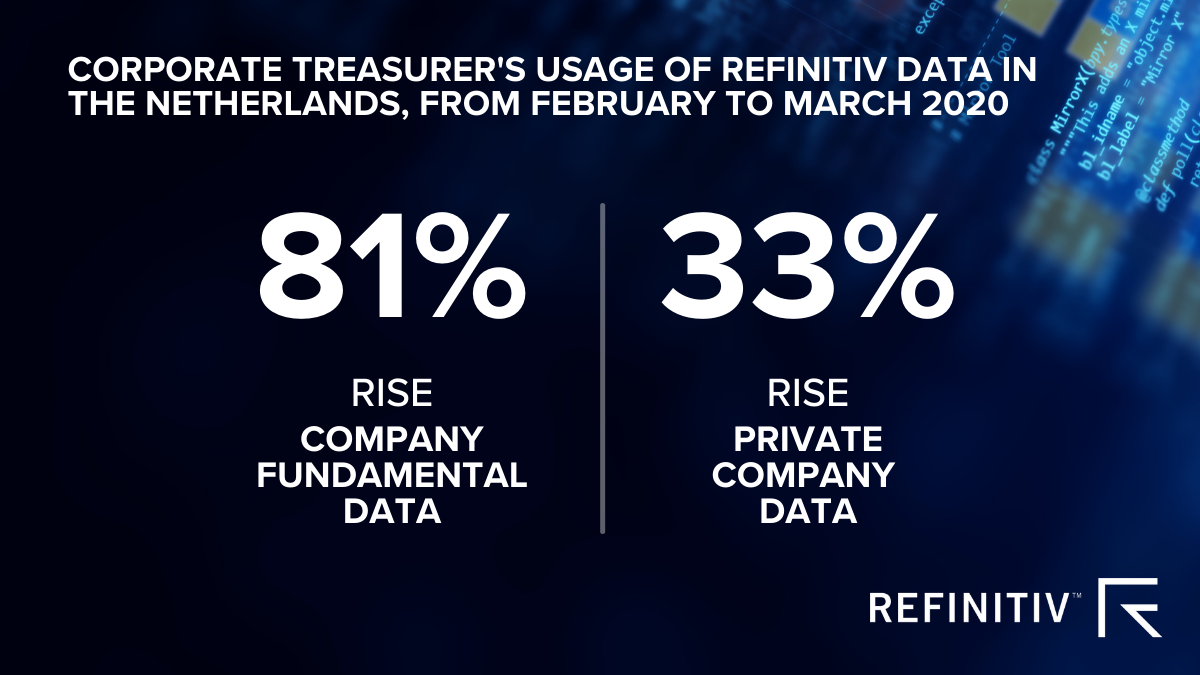
  • During the same period we also saw significant increases in usage of company fundamental and private company data. At the same time there was a clear drop in consumption of ESG data.
      • 81% rise in Company Fundamental data
      • 33% rise in Private Company data
      • 45% drop in use of ESG data

  • Looking at year on year data for the Netherlands for March 2020 and March 2021, we saw a 50% rise in CDS data; 50% rise in Debt Structure Data; 66% rise in Industry sector data; 113% rise in use of peer analysis apps.
  • Furthermore;
    • Private Company Data and Analytics grew by 31% between February to March 2020, receding during the summer months but then grew >100% from October 2020 into Q1 2021.

3. As the pandemic progressed, how did the behaviors and activities of corporate treasurer’s change?

Moving on from ‘Phase 1’ (above) and heading into ‘Phase 2’, which we can place from mid Q2 through to Q3 and call the ‘Cash Phase’, many companies focused on cash preservation and extending their cashflow runway as far as possible. Companies focused on maximising all sources of liquidity, in some cases working with suppliers to extend payment schedules and expedite receivables as far as possible. Companies also drew down reserves and utilised credit facilities. We also saw Bond Issuance accelerate significantly especially in Q3.

4. What are the Data and App usage highlights from Phase 2?

In the Netherlands, from June to October 2020, we saw a notable pick-up in usage of Issuance and Credit-related data and analytics:

  • A 40% rise in usage of the New Issues Monitor – (app providing a comprehensive library of new issues covered by Thomson Reuters and supporting IFR).
  • A more than 250% jump in usage of Starmine Credit Risk analytics and data
  • A 25% rise in usage of the Fixed Income All Quotes app

At the same time, there were also further significant changes in usage of apps and data related to the financial health of the supply chain and the corporate ecosystem in general:

  • Income Statement: Up 116%
  • Balance Sheet: Up 72%%
  • Key Ratios: Up 160%
  • Cashflow: Up 175%

5. How do you see the behaviors and activities of corporate treasurers changing as we move into a recovery mode from the pandemic?

If we identify Phase 3 as the ‘Recovery Phase’, which focuses on positioning and planning for a return to normality, or at least a new normal, our usage data suggests that many companies continue to focus on bond issuance and refinancing in order to take advantage of current lower yields. It’s notable that issuance of US$ denominated debt by non-US companies has been particularly strong in the first quarter of 2021.

There are distinct trends apparent in the usage data for our issuance-related Data and Analytics apps, in particular:

  • DCM Pricer – usage is up 21% from November 2020 to March 2021 (a custom bond calculator designed to build new bond issues and price them for the primary market)
  • Debt Structure app – usage is up 20% between November 2020 and March 2021
  • New Issues Monitor – usage is up 52% from November 2020 to March 2021 (New Issues Monitor provides a comprehensive library of new issues covered by Thomson Reuters and supporting IFR).

As countries navigate out of the pandemic, we can also see that ESG is firmly back on the agenda, with usage of our ESG apps and data rising strongly as we move deeper into 2021. For much of the pandemic period many companies focused on survival, but a rapidly developing global sustainability landscape is contributing to a significant shift towards adopting and ESG standards and behaviours across the corporate sphere.

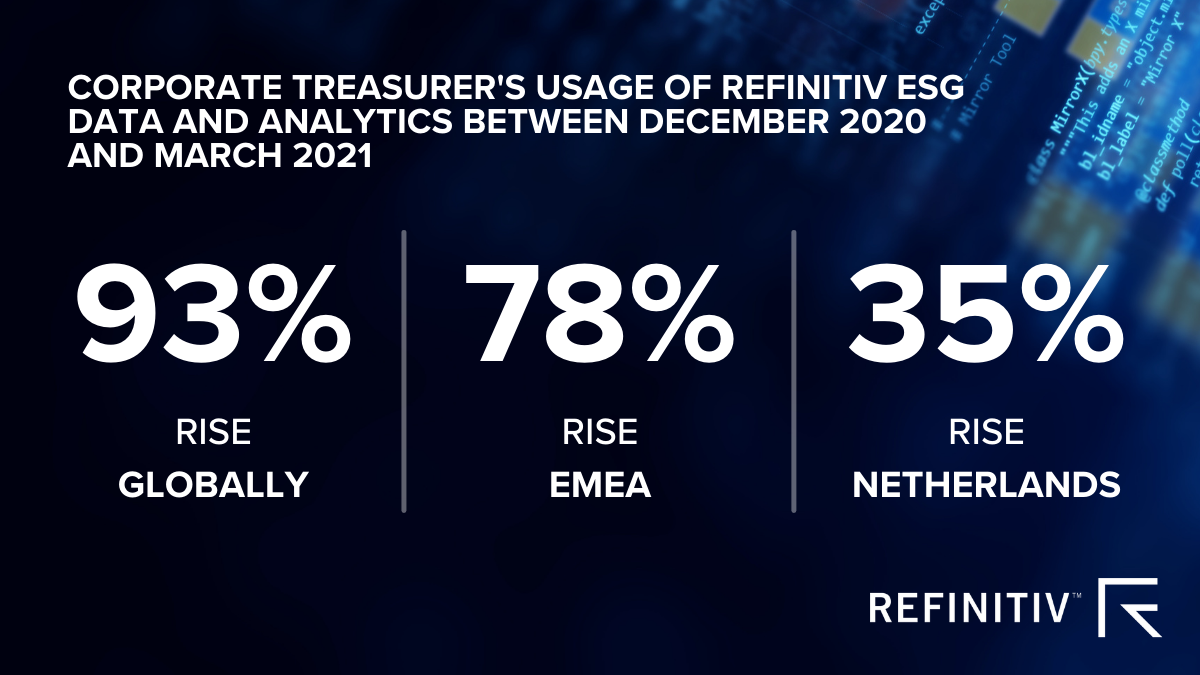
Globally, ESG Data and Analytics Usage has grown 93% between Dec 2020 and March 2021, higher than the pre-Covid-19 peak.

  • Across EMEA, this was up 78% in the same period.
  • In the Netherlands, although below the global and EMEA percentages, ESG Data and Analytics usage was still up 35% in the same period.

Looking beyond Covid-19, conversations with our corporate treasurer clients have revealed an appetite for greater visibility and predictability when it comes to cash and liquidity management. Aligned to this, is a desire for increasingly accurate forecasts and risk analysis regarding projected future cashflows. Hedge accounting and hedge effectiveness tools also feature strongly in these conversations.

Furthermore, automation to support more robust and frequent analysis and reporting, as well as a comprehensive enterprise-wide view of cashflow, risk and liquidity, are also areas of growing interest which are going to feature more in the post-pandemic landscape.

Finally, ESG data consumption has recovered and is now above pre-Covid-19 peaks. This trend is likely to continue on its upward trajectory, becoming systemically more prevalent than it was pre-pandemic, given the rapidly evolving regulatory and demand led factors which are driving an ever-greater focus on sustainability. We recently hosted an event with the Association of Corporate Treasurers on treasury ESG roles and responsibilities which you can watch on-demand here.

6. How can corporate treasurers gain access to Refinitiv’s market-leading data and navigate current and future volatility?

Serving more than 40,000 institutions in approximately 190 countries, Refinitiv provides advanced data and technology to help corporate treasury teams make critical decisions with confidence. Our corporate treasury solutions help deliver accurate and relevant data, tools and analytics that can be accessed easily and intuitively – advancing your end-to-end workflows and ensuring seamless integration with your entire treasury management eco-system.

To find out more, speak with our experts by completing your details here.

Read more about Refinitiv, an LSEG Business here.


8 questions for Treasury Expert Philip who won the award for 2020 Best Fintech Solution

19-04-2021 | Philip Costa Hibberd | treasuryXL

With over 12 years of experience in the financial industry with the last four years in treasury consulting, Philip has recently launched his own consulting activity, Automation Boutique, specialized in (robotic) process automation for Treasury, Risk and Finance.

“I have been coding for fun since I was a kid. This skill has been very useful throughout my career but has become my trademark in Treasury.”

He recently developed the tool that was awarded the “2020 Best Fintech Solution – Adam Smith award” by Treasury Today magazine. He now tries to focus on what he has always enjoyed the most during his career: solving problems at the intersection between ‘numbers’, ‘people’ and ‘technology’.

We are delighted to share the interview with Philip. Let’s dive into his treasury journey where he answers 8 questions…

1. How did your treasury journey start?

As for many of us, it started somewhat by accident. After working in other areas of finance for many years, a few ethical questions started nagging me. Add a sabbatical, some romance, and a few lucky phone calls and I found myself joining the great corporate treasury team at Zanders (a consultancy firm specialized in Treasury, Risk and Finance).

2. What do you like the most about working in Treasury?

I love the diversity of challenges. You are dealing with the financial heart of the company and need to make sure that the right amount of blood reaches every cell. This necessarily means dealing with different kinds of issues, topics and people. This keeps Treasury fun and in constant evolution!

3. What is your Treasury Expertise?

I have been working as a consultant on very different Treasury projects, from interim roles to system implementations. I guess I am what you would call a generalist, but with a knack for using technology and social skills to solve problems. I have been coding for fun since I was a kid. This skill has been very useful throughout my career but has become my trademark in Treasury.

4. What has been your best experience in your treasury career until today?

Going back to the cardiovascular metaphor for Treasury, the best experience was probably when I was called by a client to solve an urgent clot which was at risk of causing severe damage. An apparently simple data migration exercise turned out to be much more complex than anticipated and was at risk of causing severe delays to a multimillion project. The solution involved a robot, a laptop being flown up and down Europe, a wedding and unreliable hotel wi-fi. Surprisingly, instead of being the ingredients for a bad joke, this led to a happy client and to an award-winning solution.

5. What has been your biggest challenge in treasury?

My biggest challenge in Treasury was witnessing the clash of American, Dutch, Indian, Japanese and many more cultures during a global SAP implementation (going live during a pandemic). Holding three nationalities and being exposed to different cultures from an early age didn’t help me as much as I would have hoped. I would encourage anyone working with different cultures to read Erin Meyer’s book “The Culture Map”. It will be helpful.

6. What’s the most important lesson that you’ve learned as a treasurer?

No one is rational and analytical all the time, not even experienced treasury professionals. Good communication is more important than perfect data and models, especially during a crisis. Without it you will lead or be led by emotion and will certainly miss the best course of action. When fear creeps in your own monkey mind, don’t be afraid to have a good conversation with it. Assess how big the actual threat is compared to the shadow being cast by your amygdala.

7. How have you seen the role of Corporate Treasury evolve over the years?

Corporate Treasury has come a long way from its more transactional origins and – as expected – is taking more of an advisory and strategic role within organizations. The boundaries with other specialized professions have faded (risk management and FP&A just to name a few) and I think that this is a good thing. Skilled professionals should be employed to solve interesting problems and come up with great ideas. The best problems and ideas are usually found at the intersection between disciplines and it’s only natural that we tend to all meet there more and more often.

8. What developments do you expect in corporate treasury in the near and further future?

For the near future I expect the focus on the hot topics of the moment to continue: cash visibility, cash flow forecasting, operational efficiency etc.

For the further future, I won’t adventure on guessing exactly what hot topics the next crisis will bring. I will instead share my best guess on the evolution on the corporate treasurer as a person.

My guess is that she or he will be less of a specialist and more of a generalist. The ideal corporate treasurer will be ‘renaissance polymath’ if you will. Our rapidly changing environment makes it more difficult to remain a (useful) specialist for long. Technology also tends to favour the generalist by democratizing specialist’s skills. There will certainly always be room for very specialized knowledge, but the risk of learning too much about too little in a dynamic environment, is that after a while you risk knowing everything about nothing.


Philip Costa Hibberd


Does your business need support in Treasury or a Treasury QuickScan?

We have treasurers available, go to Rent a Treasurer for all information.


Invite Refinitiv Newsletter | Corporate Treasury Data

06-04-2021 | treasuryXL | Refinitiv |

Trusted by 15,000+ corporate treasurers, our Partner Refinitiv’s free monthly mail contains the latest Refinitiv data insights, must-read analysis and practical advice for Corporate Treasury teams. We dig into everything from Cash management, Market monitoring, Funding, Investments, Trading, Risk and Sustainable finance: supporting your workflow from start to finish.

Subscribe to their Corporate Treasury newsletter today to:

  • Receive expert analysis on marking-moving events
  • Keep ahead of industry developments and their impact on your team and business
  • Get exclusive access to our data-based insights and interactive charts

       REGISTER HERE


ACT Webinar – Sustainability and ESG: what role should you play?

31-03-2021 | treasuryXL | Refinitiv |

Webinar on April 22 at 12:30-13:15 BST

This webinar, in association with our Partner Refinitiv, will take place on Thursday 22 April at 12:30 – 13:15 BST.

Will upcoming sustainable regulatory and political change result in clearer and globalized standards?

Today, no two treasury teams seem to have a consistent view of their roles and responsibilities when it comes to sustainable finance. However, will upcoming sustainable regulatory and political change result in clearer and globalized standards and benchmarks? What should treasurers be watching out for? And what action should they take?

Join us for a practical discussion where we’ll outline the most significant developments coming our way – and how treasurers can respond effectively to protect P&L and balance sheets, supporting future growth ambitions.

Topics to be discussed:

Where we are today
  • When we say ‘Sustainable Finance’ and ‘ESG’ – what do we mean?
  • Various roles we see treasurers play today
  • Overview of the political and regulatory landscape
Opportunities to drive sustainable growth and leadership and solve for potential challenges
  • EU Taxonomy – impact of proposed changes and opportunities to be exported
  • Opportunity – Issuance of Green and Transition Bonds and how to stop brainwashing
  • Global ESG reporting and benchmark landscape
  • Carbon pricing
    – > What is happening and how to compare the performance of peers
    – > How to understand and report on Scope 2 and 3 emissions

       REGISTER HERE


[Developer Webinar] Instrument Pricing Analytics for Bond Pricing and LIBOR alternatives

10-03-2021 | treasuryXL | Refinitiv |

Webinar on March 30 at 10 am BTS

LIBOR is widely embedded in operating models and a transition to alternative rates will affect how many contracts are priced and risk managed.

Join this webinar where Refinitiv will showcase and demonstrate examples in Python. Register by entering your details by clicking the banner above.

Refinitiv will be using Instrument Pricing Analytics API to price:

  • Fixed Rate Bonds
  • Floating rate notes on new Risk-Free Rates

From a Quantitative perspective exploring: 

  • Impact of LIBOR transition on Bond Pricing & generating yield curves


From Practice: Transferable Letters of Credit…. something to try? (Dutch Item)

| 23-02-2021 | Ger van Rosmalen | treasuryXL

In een eerder gepubliceerd artikel heb ik hier al eens aandacht aan besteed. Steeds vaker word ik gevraagd om bedrijven te begeleiden bij transacties op basis van een Transferable Letter of Credit, soms met een onverwachte uitkomst.

Zo ook een bedrijf  dat op het punt stond een groot contract af te sluiten van enkele miljoenen euro’s. Het bedrijf kan een mooie deal doen met Corona gerelateerde producten en kan dat vanuit de huidige financiële situatie niet zelf financieren. Men wilde gebruik maken van een Transferable Letter of Credit. Aan mij het verzoek voor het opzetten van de transactie. Uiteraard wil ik hen graag helpen. Tijdens een plezierige kennismaking met een aantal enthousiaste directieleden licht ik mijn werkwijze toe. Want voordat een interessant betalingsinstrument als een Transferable Letter of Credit kan worden ingezet, vind ik het van groot belang dat de ondernemer weloverwogen keuzes kan maken op basis van eigen opgedane kennis. Die was hier (nog) niet aanwezig. Ik neem de ondernemer daarom eerst graag mee langs alle mogelijkheden en valkuilen. Daarna is de ondernemer beter in staat om juiste keuzes te maken, wat zorgt voor meer comfort en minder risico’s.

Na dit kennismakingsgesprek ga ik aan de slag met de inhoud van het contract en de toestemming van de ondernemer om zelf direct met zijn bankier contact op te mogen nemen om de transactie te bespreken. Hij informeert zijn bank dat hij TradelinQ Solutions heeft ingeschakeld hem te begeleiden.

Na bestudering van het contract stel ik vast dat de producten voor dit bedrijf geen branchevreemde producten zijn. Deze zijn namelijk passend binnen de huidige activiteiten van dit bedrijf. Daarnaast wordt er in het contract gesproken over de leveringsconditie DDP en dient er een inspectie plaats te vinden. Voor ik met de bank ga praten stem ik eerst e.e.a. af met andere experts. TradelinQ Solutions werkt samen met een groep van specialisten op het gebied van o.a. Incoterms, Douane, Compliance, (Krediet) verzekeringen, Inspecties, Factoring, Credit Management, Culturele verschillen, Cash Management en Treasury.

De leverancier van de producten geeft aan voor inspectie zorg te dragen maar onze klant wil dat graag zelf regelen en ons samenwerkend inspectiebureau kan de kwaliteit en kwantiteit van deze producten bij de oorsprong (producent) controleren. De leveringsconditie DDP wil zeggen dat de leverancier de goederen ingeklaard maar niet uitgeladen voor de deur van onze klant moet afleveren. Ook hier heb ik wel wat vragen over, zo ook wat de klant zelf al heeft gedaan om meer te achterhalen over de leverancier. Daarna stem ik e.e.a. af met de Compliance experts.

Ik heb inmiddels een behoorlijke vragenlijst die ik ga voorleggen aan de ondernemer. Voorafgaand heb ik contact gehad met de bank van de klant om af te stemmen hoe de bank tegen deze transactie aankijkt. De bank heeft duidelijke richtlijnen en is terughoudend als het aankomt op het gebruik van Transferable Letters of Credit. Heeft een klant geen kennis en ervaring dan is de bank extra terughoudend omdat er naast een mogelijk financieel risico ook reputationele risico’s en risico’s vanuit Compliance/AML (Anti Money Laundering) aanwezig zijn. Op voorwaarde dat Tradelinq Solutions dit bedrijf begeleidt met de hiervoor toegelichte  “training on the job” geeft de bank groen licht, want ook de producten zijn passend en de winstmarge is verklaarbaar. Wel geldt een voorbehoud van nog uit te voeren Compliance checks door de bank. Onder andere welke partijen zijn hierbij betrokken? Ik spreek af alle informatie aan te leveren, en ga eerst op zoek naar de antwoorden op mijn aanvullende vragen bij de ondernemer.

De ondernemer heeft wel informatie over de leverancier maar die is (te) summier. Ik heb hier al vaker aangegeven dat je als ondernemer niet meer wegkomt met slechts wat Google checks en financiële informatie. De informatie die ik heb gevonden roept vragen op die we bespreken. De leverancier blijkt een klein bedrijf in Europa te zijn terwijl de goederen uit het Verre Oosten komen. Deze leverancier wil volgens het contract een Transferable Letter of Credit  en overdragen naar de uiteindelijke producent in het Verre Oosten. Ik weet uit ervaring dat dit geen haalbare optie is in combinatie met DDP als leveringsconditie. Bovendien staat in het contract dat mijn klant invoerrechten, BTW en eventuele andere kosten moet betalen en dat rijmt niet eens met DDP. Weet de leverancier wel waarover hij spreekt? Deze ondernemer loopt nu vast want hij verwacht zelf Transferable Letters of Credit van zijn afnemer(s) die hij wil overdragen naar de leverancier. De leverancier wil het L/C overdragen naar de uiteindelijke producent. Maar daar gaat het mis! Een Transferable Letter of Credit kan maar een keer worden overdragen en hier blijken er dus 2 “tussenpartijen” te zijn. Voor een Transferable Letter of Credit is er dat een teveel! Dat levert nieuwe uitdagingen op want het contract blijkt al te zijn getekend. Daarnaast blijkt een afgesproken inspectie van de goederen na aankomst in Nederland van weinig waarde te zijn. De betaling heeft dan nl. al onder het L/C plaatsgevonden. Door nog een aantal andere bevindingen komt de ondernemer uiteindelijk zelf tot de conclusie dat hij onder het contract uit wil nu hij meer kennis en begrip van de materie heeft en blijkt er gelukkig nog een escape te zijn.

Jammer dat ik niet toekwam aan een concept Transferable Letter of Credit,  maar er waren in dit geval teveel risico’s financieel en reputationeel voor de ondernemer. Ik werd bedankt voor dit leerzame traject. Het heeft hen de ogen geopend en zelf laten inzien dat ze hier zeker door het extern inschakelen van kennis zijn behoed voor een mogelijk financieel fiasco.

Enkele aandachtspunten:

  1. Teken een contract pas nadat je de mogelijkheden met je bank hebt besproken.
  2. Heb je niet alle kennis in huis? Schakel experts in die je begeleiden om zelf de juiste keuzes te kunnen maken.
  3. Zijn de goederen passend binnen de activiteiten van het bedrijf?
  4. Welke mogelijkheden zijn er nog meer om ALLE beschikbare informatie over specifieke afnemers en leveranciers te verzamelen?


TradelinQ Solutions begeleidt bedrijven als geen ander met focus op de transactie en oog voor de risico’s. Informatie of even sparren?  bel 06-13377921 of mail naar [email protected]


Ger van Rosmalen

Trade Finance Specialist


The future of trading: The rise of data analytics in trading

11-01-2021 | treasuryXL | Refinitiv |


Redefining data: What is your strategy?

With more information available than ever, traders must find the right data, make sense of it, and ultimately take action.


With more information available than ever, traders must find the right data, make sense of it, and ultimately take action. Unstructured information, the explosion of alternative data, and the need for trusted sources makes an already daunting task even more complex.


In our second report with Greenwich Associates on the trading desk of the future we explore the data that will keep markets moving over the next 3-5 years. With an overwhelming 85% of those surveyed planning to increase spending on data management, the value of financial data is clearly increasing.

Alternative data tops the list of most important data types, but is only useful if traders trust the source. When it comes to issues of scale and trust, 41% of those surveyed will rely on large financial markets data aggregators. Finally, analytics to interpret existing, new and unstructured data are becoming as critical as finding the data itself.


The bottom line? Everyone needs a data strategy.


Download & Acces full report


Recruiting a Treasurer and The First Impression – Trap

| 28-12-2020 | treasuryXL | Pieter de Kiewit

They still exist, the hiring managers who totally rely on their first impressions. “At handshake I already know if it is a good candidate”. I am no Don Quichote but will continue my battle against this statement. Not only because we are not allowed anymore to shake hands due to covid-19. This statement radiates being impolite, dumb, not showing an interest in who you work with and wasting time.

I found new inspiration in this article of recruitment guru Lou Adler.

I will let you read the whole article by yourself but elements I took is that preparing for an interview with a potential successful hire should include assessment of abilities (soft, hard and other skills), the fit (with the culture, colleagues and manager) and of course motivation (in doing the job, not landing it). He further describes that content driven interviewers (techies) tend to focus too much on abilities and the first-impression-interviewers do not control their “stupid switch”. I will not do a comprehensive analysis but want to put your attention on the following two aspects:

  • First, in my perception many in the current corporate treasury population can be described as highly skilled. They did well at university, got high grades and enjoy the analytical. The ones that have an above average impact, the ones that go up the ladder in treasury but also other functions, did well because they were a good fit. They understood colleagues and were able to get their point across. They bridged the gap between treasury and the rest of their organisation. As many hiring managers are treasury-techies, I would like to invite them to increase their attention to the fit. It could make your team so much better.
  • Second, I see bad recruitment decisions based upon the stupid switch in organisations where hiring managers do not understand the importance of treasury. Hiring managers who do not spend (a lot of) time with the person they recruit. Hiring managers who are included in the process because “somebody has to interview the candidate and has to make the decision”. I do understand that decision makers have to be included but perhaps they are better informed with CVs or assessment reports. Also there is a task for us, the treasury community, in showing how important the job should be. Spread the word!

Let me finish up with emphasizing that the interview is only one of many components of a good recruitment process. CV screening, references, assessments and a cover letter all bring information that can be the foundation of a good recruitment decision. We like to use the Treasurer Test in our recruitment. In the article Lou Adler describes not only the theory but also helps you, with practical steps, professionalising your recruitment.

Do you know people who cannot switch of the “stupid switch”?

What do you see?

I look forward to your input,


Pieter de Kiewit

Owner at Treasurer Search


Pinpointing oil and gas sector Risks

14-12-2020 | treasuryXL | Refinitiv |

The oil and gas sector is under greater regulatory scrutiny, with record fines for financial crime-related violations. How is robust and thorough risk screening helping companies across the industry to pinpoint and protect against a range of potential risks?
  1. Screening and related due diligence tools are essential in the oil and gas sector for pinpointing and exposing potential risks early in the game.
  2. In the highly regulated upstream industry of exploration and drilling, risks include sanctions violations, bribery, corruption, and environmental crime.
  3. Refinitiv’s World-Check Risk Intelligence database comprises over four million structured records, enabling robust and accurate screening of both entities and individuals.

The oil and gas sector has been on the receiving end of some of the largest regulatory fines on record in recent years. Our Expert Talk, Drilling down: Oil and gas supply chain risk, written by Refinitiv’s Renata Galvao, takes a look at the sector and its unique challenges.

One of the highest profile was the US$853.2 million levied in 2018 against Brazilian state oil company, Petróleo Brasileiro SA, under the U.S. Foreign Corrupt Practices Act in the so-called Car Wash bribery scandal. While figures such as these are eye-wateringly high, the reputational fallout of any association with financial or environmental crime can be far more devastating. It is therefore imperative that organizations operating in the oil and gas sector take adequate measures to screen for, and mitigate, the wide range of risks to which they may be exposed within often vast, global supply chains.

Oil and gas sector risks

Organizations in the oil and gas sector — whether they are involved in upstream, midstream or downstream activities — face a range of risks and challenges. The highly regulated upstream industry — incorporating exploration and drilling — paid the largest share of all settlements for breaching Office of Foreign Assets Control sanctions in the period 2011-2019. Many oil-rich territories are situated in jurisdictions characterized by political uncertainty, and consequently organizations must contend with high levels of risk relating to bribery and corruption.  There is also exposure to a number of hidden risks, such as those related to terrorism financing and engagement with armed rebel groups.

The midstream industry — including transportation, storage and wholesale marketing — also faces a range of risks, including the financial, regulatory and reputational fallout associated with accidents such as spills, explosions, and leaks. Environmental regulations governing such issues are stringent, with penalties including both fines and imprisonment where criminal charges are brought against negligent individuals. Moreover, midstream organizations using sea transportation must be able to verify the beneficial ownership of all vessels used, as any links to criminal activity such as smuggling at sea, the illicit transportation of contraband and narcotics, or human trafficking must be identified.

The downstream industry — refining, processing, marketing and distribution — in turn is exposed to significant third-party risk from both the upstream and midstream industries. Oil theft is becoming a growing concern, and therefore understanding the source of crude and the legitimacy of the product are fundamental areas of focus for this sector. Downstream companies are also subject to growing environmental controls, with ever-more stringent national regulations monitoring and restricting the levels of pollution that refineries are allowed to emit.

Mitigating risk in global supply chains

Given this vast range of potential risks, screening and related due diligence are widely regarded as key tools to pinpoint and expose potential risk early in the game.

Refinitiv’s market-leading World-Check Risk Intelligence database can provide invaluable support to compliance teams by enabling them to conduct robust and accurate screening of both entities and individuals. World-Check One, our essential screening platform, further offers a range of specific opt-in tools, including:

  • Media Check to enable targeted searching for negative news and web articles, both current and historical, relating to individuals and entities.
  • UBO Check, which allows users to identify the ultimate beneficial owners of entities and then screen them against World-Check Risk Intelligence on a single platform.
  • Vessel Check, which reveals potential risk related to sanctioned or embargoed vessels and sea ports.

Additionally, where heightened risk is suspected, our Enhanced Due Diligence reports deliver targeted insights into potential business relationships, enabling companies to form a holistic view of potential risk before entering a new market or beginning a new relationship.

By investing in the right screening tools and technology, companies in the oil and gas sector can pinpoint, expose and mitigate risk in global supply chains, and in so doing protect themselves from the ever-growing threat of severe financial, regulatory and reputational fallout that has dogged the sector in the recent past.


How does the FATF help fight financial crime?

01-12-2020 | treasuryXL | Refinitiv |

The Financial Action Task Force (FATF) plays a crucial role in the global fight against crime, corruption and terrorism through its Mutual Evaluation assessment. How has the FATF evolved since its birth 31 years ago, and what role does it play in anti-money laundering (AML) and countering the financing of terrorism (CFT)?

  1. The FATF is an intergovernmental body that oversees global efforts to combat money laundering and the financing of terrorism.
  2. To become part of the FATF group, a country must undergo a ‘Mutual Peer Review’ to determine its levels of compliance with FATF’s Recommendations.
  3. The FATF’s methodology change, introducing the Effectiveness Assessment, is yielding more accurate results of a jurisdiction’s levels of compliance with its AML/CFT global standard.

The FATF is an inter-governmental body that was established in 1989 by the G7 nations to combat money laundering. For the first 12 years, of its existence it was a little-known organization. However, it came to prominence after 9/11 when its mandate was expanded to include additional Recommendations to combat the financing of terrorism and the financing of the proliferation of weapons of mass destruction. Since then, the FATF mandate and Recommendations have been endorsed by different UN resolutions, and it has been transformed to adapt to different emerging threats. In 2008, after the global financial crisis, FATF’s role as an international standard policy-making body in AML and CFT was expanded by the G20. It was given the ‘soft power’ to generate the necessary political will to bring about legislative and regulatory reforms in countries.

The FATF Mutual Peer Review

Countries wishing to become members of the FATF group must commit to a ‘Mutual Peer Review’ system. This will determine the country’s levels of deployment and compliance with the FATF Recommendations, which have been set as the international AML/CFT standard. The FATF oversees these reviews in conjunction with different international members and observers such as the IMF, the World Bank, the OECD, and the European Commission.                                                                                       
In addition to the information received from the assessment team performing the review, the FATF Mutual Evaluation’s Effectiveness Assessment also considers information from the FATF team that visits the country being evaluated. The Mutual Evaluation team comprises highly trained experts drawn from FATF member countries and international bodies.


Recommendations focus on effectiveness

Until 2013, the results of the FATF review were largely focused on the technical implementation of the Recommendations into the local legislations. However, because of the high levels of money laundering (ML) and financing of terrorism (FT) globally, the FATF decided to enhance its methodology to focus more on effectiveness rather than just technical compliance. This revised methodology helped to produce the expected tangible results in the fight against AML/CFT. It shed light on many countries that had previously been evaluated, but who under the new methodology began to show serious weaknesses in the fight against ML and FT. This resulted in the number of countries and jurisdictions on the FATF Grey List — those who were placed under increased monitoring — to start growing.

The FATF Mutual Evaluation employs peer pressure from other countries, as well as bodies such as the IMF and the World Bank, which impels the assessed countries to act. Negative mutual evaluation outcomes not only seriously damage the reputation of the assessed countries and embarrass its governments, but might also generate replicated systemic risks of coercion by other international institutions such as the European Commission. And the new methodology is working. In recent years, the Effectiveness Assessment is yielding more accurate results of a jurisdiction’s levels of compliance with FATF’s AML/CFT global standard. Many jurisdictions are now finally realizing the coercive power of the Mutual Assessment.

New evaluation methodology

The fourth round of Mutual Evaluations from FATF continued the shift towards concentrating on how effectively regulations are deployed rather than mainly focusing on technical compliance and whether country laws and regulations are in place in accordance with the FATF Recommendations.

This can be very challenging for a number of countries in many sectors, including some that have previously been assessed to be complying with the standards before the introduction of this new evaluation methodology.

The pressure to ensure that legislation was changed and that industry sectors complied with the Recommendations was achieved by targeting the industry sectors that posed the highest AML/CFT risk. At least this was the case in the Middle East and Africa. The early years concentrated on the banking and financial sectors, including the capital markets. This focus was later broadened to non-banking remittances and payments organizations and money exchanges. This was followed by the insurance sector and so on.

Non-financial sectors under the spotlight

The last few years has seen Mutual Evaluation reports focus on the designated non-financial business and professions (DNFBPs) sectors — real estate, lawyers, accountants, gold and precious stone dealers, for example — that had been previously overlooked area by past evaluations. For example, the EU Fifth Anti-Money Laundering Directive, which came into effect in January 2020, further strengthened its AML/CFT legislation to fall in line with the FATF, when it included a number of new sectors.

The non-financial sector often has the misconception that AML/CFT regulations are solely for the banking and financial sectors. A key shortcoming identified by FATF across many jurisdictions in emerging markets is that DNFBPs are falling short of FATF expectations. Recent evaluation reports from several countries show that DNFBPs have less comprehensive, and sometimes limited or no understanding, of AML/CFT regulations and the risks that they are facing.

However, the new approach of measuring effectiveness rather than technical compliance might keep many countries’ institutions and companies to consider: “Are our sanctions and transactions screening just a checklist process, or do they show the real effectiveness of our AML/CFT risk process as defined by FATF?”