4 questions for the Cash and Currency Manager at Boskalis

| 13-04-2021 | by treasuryXL | Kendra Keydeniers

Without a doubt you have seen the giant container ship ‘Ever Given’ blocking the Suez canal from March 23 till March 29, 2021. One week later we were very close to an unprecedented oil spill by a rudderless cargo ship, nevertheless this story got a happy ending. Boskalis, the leading global dredging and offshore contractor and maritime services provider, saved the world twice in nine days.

Back in 2019 we interviewed the Cash & Currency Manager at Boskalis, Steven de Klein. We took this momentum to look back and see when his career in treasury started and why he decided to start with the Register Treasurer program.

Steven de Klein decided to take a deeper dive into the world of treasury and started the Register Treasurer (RT) program in 2014. He graduated as RT  in 2017. Before moving into treasury, he studied Business Economics in Nijmegen.

His first experience in treasury was a good one, “The field of treasury is much greater than most people expect” said Steven.

With its roots in the Netherlands, Boskalis has over 100 years’ experience in hydraulic engineering, coastal protection and land reclamation. The head office is located in Papendrecht and they have an extensive network of branches around the world. They operate in 90 countries and across six continents, with a versatile fleet of more than 900 vessels and floating equipment. Shares in the company have been listed on Euronext Amsterdam since 1971.

We asked Steven 4 questions about the RT program:

  1. What for you was the main reason to start a career in treasury?

    During my final year at the Radboud University in Nijmegen where I studied Business Economics, I started at a small advisory firm specialized in (corporate) financing. That was my first experience in treasury and it suited me well. Soon afterwards I joined a development & construction company that showed me that treasury was more than just financing and before you know it, you are a ‘treasurer’.

  2. Why did you start with the RT program?

    After working within the same company for a few years I noticed that my learning curve was leveling out. I started to investigate what treasury courses and programs where available and found that the RT program is without any doubt the best and most comprehensive treasury course available in The Netherlands.

  3. How did the education help you in your career?

    Not only did I gain a lot of new knowledge about treasury, but also about related topics such as macro-economics, fiscal law and (hedge) accounting. This helps to connect the dots a lot better when you’re back at your daily job. It also brought me a new network of people, good memories and I even think my current job at Royal Boskalis Westminster NV.

  4. Are you still in touch with your peers?

    Absolutely, during the 2-year program you built a strong relationship with your peers, since you do spend almost a full day per week with them. This is also one of the bigger benefits of the RT program in comparison to at-home studies.

We have more RT stories to share with you, here are the stories of Bouke, Michel, Jarno, Mathieu and Richard.

The post-graduate Executive Treasury Management & Corporate Finance programme combines two finance disciplines: Treasury Management and Corporate Finance. These disciplines largely overlap and are inextricably connected.

After a successful completion of all required modules, the title of Registered Treasurer (RT) is conferred by the Registered Treasurer foundation.

Kendra Keydeniers

Director, Community & Partners treasuryXL


Webinar Series Treasury Management | “Bitcoin. Is this the New Reality in Corporate Treasury or is it a Hoax?”

| 12-04-2021 | VU Amsterdam |

This Webinar is offered to you by the postgraduate programme Treasury Management & Corporate Finance at the School of Business and Economics.

Webinar Treasury Management in short

Date:     Wednesday 28 April 2021
Time:     19.00 – 20.30 hrs.
Costs:    Free-of-charge

Bitcoins are in the news. Opinions vary a lot in between “the new global currency standard” and “difficult to understand in practice and governance”.  Corporate Treasurers need at least to have a start of an opinion. We see Tesla and other big corporates currently buying crypto currencies. What are opinions among corporate treasury professionals? Is investing surplus cash in crypto currencies the new reality in corporate treasury or is it a hoax?

Tristan Verhagen, a student in our TM&CF programme, will introduce the topic at this webinar. Tristan will share his provoking ideas about investing surplus cash in Bitcoin. Is this the New Reality in Treasury or a Hoax? Tristan wrote an academic paper on this subject and this has added value in terms of a new insight for the treasury professional and is very useful for experts as well as laymen to be updated on the issue.

Description Academic Paper

As the world grapples with the COVID-19 pandemic, it’s important for (institutional) investors and (corporate) treasurers to understand the effects of central bank and government intervention. Especially in the context of Bitcoin and the unique attributes it possesses. The role of central banks and governments in stabilizing the economy and the realization of economic growth in the aftermath of crises is becoming ever more important. Currently central banks and governments are “all in” to cushion the effect(s) of the current crisis. The response is considered to be bigger and broader than it was for the great financial crisis. Interest rates are historically low and central bank balance sheets have expanded considerably. This led to a significant increase in the money supply, which sparked a debate among economists about the implications for inflation.

When central banks and governments worldwide enact in ‘quantitative easing’ and increase the money supply, the associated fiat currencies depreciate in value. In contrast, Bitcoin experiences a ‘quantitative tightening’ (or reduction) of new supply as halving events programmatically decrease the number of new Bitcoin entering circulation regardless the demand for the asset. This feature is native to the digital protocol and possibly makes it the ultimate ‘store of value’ asset. During times of economic uncertainty and in a world where ‘software is eating the world’ more and more (institutional) investors and (corporate) treasurers are becoming convinced of the potential of Bitcoin. The paper/discussion aims to investigate to what extent this is justified.

Speakers

Tristan Verhagen MSc MSRE graduated in Strategic Management from Tilburg University. Real estate is the cornerstone of his career. He has worked for various real estate investors and is now Director Finance & Control at Eigen Haard. A few years ago, he fell through the Bitcoin rabbit hole and since then his views on money and monetary policy have changed significantly. He is open to the idea that Bitcoin’s unique properties will in the future lead to it becoming an important (macro) asset and therefore suitable for a large group of investors (e.g. insurance companies and pension funds).

Strong ideas are worth to have strong opposition, so we have two panel members to challenge the vision of the keynote speaker.

Wilko Bolt is a Senior Economist in the Economics and Research department at De Nederlandsche Bank in Amsterdam and Professor of Payment Systems at the Vrije Universiteit Amsterdam. His current research focuses on the payment economics, digital currencies, two-sided markets theory and antitrust implications. He has published in journals such as American Economic Review, European Economic Review, Economic Theory, International Journal of Industrial Organization, International Journal of Central Banking and Journal of Money, Credit and Banking. Bolt was awarded the Hennipman Prize by the Dutch Royal Economic Association in 2007 for his research.

Joan Schutte joined ASML back in 2014 as VP & Corporate Treasurer and is responsible for Treasury, Corporate Finance and Insurances globally. From 2010 to 2014 Joan was Director Treasury for VimpelCom (Veon) in Amsterdam. Before that, he worked 12 years for US based Sara Lee Corporation in various Treasury roles in Curaçao, Singapore and Chicago and as Finance Director for the global procurement function in Utrecht. Joan started his career in Treasury in Belgium for CSM NV and Campbell Soup Company. Joan holds a MSc in Economics from the University of Amsterdam. He serves on the Board of the Dutch Association of Corporate Treasurers (DACT) and has served on the Board of the Association of Corporate Treasurers Singapore (ACTS).

The webinar is moderated by Pieter de Kiewit, he is treasury aficionado, recruitment consultant and owner of Treasurer Search. Together with his team, Pieter finds candidates for interim assignments and permanent positions in corporate treasury. Pieter holds an MSc. in Organizational Science (Technische Bedrijfskunde, Universiteit Twente) and has over 25 years experience in international recruitment. In many ways he contributes to the treasury community by connecting people and companies. He supports educators, for example as a member of the management board of the RT programme of the Vrije Universiteit Amsterdam. On a regular basis he blogs, presents and moderates with the purpose to make treasury known by a bigger audience and facilitate experts to deepen their knowledge.

For whom?

We specifically invite our alumni of the PGO Treasury Management & Corporate Finance and those interested to join the programme and DACT members.  Of course, those professionally involved in the subject, TreasuryXL – followers, are also very welcome to join. A truly inclusive (corporate) treasury community!


Invite Refinitiv Newsletter | Corporate Treasury Data

06-04-2021 | treasuryXL | Refinitiv |

Trusted by 15,000+ corporate treasurers, our Partner Refinitiv’s free monthly mail contains the latest Refinitiv data insights, must-read analysis and practical advice for Corporate Treasury teams. We dig into everything from Cash management, Market monitoring, Funding, Investments, Trading, Risk and Sustainable finance: supporting your workflow from start to finish.

Subscribe to their Corporate Treasury newsletter today to:

  • Receive expert analysis on marking-moving events
  • Keep ahead of industry developments and their impact on your team and business
  • Get exclusive access to our data-based insights and interactive charts

       REGISTER HERE


ACT Webinar – Sustainability and ESG: what role should you play?

31-03-2021 | treasuryXL | Refinitiv |

Webinar on April 22 at 12:30-13:15 BST

This webinar, in association with our Partner Refinitiv, will take place on Thursday 22 April at 12:30 – 13:15 BST.

Will upcoming sustainable regulatory and political change result in clearer and globalized standards?

Today, no two treasury teams seem to have a consistent view of their roles and responsibilities when it comes to sustainable finance. However, will upcoming sustainable regulatory and political change result in clearer and globalized standards and benchmarks? What should treasurers be watching out for? And what action should they take?

Join us for a practical discussion where we’ll outline the most significant developments coming our way – and how treasurers can respond effectively to protect P&L and balance sheets, supporting future growth ambitions.

Topics to be discussed:

Where we are today
  • When we say ‘Sustainable Finance’ and ‘ESG’ – what do we mean?
  • Various roles we see treasurers play today
  • Overview of the political and regulatory landscape
Opportunities to drive sustainable growth and leadership and solve for potential challenges
  • EU Taxonomy – impact of proposed changes and opportunities to be exported
  • Opportunity – Issuance of Green and Transition Bonds and how to stop brainwashing
  • Global ESG reporting and benchmark landscape
  • Carbon pricing
    – > What is happening and how to compare the performance of peers
    – > How to understand and report on Scope 2 and 3 emissions

       REGISTER HERE


Centralising Payments and Fraud Management with Kyriba – Şişecam

30-03-2021 | treasuryXL | Kyriba |

Şişecam is a Turkey-based, multi-national glass manufacturer that wanted to centralise payments, get better visibility of the group’s accounts and reduce the potential for fraud. Kyriba helped them achieved all this – and more.

Barış Gokalp, Head of Treasury at Şişecam explains the background to the project: “when I joined Şişecam, it was very decentralised, with each company managing its own banking operation. We had too many banks, over 60 companies and multiple ERP systems. After 2013 we did a lot of M&A so there were various different ERPs. There was also a lots of connection types, including SFTP, fax and email, with no standardisation. Each payment operation had its own route, which made it hard to manage.”

“We realised that first we had to solve the connectivity issue with the banks. We figured out that we were spending a lot of time answering how much money do we have and also on the banking operations for our payments.”

Levent Coskuner, Managing Partner of ELC Strategy which advised Şişecam, explains the approach taken: “we knew the internal culture and structure of financing at Şişecam, so we were looking for the best global solution. Between his arrival at Şişecam and the end of 2018, Barış and I visited various countries to understand the different options. It was very important that the solution was very scalable and secure – security was one of the main issues. And given that they have multiple ERPs, we needed a standardised approach. Kyriba has the number one SaaS solution.”

The project had several key elements. “The focus was on enabling payments for ERP systems, centralising and securing them,” says Nik Romano, Head of Emerging Markets at Kyriba. “But they also wanted to gain visibility into the group’s bank accounts. Şişecam selected us as much on the capability of our technology from an application perspective as on the capability to enable connections across so many banks and so many jurisdictions.”

When the Şişecam team looked at Kyriba’s references they realised that a lot of companies have worries about transactions, and that was one of the key points in their decision.

“The number of transactions is not important to us, rather the variety of those transactions. We saw that our geographic reach – Kyriba’s and Şişecam’s – matched, and when we visited Kyriba clients to get references the feedback was marvellous!” says Gokalp.

Tackling supply chain finance was not on the initial agenda, but when the Şişecam team visited a Kyriba client in France they realised that they could also use the treasury management system for other parts of their treasury activities. So although they began with account visibility and payment operations, they realised that they could also include supply chain finance, FX management, cash flow management and cash flow forecasting.

“As the treasury director I saw that we could manage all our treasury activities on one platform with many banks, many countries and many companies. Perfect!” says Gokalp.

“We began to go live with the various countries within the Şişecam group, and by the end of 2021 we will have finished that. All the connections will be established and all the payments will be done via Kyriba. We have also begun to sort out the supply chain finance issues and we will plug the banks into our supply chain finance because we know that a company’s strength comes from its suppliers. In addition, we know that we can manage our FX position via Kyriba. So we will look at that and, if we can manage to finalise things, we will also use Kyriba’s cash flow management module by the end of next year,” says Gokalp.

Gokalp agrees that fraud was the key motivation for the group’s top management. “As all treasurers know, we need to do the checks before the money leaves,” he says. “You should establish in your workflow rules, so that if there is some ‘noise’ around a payment, you can stop it. We have begun to follow where the money is going and when it will reach us. I hope that by the end of the next year we will be fully digitalised, which is one of the objectives of our organisation. The payment file will come from the ERP and no one will be able to touch it, it goes directly via Kyriba.”

Full digitisation means that when a file is created it goes directly and securely to Kyriba, through the approval process and on to the bank. The ERP and the accountants can see in a couple of minutes what has happened to the payment and, if there is a rejection or some other problem that is also reflected back to the ERP system. This is a fully integrated process.

As with so many clients, the Covid crisis showed Şişecam just what their new system could do.

Gokalp explains: “When the pandemic hit we were initially using Kyriba with five companies in Turkey, but in two days all the companies were able to use Kyriba for payments. So the need for the people to come into the office for the signatures and approvals – that was all removed. That was a big credibility boost for the project as well. Before, it was very hard to make a payment. You sent it to the bank and then it arrived, or, if it didn’t you just sent it again. But now all this is done in 10 minutes max.”

“At first some people internally were worried about this project, but when they understood what the project entailed, they too wanted to be part of it.”

About Şişecam

Şişecam is one of the biggest glass manufacturers in the world, based in Turkey but with operations in the Eurozone, Russia, India and Egypt. The group manufactures all sorts of glass – table glass, glass packaging, flat glass and automotive glass – and also produces the chemicals used to produce glass. It has 20 companies worldwide and is working with approximately 60 banks.

Digitalizing Treasury with a Best-of-Breed Ecosystem

24-03-2021 | TIS |

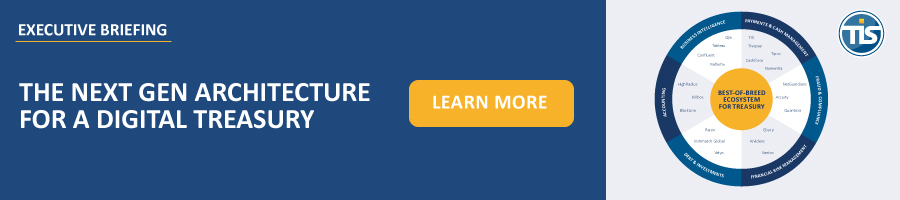
The idea that best-of-breed selection, as opposed to a traditional “full stack” TMS, is the way forward gets the TIS “Executive Briefing” treatment in its latest paper. Are treasurers ready to abandon their love of TMS’ and migrate to best-of-breed solutions instead?

Read the Executive Briefing and find out more about:

  1. Advantages of specialist vendors compared to All-in-One solutions for treasury
  2. How seamless data flow through API integration can deliver better user experience and faciliate strategic business decisions
  3. How to set up a best-of-breed solution that is tailored to your company’s treasury needs and future growth

Leverage the expertise of multiple specialists with seamless API integration and cloud technology.


About TIS

TIS (Treasury Intelligence Solutions GmbH), founded in Walldorf, Germany in 2010, is a global leader in managing corporate payments. The Financial Times named TIS one of “Europe’s Fastest Growing Companies” in 2019, 2020 and 2021. Offered as Software-as-a-Service (SaaS), the TIS solution is a comprehensive, highly-scalable, cloud platform for company-wide payments and cash management. The TIS solution has been successfully used for many years in both large and medium-sized companies, including Adecco Group, Hugo Boss, Fresenius, Fugro, Lanxess, OSRAM and QIAGEN. More than 25% of  DAX companies are already TIS customers.

Your world of Payments. ONE Login.

www.tis.biz

5 essential questions to let Kyriba manage TRILLIONS of dollars every day

22-03-2021 | treasuryXL | Kyriba | Joe Marcin

Someone recently asked Joe Marcin, “What does Kyriba really do?” he thought about it for a moment and although Kyriba solves some really complex problems for their customers, it really comes down to a pretty simple answer.

At Kyriba, they help some of the world’s most well-known companies, government entities, and financial institutions answer these 5 essential questions:

  1. How much money do I have?
  2. Where is it?
  3. How much money will I have in the future?
  4. How do I optimize the way I move my money across financial institutions, legal entities, and international borders to lower risk and minimize costs?
  5. How do I turn my money into a growth asset by investing it in ways that yield higher returns while not increasing risk or lowing my access to liquidity whenever I need it?

Enterprise Liquidity Management is transforming the office of the CFO from a cost center to a profit center for customers all over the world. That is why the Kyriba customers trust them to manage TRILLIONS of dollars for them every day.

See some of the success stories here: https://lnkd.in/gp7sZMW


Contact Kyriba directly for more information.

Webinar recording: Cashforce & TIS are Partnering Up to Deliver Best-of-Breed Technology

| 17-03-2021 | treasuryXL | Cashforce | TIS

Cashforce & TIS are partnering up to deliver best-of-breed technology. Watch the webinar recording with Nicolas Christiaen and Joerg Wiemer and get to know more about this best-of-breed approach and how this partnership can help you tackle your challenges in cash flow forecasting and corporate payments.


5 concrete tips for preventing Payment Fraud

| 16-03-2021 | treasuryXL | Nomentia |

Payment fraud has become a real and permanent threat for companies of all sizes. No company can afford to close their eyes on the risks – fraudsters target all industries, and large and small businesses alike. It is the eleventh hour to start focusing on the safety of your payment process if you want to avoid financial damage.

The good news is that the fraudsters prefer easy targets, so even raising awareness on the topic in your organization is a step in the right direction. With this blog, I want to share 5 concrete tips for preventing payment fraud and improving the safety of your organization’s payment process.

Get rid of risky task combinations

Do you know who has access to your payments at each stage of the process? Risky task combinations may have formed overtime without anyone noticing that a single person can, for instance, create a new payment in the system and approve it to be paid. Overly broad user rights leave unnecessary room for both malpractice and costly mistakes. Applying strong user rights management – the four-eye principle, for example – is a quick way to reduce the risks. You should require double approval also on the changes made in the vendor master data, as well as user rights.

Build your payment process on best practices

Design a secure payment process with best practices approach. Establishing a “no PO, no pay” principle where invoices are approved for payment only if they have a purchase order number or if they are paid to registered suppliers supports preventing payment fraud. You can improve the safety of manual payments when you utilize the ready-made templates of a payment system and demand multi-factor identification from the person who makes the spontaneous request for payment. Many CFO attacks could have been prevented if the origin of an email payment request had been confirmed via another channel.

Automate and focus on end-to-end safety

You would be surprised if you knew how many companies have gaps in their payment process, creating payment fraud risk. For example, if the payment file batches are waiting to be uploaded to bank in a folder or file share, it leaves the data open for tampering even if the process up to that point had been secure. Eliminating manual phases through automation is one of the best ways to increase safety as it reduces not only the risk of fraud but also the risk of mistakes.

Improve transparency

Standardized and harmonized practices build up transparency, which makes spotting and preventing payment fraud easier. Create a uniform, company-wide process for handling payments and make sure that there are no routes round it. By centralizing all your bank connections to a single system, you will take transparency to another level, and, in addition, you are able to better control the risk related to data transfer and system management.

Keep an eye on deviations

It is not rare that payment fraud is discovered only by accident. As a part of good risk management, you need to focus also on the measures that help you spot the fraudulent payments that manage to go through your defenses. Keep an eye on payments that are going to unknown bank accounts or that are made outside normal payment schedule. Your payment system should support you in risk management and filter out deviations from your payment flows before they are paid. Machine learning and artificial intelligence will soon create new possibilities for recognizing and managing deviations in accounts payable in a more real-time and automated fashion.

Preventing payment fraud in an ever-changing threat landscape requires that you take a comprehensive and proactive approach. I recommend that you download and read our e-book, where we take a look at this topic in detail, and provide you with all the different perspectives a corporate payment process should be examined from. In the e-book, you will find best practices and concrete advice you need to keep your organization from falling victim to payment fraud.

About Nomentia

Nomentia is a Nordic powerhouse for global cash management. We believe in a world in which businesses can make the right decisions no matter how unpredictable the times are. Our SaaS-based platform offers solutions for cash forecasting and visibility, global payments with bank connectivity, reconciliation, in-house banking, guarantees, and FX dealing. We serve 2,300+ clients in over 100 countries processing more than 200 billion euros annually. Cash is king!

Meet Jukka Sallinen


How to anticipate Liquidity risks to secure the Cash Flow

15-03-2021 | treasuryXL | Kyriba |

For the past 10 years we have lived with an overabundance of liquidity. In most people’s minds, abundant liquidity means constant availability. But the subprime crisis, the European debt crisis and now the COVID pandemic have shown the opposite to be true.

In a world of extreme volatility, liquidity flows can be interrupted overnight. And for financial managers therein lies the paradox. Despite its overabundance, it has never been more crucial to secure, diversify, monitor and optimise liquidity.

Prepare for the unthinkable.

In this environment, liquidity is obviously strategic, but above all it must be seen as a volatile and fragile resource, especially vulnerable to market disruptions whose occurrence and scope are unforeseeable by definition as well as by their very nature. The health crisis showed us that nothing is safe from a complete, abrupt halt, not even cash flow from operations, across every sector.

CFOs must now prepare their companies for the unthinkable! They will need to spend more and more time and energy to activate every possible source of liquidity by monitoring prices, availability, term, currencies and security packages for each of these sources. They will do this with a constant focus on optimisation, and above all must be ready to make snap decisions about sources that have run dry. It’s a massive undertaking. In a world of extreme volatility, Active Liquidity Management will make tomorrow’s leaders stand out from the crowd.


Contact Kyriba directly for more information.