Tag Archive for: treasury management

First 100 days of a treasurer

| 11-9-2017 | TIS (Treasury Intelligence Solutions GmbH) – Sponsored content |

When a government official enters into office, the 100 days in the new role are closely observed by all. Similarly, the first impressions left by a new treasurer are often long lasting and critical to success further down the road. In most cases, after the first three months, all stakeholders have formed their opinion.

Sounds familiar? We know that the first 100 days in a new job are known to be crucial in setting the right course. The challenge facing treasurers is to acquire a quick overview, identify company-critical risks, introduce necessary measures at short notice and, at the same time, convince the new boss that they are also able to set the right strategic course.
In our Executive Briefing, our treasury experts share their experiences and provide tips and insights to support you in the first 100 days of your latest position.

TIS (Treasury Intelligence Solutions) GmbH


What are hot topics in corporate treasury? Let us know!

 | 28-8-2017 | TreasuryXL |
 The treasury community knows us from ‘fresh’ content on a daily basis. A growing number of treasury professionals, our experts, send in articles and blogs and it is our goal to present  interesting content that matters to our readers.
In order to be able to do so, it is important to stay on top of developments and trends and know what keeps you busy. At the moment we are exploring what the hottest topics in corporate treasury are and we would like to ask your help with this!

In cooperation with Treasurer Search we are making a list of the hottest topics. We are curious what subjects you, as a treasury professional, are dealing with on a daily basis.

Please answer the one-question survey (It only takes 1 minute of your time)

Based upon your input we will know what is relevant for you and we will be able to manage our content better.

Thank you for completing the survey.

Annette Gillhart – Community Manager treasuryXL

[button url=”https://www.treasuryxl.com/about/” text=”View more information” size=”small” type=”primary” icon=”” external=”1″]

[separator type=”” size=”” icon=””]


Trump’s determination to protect American business

| 14-8-2017 | Rob Beemster |

 

Many negative issues surround the President of the United States.  Approval rating hits new low,  surprise on his erratic conduct seems to grow daily. Trump is a unique politician. He is incomparable to any other western political leader. I want to pinpoint his monetary policy in 2017, by looking at the pattern of the dollar so far this year.

The dollar in 2017

Currency pair             January 2017              August 2017               Relative decrease USD

EUR/USD                    1.05                            1.18                            12.4%

AUD/USD                    0.72                            0.80                            11.1%

GBP/USD                    1.22                            1.32                            8.2%

USD/JPY                      1.18                            1.10                            6.8%

USD/CNY                    6.96                            6.70                            3.7%

Maybe Mr Trump does have a foreign economic policy.

He sees the results of Chinese manipulation and soft American response as an unfair trade relationship. The President of the US must do something about these unbalances. At least, this is how Trump judges.

Let’s take into account this Potus is a streetfighter. Long bilateral meetings with the Chinese are not options for Trump. Fast and furious, that it is: Bring the dollar down!!
And this is going on for half a year now. It is going the Trump way. Tough (but efficient)!

How to see the future value of the dollar?

The current outlook for the dollar against its main trading relations is related to some issues:

–          Process of QE by ECB, and  Euro interest rates

–          North Korea

–          China’s position in this geopolitical stress

–          Economic conditions of the US

–          Economic conditions of the main trading partners of the US

These are very important to determine the future value of the dollar. But this is the holistic view, we are all used to. Let’s be flexible and take a different stance. Just conclude as Trump will do. Be his alter ego.Then the most important issues are:

–          Pattern of the Euro against the dollar and the bilateral trade balance between US and Germany

–          China’s reaction to a lower dollar

–          US trade balance

–          US corporates repatriation of overseas cash

–          US investments to produce within America

–          FDI (Foreign Direct Investment) in America

This is a totally different scope. If we want to understand Trump, then we have to use his view on the international arena. The above mentioned bullet points are crucial. All can easily be measured, Trump loves that. I would like to go through these points to be able to clarify the possible outcome of the dollar for the coming time.

Pattern of the Euro against the dollar and the bilateral trade balance between US and Germany

The more than 12% revaluation will have a serious impact on the trade balance between US and Germany. When the correction emerges, Trump might temper his view on Germany. When we notice correction in the trade data, the dollar has gone far enough…

China’s reaction to a lower dollar

So far the yuan has gained some territory but not as much as other major currencies rose against the dollar. How will PBOC and the Chinese Government react on Trump’s wishes to correct the trade balance by a devaluation of the dollar against the yuan? If they take action on Trump’s stated requirements, whatever this may be, then pressure may diminish.

US trade balance

For many years the US  faces a deficit on its trade balance. The more than $500 billion yearly shortage is a notable pain point. If a remarkable achievement can be noticed on short term, a more relaxed dollar attitude may be expected.

US corporates repatriation of overseas cash

In history, attempts have been organised by US governments to return overseas cash of US corporations. During President Bush jr Presidency, corporations did repatriate cash. When Trump does decrease the corporate tax tariff to  15% and he rewards the US corps to transfer their money back to the US without any other penalty payments, a large repatriation may get going. Many of these funds will until now be held in local currencies, so a switch to the dollar may occur.

US corps return back to America

Trump has ordered US companies to produce in the US instead of overseas. If he becomes successful by bringing factories back to the US, the trade balance will shift, employment will improve. Also when large repatriation is done, these funds can be invested in local factories.

FDI in America

Many non-US corporations are scared by the threat of the US government that regulations like import tariffs and other taxes may be charged on imports. It will damage the advantage corporations have experienced last couple of years due to the high dollar. If special import tariffs are installed, investments may be done in the US to avoid these special expenditures. Onshore producing on American soil will become an alternative.

How to manage this?

Foreign currency management has always been a hard part of the international business. Currency moves are unpredictable. But since Trump, one has to be aware of non-economic issues as well. Note that all the above mentioned issues can have effect on the value of the dollar. Professional guidance of your flows is becoming more and more important. Barcelona valuta experts helps you to install a decent strategy to counter unpredicted events. We guide you in protecting the cash flow.

 

Rob Beemster

Owner of Barcelona valuta experts BV

Re-inventing treasury workflows: Smart Treasury

| 3-8-2017 | Nicolas Christiaen | Cashforce | Sponsored Content |

While the role of the treasurer is changing, it becomes increasingly challenging to maintain the current workflows and simultaneously take on new demanding tasks. One of these often manual and time-consuming tasks is risk management. As seen in, among others, this year’s Global Treasury Benchmark Survey of PwC, the registration and management of financial instruments stands among the top 3 challenges on the agenda of the surveyed treasurers. In this article, we take a more in-depth look at possible optimizations in some key treasury workflows.
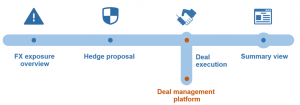


Example FX management workflow

Hedging your FX exposure risk made easy

A common problem is the lack of visibility on the existing (global/local) FX exposure risk.
In order to calculate the FX transaction risk, transactional data from the TMS & ERP systems need to be consolidated effectively. Typically, this happens to be a (very) painful exercise. With Cashforce, however, using our off-the-shelf connectors (for ERP & TMS) and our full drill-down capabilities, you have all FX exposures at your fingertips.


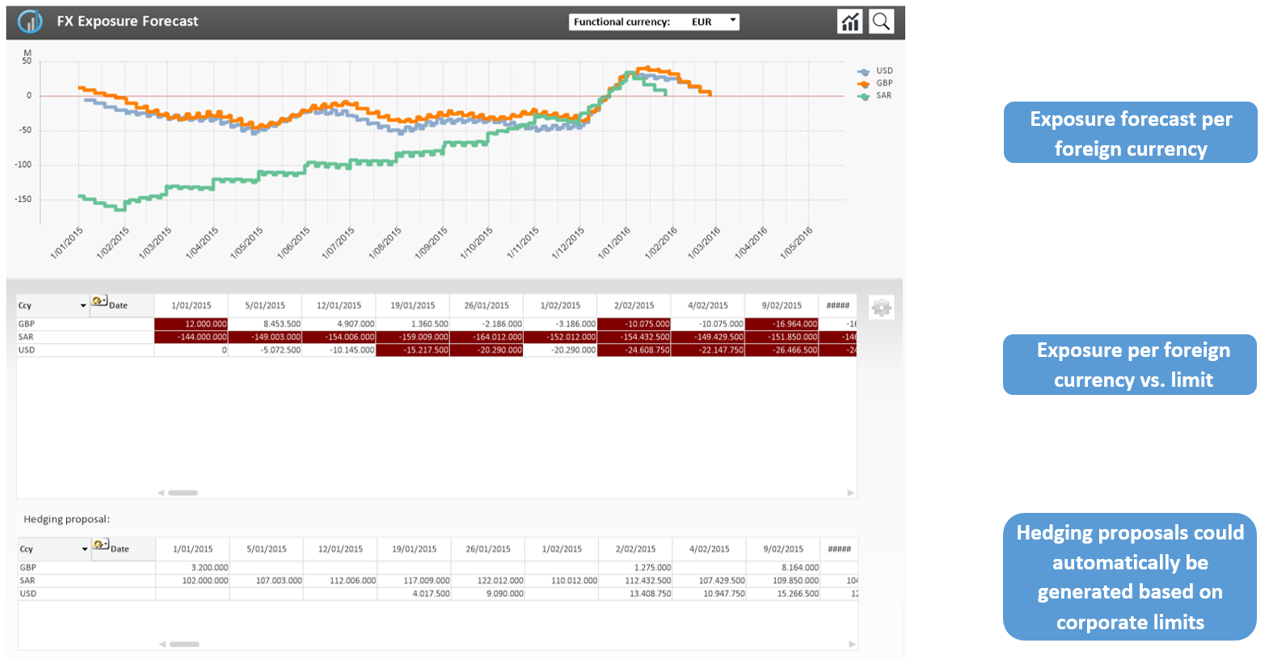
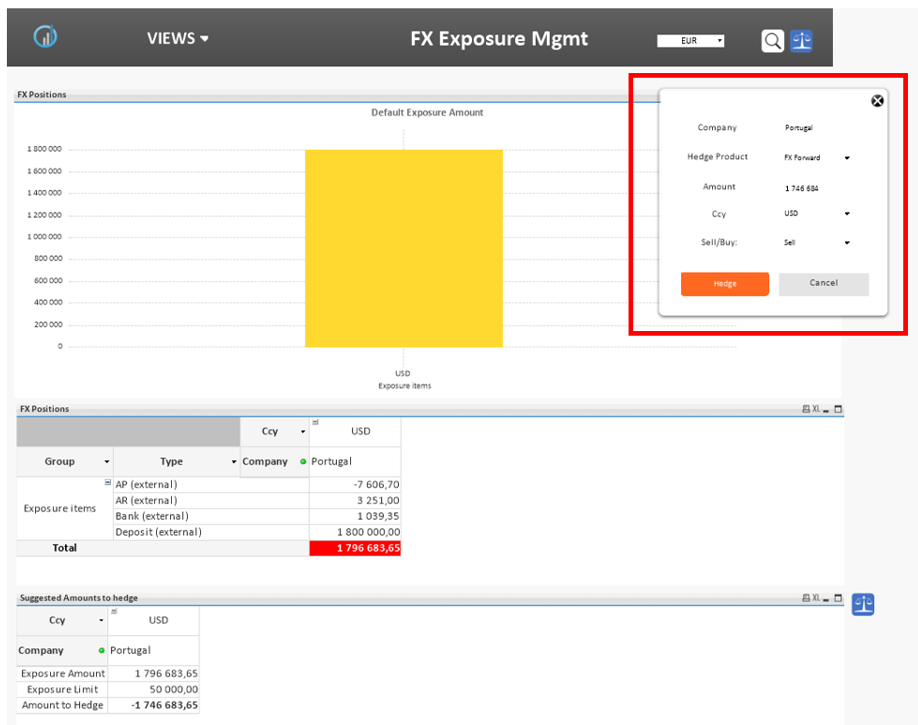
FX Exposure Management – Current positions & exposures


But there is more to it. Imagine that linked to your FX exposure, an automated proposal of the most relevant FX deal would be generated to properly hedge this risk. A grin from ear to ear you say?


FX Exposure Management – Suggested hedge


And what about forecasting FX exposures? It’s now all within reach!

FX Exposure Management – Future positions & exposures
 

Whether you choose to take on an intercompany loan, a plain vanilla FX forward or another more exotic derivative product, chosen deals could then be automatically passed on to your deal transaction platform, to effectively execute the deal without any hassle. After execution, deals will automatically flow back into the system. Consequently, a useful summary/overview will be generated to effectively manage all your financial instruments.


Workflow integrated cash forecast

Finally, integrated cash management

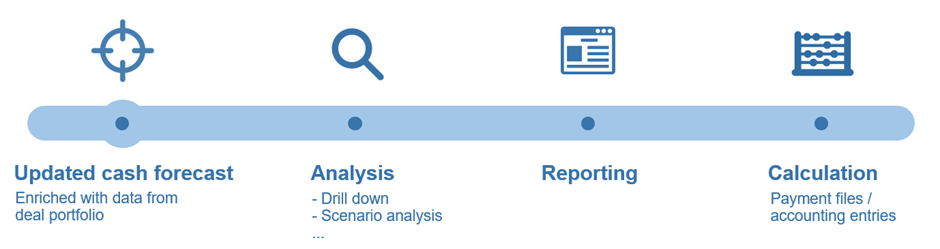
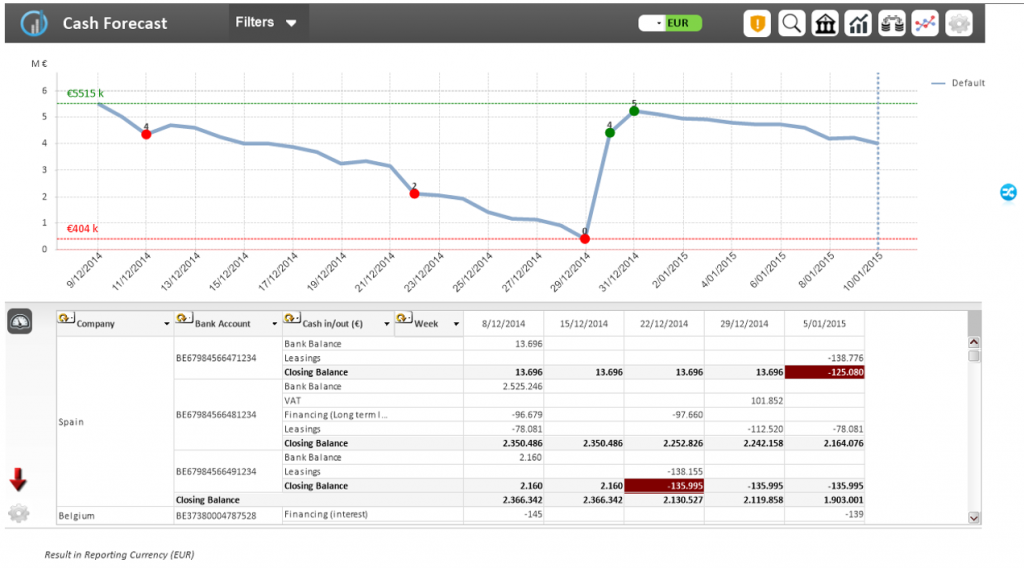
New financial instruments / deals will generate a set of related cash flows. Ideally, these are directly integrated in your cash flow forecasts. In Cashforce, this data is automatically integrated within the cash flow forecast module, and will be put into a dedicated cash flow category. Learn more one how to set up an effective cash forecast in this article or this webinar.


Cash flow forecast overview


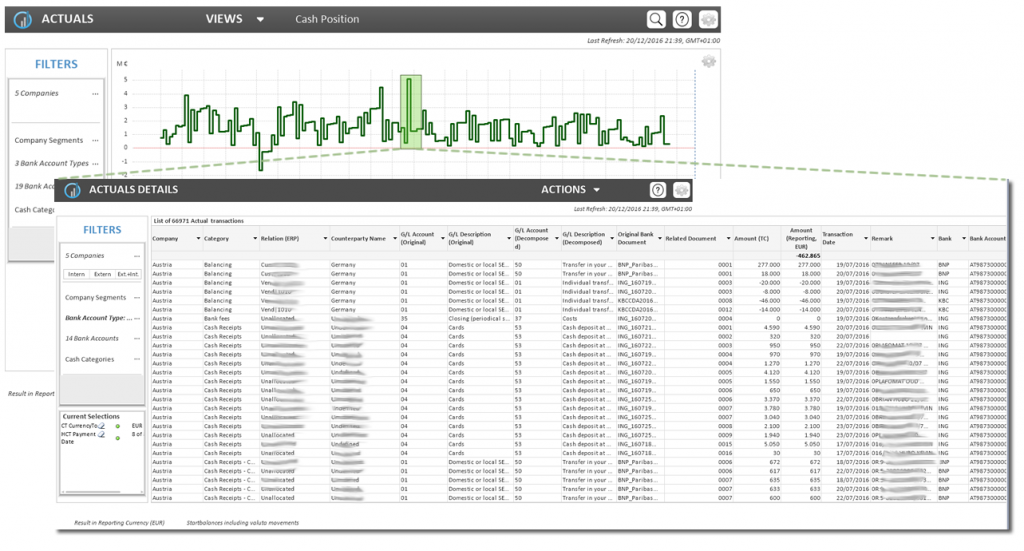
The analysis possibilities are now limitless, thanks to the ability to drill down to the very transactional-level details. The real number crunchers strike gold here: the analysis features open doors to unlimited in-depth analysis and comparison of various scenarios (E.g. the simulated effects of various exchange rate movements).


Drill-down to the transaction level


Using our big data engine, the delivery of rich and highly flexible reporting is facilitated. It’s fair to say that the typical SQL server (which currently 95% of the TMS systems use) can’t hold a candle to this. Through an advanced ‘self-service’ interface, users can drill down completely into respective amortization tables, historical transactions and effortlessly create customized reports and dashboards. We’ll talk more about why we believe Big Data engines are crucial for any Treasury software in our next blog.

Integration with ERPs & payment platforms

Next to this, Cashforce will automatically generate the accounting entries (in the format of your ERP/accounting system) related to your deals. The appropriate payment files will be generated in a similar fashion.

So…

As might be clear after reading this article, we strongly believe that integrated data flows & a Big Data engine are the foundation of a new type of Treasury Management System that runs like clockwork and can serve effective treasury departments, but also renewed finance/controlling/FP&A departments.

You are curious to hear more about effective treasury management? We’ve recently recorded a webchat on how to set up an efficient cash flow forecast process.


Nicolas Christiaen

Managing Partner at Cashforce


How to convince a manager as a treasurer

| 17-7-2017 | Theo Paardekooper |

Management decisions are generally made based on analysis of data. However, this statement is far from correct. Arguments count, too. However, having the correct arguments does not mean that they are convincing. Being right is not the same as getting what you want.

How is this possible? If you are in full control of this principle, every action will become a success. To understand this principle we have to get involved in the world of behavioral finance. It is the cross section of economics and psychology. As a treasurer or financial professional you have to discuss issues regularly with your management and some background on this topic might come handy now and then.

One of the main biases is the risk appetite of a human being. People are risk averse if they can get a profit, but they are risk minded to make a profit to reduce former losses.

Another bias is about the difference between perceived risk and actual risks. A human being expects that small risky events will occur more often, than high-risk events. For this reason people buy a lot of insurance products that will cover these small risks, like travelling insurance, biking insurance, etc. Also the success of big lotteries is linked to this bias. The chance to win a million Euro’s in a lottery is as big as the risk to get involved in a car accident.

Decision-making is highly influenced by former experience. This can create a bounded awareness on the topic. People can get overconfident about their opinion or over-optimistic about the likelihood of outcomes of actions. People who are overconfident are often surprised, while people who are over-optimistic are often disappointed.

Every human being is influenced by bounded awareness. Just take a look at the example.

Didn’t you spot the gorilla? If you didn’t don’t be ashamed; almost half of all people don’t see it.

Decision-making is often a group process. Groups have effect on decision making by itself.

Just take a look at the following experiment.

It is hard to understand but from a behavioural perspective it is not important to know why, but it is important to know how. If you can use these non-rational principles to influence the decision making process, it will help you to convince everyone.

Are you convinced, if not, I probably forgot some other non-rational principles…


Theo Paardekoper 

Independent treasury specialist

Roadmap for unwinding derivatives

| 14-7-2017 | Roger Boxman |

Banks offer proposals to smaller companies and housing associations to unwind interest rate swaps. The benefit for the banks is that this will reduce their risk weighted assets. Whether this offer is attractive or not depends on several issues.

A short-list of advantages of unwinding to keep in mind is found below:

  • The advantage of skipping break clauses and uncertain margin call events and therefore a reduction of liquidity risk.
  • Creating a potential current tax loss on the unwinding fee which can be possibly offset in the near future.
  • Opportunity to restructure the funding structure and refinance against lower interest rates.
  • Optimise the redemption schedule and therefore to create lower interest rate risk in the loan portfolio.
  • Reduce costs of monitoring and supervision.
  • No hedge accounting issues with unexpected profit and loss accounting in combination with latent taxes.

Off course the decision to unwind or not depends highly on the amount of the fee and the specific expectations of the organisation. No situation will be the same, an exact blueprint simply does not exist. In a substantial number of situations, the ‘do nothing option’ will be the best.

Roger Boxman

Senior Advisor Internal Control

Een parttime CFO – parallellen met de Flex Treasurer

| 29-6-2017 | CFO netwerk | treasuryXL |

CFO netwerk biedt (parttime) CFO diensten aan ondernemingen, waarvan aard en omvang van de activiteiten de fulltime inzet van een CFO niet rechtvaardigen. Wat dat betreft herkennen wij parallellen met onze Flex Treasurer, die wij op treasuryXL aanbieden aan ondernemingen, die wel treasury exposure hebben, maar geen ruimte om een fulltime treasurer of cash manager in dienst te nemen. We waren in gesprek met Jeffrey Janssen van CFO netwerk en hebben de parallellen voor u uitgewerkt.

CFO op maat

Wat is de toegevoegde waarde van een CFO voor een onderneming?

Veel jonge en kleine bedrijven hebben vaak niet de financiële mogelijkheden om een ervaren CFO in dienst te nemen. In deze situatie is wellicht een parttime CFO een goede oplossing. Een ervaren professional met commitment die u voor een beperkt aantal uren inhuurt, maar toch de vinger aan de pols houdt en indien nodig 24/7 voor u beschikbaar is.

Maar waar u als ondernemer ook bent in de levenscyclus van uw bedrijf, het goed functioneren van uw financiële afdeling is van groot belang en zij hoort u tijdig te informeren over strategische, financiële vragen die van belang zijn voor het voortbestaan van uw bedrijf. Daarbij gaat het niet alleen over cijfers, maar ook over een sterke CFO, die u uitdaagt en als business partner optreedt bij de bepaling van de strategie en volgens een strakke CFO-agenda de groei van uw bedrijf ondersteunt.

Uw bedrijf groeit

U werkt hard en investeert. Het bedrijf groeit en alles gaat eigenlijk beter dan verwacht. Of toch niet? Er ontstaan groeistuipen en er worden veel ad-hoc beslissingen genomen om de voortrazende trein op het rechte spoor te houden. In deze fase kunnen grote fouten worden gemaakt die de continuïteit in gevaar brengen. De belangrijkste hiervan is dat het strategische plan niet wordt gevolgd en dat dit plan niet regelmatig wordt geëvalueerd en aangepast.  Aspecten die in deze fase van groot belang zijn:

  • Het hebben van juiste en tijdige stuurinformatie (ook wel KPI’s genoemd)
  • De kwaliteit van de organisatie (juiste mensen, juiste skills) De administratieve systemen en procedures. Zijn deze nog adequaat en kunnen ze de groei aan?
  • Is er voldoende cashflow aanwezig om de continuïteit te waarborgen?

Succesvol en nu verder…

Alle bedrijfsprocessen zijn goed ingericht – het gaat heel goed met uw bedrijf. De resultaten zijn uitstekend, maar blijft dat zo? Indien u niet bezig bent met nieuwe innovaties, oog hebt voor de veranderingen in de markt loopt u het risico dat uw groei gaat stagneren en te laat uw organisatie hierop aanpast. Ook dan moet U keuzes maken die ingrijpend zijn en een weerslag hebben op mensen en systemen. In deze fase is het cruciaal dat u de continuïteit van het bedrijf centraal stelt en het bedrijf robuust maakt voor de toekomst.  Ook hier is het de taak van de CFO om dit spanningsveld te bewaken en u tijdig te helpen in uw besluitvorming.

Ups and downs

Iedere onderneming komt ze vroeger of later tegen. Door te weinig innovatie streven uw concurrenten u voorbij. De resultaten lopen opeens terug. Uw bankiers komen vaker langs en aandeelhouders zijn niet tevreden en eisen veranderingen. U bent het grootste deel van uw tijd kwijt aan het managen van uw liquiditeit en het sussen van aandeelhouders en personeel. Zorg dat u in deze fase de juiste mensen binnenhaalt om het tij te keren, dan wel te zorgen dat keuzes worden gemaakt. Dit kan van levensbelang zijn om een faillissement te voorkomen.

Wat kan een CFO betekenen?

Een krachtige CFO is een sparringpartner die u als ondernemer in iedere bedrijfsfase ontzorgt en uw financiële continuïteit bewaakt. Hij of zij is onder meer verantwoordelijk voor de financiële systemen en processen, de stuurinformatie en de contacten met financiers en accountant. Maar bovenal moet hij als financiële business partner onderdeel zijn van uw team en mede sturing geven aan de strategische agenda van uw onderneming. Een onderneming kan niet functioneren zonder een goede CFO in het hart van uw organisatie.

Een Flex Treasurer als ondersteuning voor de CFO

We merken dagelijks dat treasury iets is waar CFO’s en Controllers er vaak te weinig tijd voor hebben en/of niet altijd de noodzakelijke kennis. HR managers en directeuren bemoeien zich er liever niet mee.

Ook hier hetzelfde beeld: de meeste organisaties zijn niet groot genoeg om een treasury-afdeling te huisvesten maar dat betekent niet dat deze organisaties geen kosten kunnen besparen of dat er geen mogelijkheden zijn voor bijvoorbeeld funding. Om de treasury van uw organisatie onder controle te hebben is het niet altijd nodig om er een complete afdeling van te maken.

Een ervaren hands-on treasurer kan een eerste check doen binnen de organisatie om te bepalen of het de moeite waard is om te investeren in treasury. Door optimalisatie van interne processen, het beter beheren van banken en bankkosten of het opnieuw organiseren van FX processen kan vaak een substantiële besparing worden gerealiseerd.

Cash & liquidity management ondersteuning

Heeft u een goed overzicht van uw liquiditeitspositie? Is er geen versnipperde cash- en kredietbenutting? Bent u onlangs geconfronteerd met liquiditeitsproblemen t.g.v. onverwachte uitgaven? Wordt u regelmatig geconfronteerd met manuele verwerking van betalingen? Bent u recent geconfronteerd met fraudegevallen? Is het aantrekken van de financiering een issue?

Een treasury expert kan u helpen in het vinden van de juiste antwoorden op deze vragen. Een Flex Treasurer kan ondersteuning bieden op tijdelijke basis, onder meer voor de volgende aspecten:

Begeleiding opvolging liquiditeitspositie groep en uittekenen processen in dit verband
Assessment van het cash forecasting proces en voorstellen tot optimalisatie
Optimalisatie betalingsprocessen (incluis fraudepreventie)
Advies selectie bankpartners
Nazicht van de bankvoorwaarden
Bepalen van de optimale financieringsstrategie
Automatisatievoorstellen en begeleiding van de implementatie

Optimalisatie werkkapitaalverkeer

Kampt uw bedrijf met een DSO (gemiddelde betalingstermijn klanten) die veel hoger is dan het sectorgemiddelde? Heeft u een duidelijk afgelijnd acceptatieproces en een politiek voor de betaaltermijnen? Is je facturatieproces optimaal? Heeft u een afgelijnde politiek voor de selectie en de betalingstermijnen aan uw leveranciers? Heeft u regelmatig incassoproblemen? Kampt u met wanbetalingen en afschrijvingen op uw klantenportefeuille? Ondervindt u regelmatig reconciliatieproblemen bij binnenkomende en uitgaande betalingen?

Dan kan een Flex Treasurer, die treasury & working capital management expert is, u  helpen bij het vinden van de juiste antwoorden op deze vragen en het optimaliseren van uw werkkapitaalbeheer.

FX en IR risico analyse

Heeft u een goed zicht op de risico’s die je bedrijf oploopt (o.m. valuta en renterisico) en op de impact hiervan op uw bedrijf? Heeft u een politiek in  verband met de risicoafdekking? Heeft u een zicht op de mogelijkheden om ze in te dekken? Koerswijzigingen in valuta en rente kunnen zeer vluchtig zijn en leiden tot onnodige extra kosten. Als u zich wilt concentreren op uw ‘core business’, zonder u zorgen te hoeven maken over bv. de EUR/USD wisselkoers of de Europese rente dan is het inhuren van een Flex Treasurer de ideale uitkomst. Hij kan de organisatie helpen eenvoudig en effectief de risico’s af te dekken, alsmede te onderhandelen over betere spreidingen en lagere kosten bij uw bank.

Aangeboden diensten

Met  de verschillende CFO diensten van CFO Netwerk krijgt u het beste van beide werelden: de expertise van een ervaren CFO en op maat gemaakte uitbestede CFO diensten — tegen een prijs die u zich kunt veroorloven. De CFO-diensten zijn schaalbaar in de tijd. Dit betekent dat het niveau van ondersteuning geleverd wordt, dat u nodig hebt en wanneer u het nodig hebt.

Op treasuryXL bieden wij een Treasury Quick Scan aan, die beoogt de treasury-pijnpunten in kaart te brengen en de aanbevelingen om deze te verhelpen, inclusief de business case. Op basis daarvan kunt u bekijken of er voor verdere ondersteuning een treasury-expert voor uw organisatie zinvol is.
Daarnaast biedt treasuryXL ook treasury coaches aan. Treasurers werken vaak alleen of in een klein team en hebben ondersteuning nodig van andere (meer senior) treasury professionals. Vaak is deze ondersteuning niet aanwezig binnen het eigen team. In ons netwerk zitten een aantal senior professionals die deze ondersteuning op regelmatige basis kunnen bieden. Zij kunnen op regelmatige basis of incidenteel ingepland worden.

Mogelijke samenwerking

Omdat er duidelijk parallellen zijn tussen de diensten van CFO netwerk en treasuryXL en de diensten elkaar goed aanvullen, onderzoeken wij op dit moment of wij wellicht kunnen samenwerken. Het doel is om organisaties, die een financiële professional – parttime CFO of Flex Treasurer  – nodig hebben, als klant nog beter van dienst te zijn.


How to get a fair deal on your derivatives trades

| 15-6-2017 | Simon Knappstein | treasuryXL


We discovered the article ‘Are you getting a fair deal on your derivatives trades” on treasurytoday. In the article derivatives are described as a good tool to mitigate risk and protect the company’s financials from moves in the market. However, derivatives come at a cost and often these costs are also hidden, which means that the  treasurer cannot be sure that he is getting a fair deal.


Price of the deal

Greater transparency is needed and  that was the reason why company NEXTrioptima developed its triCalculate solution. When treasurers execute a deal with a bank they typically cannot see how the price of the deal is calculated and what the bank is charging them for credit risk.The tool triCalculate tries to change this by taking the corporate’s derivatives trade file, a credit curve file and a credit support annex (CSA) file (where one exists) and running these through a series of highly complex mathematical simulations. The result: an accurate XVA calculation that enables corporates to quickly identify and price the impact of a counterparty default and the cost of funding a derivative portfolio. This is the first Software as a Service (SAAS) on the market. The tool does not only provide  companies with  greater transparency over their current derivative portfolio, but also offers the chance to plan new deals much better.

We asked our expert Simon Knappstein if this tool is really worth the while.

All the capital a derivative trade consumes, or is expected to consume, over its lifetime is  increasingly incorporated in the price of a trade. CVA, a valuation adjustment for counterparty credit risk was initially the major adjustment, soon to be followed by FVA (funding value adjustment) and many related adjustments that go under the umbrella name XVA. Properly calculating these adjustments for every trade on a portfolio basis is difficult and time consuming. So the new product offering TriCalculate by NEX TriOptima looks like a promising tool for corporate treasurers to help them gain insight in the pricing process of derivatives offered by their bank. By the way, being able to calculate a fair value on a potential trade does not guarantee you a fair deal, but it will certainly help.

Simon Knappstein - editor treasuryXL


Simon Knappstein

Owner of FX Prospect


More articles of this author:

FX global code of conduct

Negatieve interest rate policy: No lasting effect on FX


PSD2 is coming soon: Some information about PSD2 summed up

| 14-6-2017 | Mark van de Griendt | PowertoPay |

PSD2 is approaching soon, just a few months left. But do you know what exactly PSD2 is? And more important, what does PSD2 mean for your businesses? PSD2 enables relations of banks, to use (selected) third-party providers to manage their financial data. In the near future, you maybe will use social media to directly pay your bills, while still having your money safely placed in your own bank account(s).

PSD2

With the coming of PSD2, banks are obligated to provide these (selected) third-party providers access to their customers’ accounts through open API’s. This will enable third-parties to create financial services on top of the banks relation data or banks’ infrastructure.

Banks get a different role and since these third-party companies can now be their competition, banks are working together with these FinTech companies. PSD2 will fundamentally change the order to cash value chain, what business models are profitable, and customer expectations. Through the directive, the European Commission aims to improve innovation, reinforce consumer protection and improve the security of internet payments and account access within the EU and EEA.

For banks, PSD2 might possess substantial business challenges. IT costs will increase dramatically due to new security requirements and the opening of API’s. And, as FinTech’s take over the customer interaction, banks may find it increasingly difficult to differentiate themselves in the market for offering loans. The first business cases show us successful new products for renewed loan offerings based on actual data, PSD2 will boost product development, end-users will take advance of new market propositions.

What exactly will PSD2 bring?

  • The introduction and regulation of third-party payment service providers
  • 2 types of providers will be selected, those that offer:
    • Payment Initiation Services Providers – PISP
    • Account Information Service Providers – AISP
  • The unconditional right of refund for direct debits under the SEPA CORE scheme
  • A two-factor authentication check out system
  • Ban on additional costs for card payments
  • Better consumer protection against fraud, capping any potential payments if an unauthorized payment is made up to €50
  • Improved consumer protection for payments made outside of the EU or in non-EU currencies

Sources:

SEPA for corporates
Evry

 
Mark van de Griendt – Cash Management Expert at PowertoPay

[button url=”https://www.treasuryxl.com/community/experts/mark-van-de-griendt/” text=”View expert profile” size=”small” type=”primary” icon=”” external=”1″]

[separator type=”” size=”” icon=””]

What is the Blockchain and why you should care

| 7-6-2017 | Carlo de Meijer | treasuryXL |

You might visit this site, being a treasury professional with years of experience in the field. However you could also be a student or a businessman wanting to know more details on the subject, or a reader in general, eager to learn something new. The ‘Treasury for non-treasurers’ series is for readers who want to understand what treasury is all about. Our expert Carlo de Meijer is a blockchain specialist and tells us more about this new technology.

Blockchain

Blockchain is an immutable digital database or ‘distributed ledger’ that allows multiple parties to  transfer and store information (records) securely and reliably, shared via a peer-to-peer network of computers. There are public (or permissionless) blockchains where everybody is free to participate and private (or permissioned) distributed ledgers where only selected parties may enter the network.
The ledger is maintained collectively by all participants in the blockchain system based on a set of generally agreed and strictly applied rules.  It enables digital transactions to be validated quickly and to be securely maintained through cryptography, computational power and network users without the need  for a trusted third party.
In addition to transactions, blockchain has also the ability to run so-called smart contracts, to be coded and connected in such a way that the contract automatically executes an event if certain preconditions are met. Smart contracts could be used in real estate transactions to transfer title and release escrow when ownership is confirmed. Peer-to-peer insurance is potentially another use case.

Main characteristics

What are the main characteristics of a blockchain?
Blockchain has special qualities that makes it better than traditional databases: trusted, decentralised, shared, secure and automated.
·         Trusted: the distributed nature of the network requires computers servers to reach consensus, which allows for transactions to occur between unknown parties in a trusted way.
·         Decentralised: Blockchain allows to trade directly with any counterparty in a secure, fast and cost effective way, without making use of a central authority or third party intermediaries (middlemen) to approve transactions and set rules.
·         Shared: servers or nodes, maintain the entries (known as blocks) and every node sees the transaction data stored in the blocks when created. Each counterparty has its own copy of the same ledger. It allows anyone to obtain an accurate view.
·         Secure: the database is built to be immutable and irreversible, which means that there is inherent security. Posts to the ledger cannot be revised or tampered with. The information is tamper-proof and visible for all parties involved.
·         Automated: Software is used to generate and record information about the transaction (when it took place, and the chronological order of all transactions). This results in a chain of information, stored in a so-called block; hence the name blockchain.

Use cases

What are use cases for blockchain?
As the blockchain can be used to store and send anything of value, applications may be numerous. These do not limit to financial transactions such as payments, remittances, supply chain finance, securities settlement, stock trading etc. The potential may well be beyond the financial sector ranging from securing  intellectual property, health records, land registry and ownership records, marriage contracts, identity management, voting records, vehicle registries, tax collection etc.
What are the benefits of blockchain?

Conclusion

There are many benefits to be gained from using blockchain technology. Immutability, coupled with its immediacy, assured provenance  and transparency are core blockchain attributes. Removing the middlemen for transaction increases the speed and eliminates transaction fees for consumers and institutions alike. Other business benefits are also relatively easy to imagine, such as in facilitating identity authentication, privacy, access management, regulatory compliance.


Carlo de Meijer

Economist and researcher