What are: Currency Pegs | By Harry Mills
04-05-2023 | You may have come across a currency described as being “pegged” to another, probably against the US dollar, but what does it mean?

04-05-2023 | You may have come across a currency described as being “pegged” to another, probably against the US dollar, but what does it mean?
12-04-2023 | Inherent risk and residual risk are simple but important concepts to grasp when assessing risk. This article explores how these concepts fit into a risk management programme and why it’s important to know your numbers!
28-03-2023 | Harry Mills | treasuryXL | LinkedIn | Inherent risk and residual risk are simple but important concepts to grasp when assessing risk. This article explores how these concepts fit into a risk management programme and why it’s important to know your numbers!
23-02-2023 | treasuryXL | LinkedIn |

Download the comprehensive eBook on Treasury function, compiled by treasuryXL. This valuable resource covers a wide range of relevant topics including Treasury, Corporate Finance, Cash Management, Risk Management, and Working Capital Management.
Drawing on the expertise of Treasury professionals and their best practices, we have carefully crafted clear and concise articles that provide you with the most crucial information about the key topics in the world of Treasury.
In this eBook, we take a deep dive into each Treasury function and explore:
Whether you are new to Treasury or an experienced practitioner looking to expand your knowledge, this eBook is an essential resource that will help you stay up-to-date with the latest best practices and insights in the field.
We simply giveaway two presents for you! By signing up for our newsletter you will automatically receive the following in your inbox:
Subscribe, Join, Download and Relax.
Welcome to our community and have fun reading!
Director, Community & Partners at treasuryXL
14-02-2023 treasuryXL | Treasurer Search | LinkedIn
Join us for a thought-provoking Live Session on Interim Treasury Management, where our experts will delve into the pros and cons of this exciting market.
Unlock the Benefits of Interim Treasury Management: Discover Why it’s a Must-Have for Your Business!
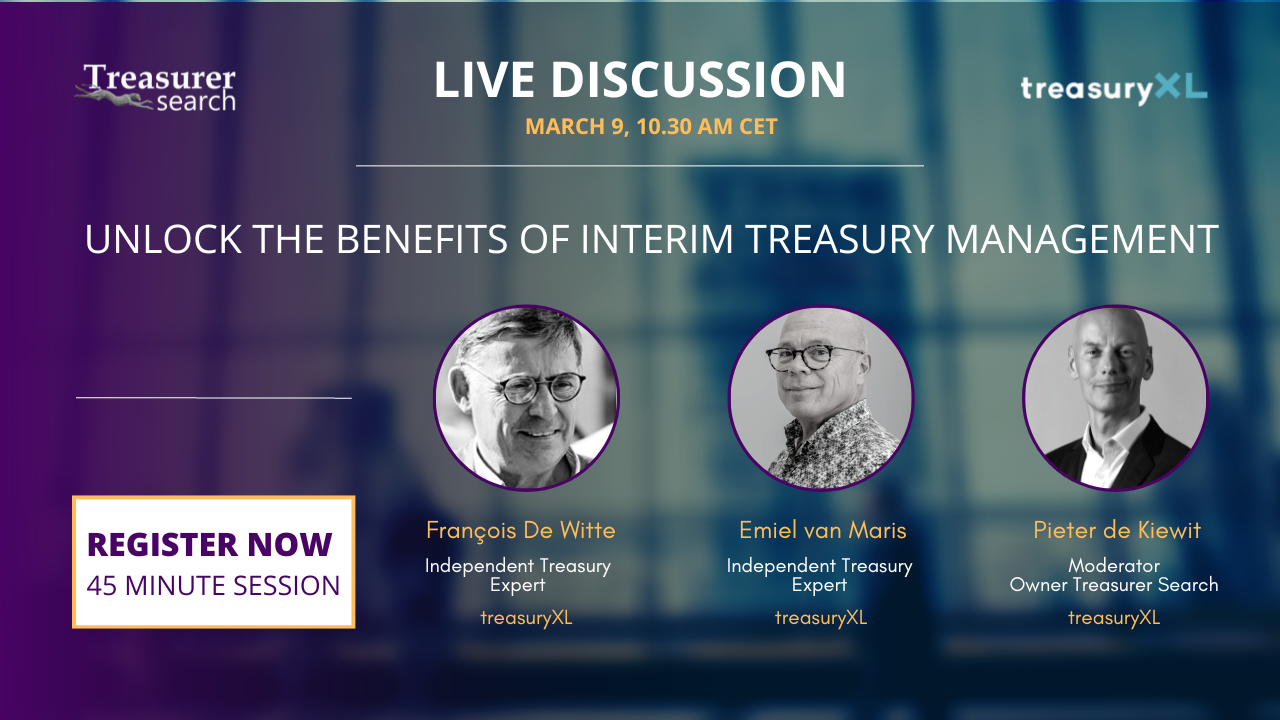
Our panel of seasoned interim treasurers, including Emiel van Maris, Francois De Witte, and treasury recruiter Pieter de Kiewit, will share their valuable insights and experiences.
This webinar is designed for aspiring interim managers, potential clients, and anyone interested in learning more about this market.
Don’t miss this opportunity to gain tips and tricks from the experts in the field and engage in an open discussion.
Register now to secure your spot!
Everyone is welcome to this webinar.
🌟Moderator: Pieter de Kiewit of Treasurer Search
🌟Duration: 45 minutes
𝘉𝘺 𝘳𝘦𝘨𝘪𝘴𝘵𝘦𝘳𝘪𝘯𝘨 𝘺𝘰𝘶 𝘤𝘰𝘯𝘴𝘦𝘯𝘵 𝘵𝘰 𝘳𝘦𝘤𝘦𝘪𝘷𝘪𝘯𝘨 𝘤𝘰𝘮𝘮𝘶𝘯𝘪𝘤𝘢𝘵𝘪𝘰𝘯𝘴 𝘧𝘳𝘰𝘮 𝘵𝘳𝘦𝘢𝘴𝘶𝘳𝘺𝘟𝘓 𝘳𝘦𝘨𝘢𝘳𝘥𝘪𝘯𝘨 𝘵𝘩𝘦 𝘭𝘢𝘵𝘦𝘴𝘵 𝘵𝘳𝘦𝘢𝘴𝘶𝘳𝘺 𝘪𝘯𝘴𝘪𝘨𝘩𝘵𝘴. 𝘠𝘰𝘶 𝘮𝘢𝘺 𝘸𝘪𝘵𝘩𝘥𝘳𝘢𝘸 𝘢𝘯𝘺𝘵𝘪𝘮𝘦. 𝘗𝘭𝘦𝘢𝘴𝘦 𝘳𝘦𝘧𝘦𝘳 𝘵𝘰 𝘰𝘶𝘳 𝘗𝘳𝘪𝘷𝘢𝘤𝘺 𝘗𝘰𝘭𝘪𝘤𝘺.
We can’t wait to welcome!
Best regards,
Kendra Keydeniers
Director, Community & Partners
07-02-2023 | Eurofinance | treasuryXL | LinkedIn |
Join senior treasury peers on March 7th in London at EuroFinance’s 10th annual Effective Finance & Treasury in Africa. Understand changing developments and the unique opportunities and challenges of doing business in this dynamic region.
This year’s speaker line-up includes experienced treasurers – all active in African markets – including:
● Edward Collis, Treasurer, Save the Children
● Neiciriany Mata, Head of finance, Angola Cables
● Marta de Teresa, Group treasurer, Maxamcorp
● Chigbo Enenmo, Finance and treasury manager, Nigeria LNG
● Folake Fawibe, Integrated business service lead, Danone, Southern Africa
● Jan Beukes, Group treasurer, MultiChoice Group
They will discuss important topics including cash and FX, payments, liquidity and financing, digital transformation, share success stories and provide practical guidance on how to optimise your treasury operation for growth.
For the full agenda and to register, please visitt this link.
Quote discount code MKTG/TXL10 for an exclusive 10% discount for TreasuryXL readers.
If you have any questions, you can contact the EuroFinance team directly at [email protected].

20-12-2022 | treasuryXL | Dinesh Kumar | LinkedIn |
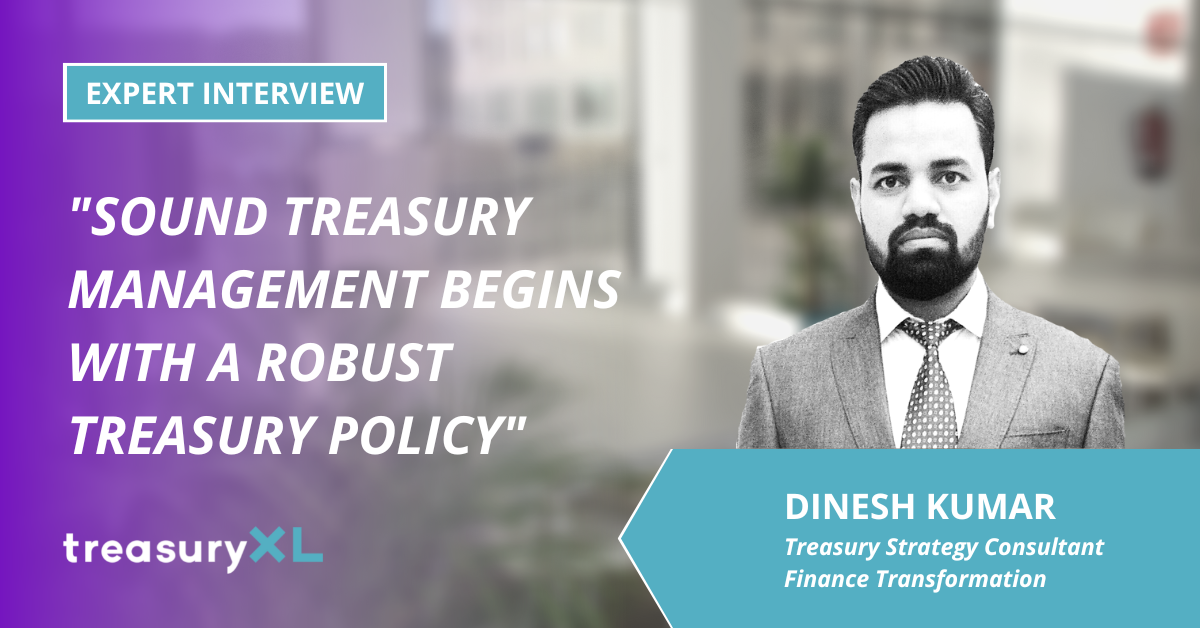
Meet our newest expert for the treasuryXL community, Dinesh Kumar.
Dinesh is specializing in architecting and leading large scale treasury technology transformations helping clients embrace the power of technology. He supports group wide treasury projects in the further development of a broad range of methods and processes in the related treasury IT systems, e.g., improvement of cashflow planning, FX management and treasury reporting.
He involves in designing overall organizational strategy in the field of treasury technology application services, including evaluating new processes, models, pricing, and tools and related competitive offerings delivered treasury Service providers.
Dinesh has successfully led large treasury transformations projects utilizing SAP S/4 HANA across US, Australia, and Middle East region.
After finishing my studies in Finance, I started working on stock and option trading platforms at a stock broker firm. I learned the basic concepts of stocks and options. I also built up experience at the front office, middle office, and back office. During my time at this stock broker firm I received a lot of exposure working on trading platforms.
After 2 years, I got a chance to work on a SAP treasury implementation for a giant telecom company. I worked on Money Markets, Derivatives, Forex and Cash Management. Since then I am working on Treasury transformation projects for various clients in various countries.
I love the diversity of challenges. You are dealing with the financial heart of the company and need to make sure that the right amount of blood reaches every cell. I was more into technology so turning treasury operations into systems was always challenging. I worked for many international clients, I had the opportunity to learn how different companies from different sectors and industries adapt their treasury operations and cash management as per various country regulations.
I have been working in various roles on different Treasury projects, from interim roles to system implementations. My core treasury expertise areas are the selection and implementation of Treasury Technology (i.e., SAP, Payment Hubs, SWIFT, integration with Trading Platforms), Treasury Analytics and Insight, Technology Integration and Optimization, and Application Managed Services.
For me, it’s working with different geographies, different people and cultural diversity that I personally feel is the greatest experience so far.
“Sound treasury management begins with a robust treasury policy”.
Treasurers play a unique role in managing a large portion of the balance sheet. In addition to the detailed understanding of the organization in which they operate, they are closest to macro-economic developments, particularly financial markets, and can offer valuable insights to support corporate strategy.
Increasingly over the last 10-15 years treasurers have been asked to play a bigger role, as a strategic partner to the board, advising on how best to build the business line with funds available. Treasurers, certainly in the larger companies, are now much more visible in the board room, recognized for the skills and knowledge they can bring to the table.
More and more treasurers are getting involved in ESG initiatives. Not only financing them but also embedding them into treasury processes and spearheading departmental sustainability projects. When discussing ESG in corporate treasury, green financing is often mentioned as one of the main instruments to support ESG goals.
I sense that treasurers generally are now exploring options other than multiple spreadsheets, excel data, and month-end accounting and reporting much more than they used before Covid. They are devoting more time and energy to enterprise digitalization and process automation. This is enhancing their ability to support the business round the clock from the office or virtually.
With the help of technologies like AI, we can make fact-based decisions much more rapidly in terms of resources available. Such advances are helping us to analyze M&A opportunities more critically, and explore funding, forecasting, and hedging options more forensically, even helping predict and shape our responses to supply chain disruptions.
Technology is allowing us to think and act differently, in a good way, and as treasurers, we have to seize it.
Finance and in particular treasury operations today are very dynamic and open to many uncertainties. And all the signs are that the current turbulence will continue for some time yet, perhaps worsen considerably.
In such a climate treasurers need a highly dynamic approach to fulfilling both their core and strategic responsibilities. They need to anticipate and react quickly to fast-moving developments.
They should not be afraid to act decisively, even though it may not be possible to do so based on having a clear direction and end-point certainty – inaction can also cause considerable damage.
Thanks for reading!
Kendra Keydeniers
Director Community & Partners, treasuryXL
21-11-2022 | treasuryXL | Kurt Smith | LinkedIn |
Meet our newest expert for the treasuryXL community, Kurt Smith.
Kurt is a Director of Marengo Capital, a corporate advisory company specialising in treasury, financial markets, corporate finance and private equity. Marengo Capital has a track record of, and passion for, creating and managing for long term enterprise value by aligning corporate strategy, finance and risk.
Kurt is also the Vice President and Technical Director of the Australian Corporate Treasury Association, a member of the Australian Payments Network Stakeholder Advisory Council, and a member of FX Markets Asia Advisory Board. His career includes senior positions across fund management, bank derivative trading, Fintech, private equity and corporate treasury. He has a Ph.D in Finance and is a graduate of the University of Cambridge.
Kurt is an engaging and compelling public speaker with substantial experience in presenting, being a panellist and master of ceremonies, for intimate and large audiences in Australia, Asia, Europe, and the United States. He is well known for providing unique insights into new and well-worn issues, balancing contrarian thinking with informed judgment, and communicating highly technical issues to non-technical audiences.
I started in financial markets, firstly as a portfolio manager with a macro fund, and secondly as an FX option trader and Head of Derivative Trading for a commercial bank. While I enjoyed the excitement, spontaneity, and commercial pressure of each day, I wanted something more fulfilling.
I became a Director in two FinTech companies commercialising option valuation and risk management technologies, one for the interbank exotic option market and the other for retail investors. Sourcing capital for product development was a constant challenge but also very rewarding. By this stage I was hooked on corporate treasury. Treasury allowed me to direct my passion for financial markets to create, operate and scale businesses by funding growth and making them financially sustainable.
I then moved to a $10B+ corporate to run their treasury, corporate finance and insurance businesses. My main responsibility was developing and implementing capital management and financial risk management strategies to ensure that the company target credit rating was achieved, while obtaining funding, allocating capital to investments, and hedging market exposures to reduce earnings volatility.
I am now a Director of Marengo Capital which specialises in creating and managing for value in corporate treasury and corporate finance. I am still involved in FinTech as the Group CFO of a cash flow securitization company; and I am also the Vice President and Technical Director of the Australian Corporate Treasury Association, which is engaging with and improving the treasury community in Australia.
I like that the success of the company is in your hands. The company can formulate exciting corporate strategies and business plans, but those strategies and plans will not be delivered unless capital is sourced, structured and allocated properly, and financial risks are hedged to provide corporate resilience to business cycle downturns and adverse economic conditions.
When you think about it, it is a massive responsibility. However, I prefer to think of it as a fantastic opportunity to make an impactful contribution.
My specialist expertise is in creating and managing for long term enterprise value. Increasing value is critical to increasing the capital funding capacity of the company and delivering into the main goals of Executives and the Board. Most treasurers consider treasury a cost centre and do not have ambition to add value. To me, that makes treasury a tax on the business, an overhead to be recovered by everyone else. I believe that there are a large number of ways that treasury can add substantial value, by increasing cash flow not just forecasting it, managing the capital structure to reduce the cost of capital, and evaluating the allocation of capital to investments to ensure value accretive and efficient returns.
While I get a kick out of applying commercial acumen to improve businesses, I really get a kick out of convincing others to do the same, from decision-makers to operational teams. I get very enthusiastic – but I truly believe that value is the key to financial sustainability, which is necessary for companies to do more of what they want to do.
I built a very high-functioning treasury and got team members to work on several projects simultaneously in small multi-disciplinary teams. Team leadership was based on expertise not the hierarchy, and it not only provided all team members with rapidly growing CVs to support their careers, it also provided opportunities for, and the most satisfying discovery of, junior employees with real talent fast tracking into leadership succession planning. This way of working was new to all of us, and we created a lot of value and had a lot of fun doing it!
I worked for a capital-intensive company that had rapidly growing capital expenditure to be funded predominantly by debt, during an expected aggressive interest rate tightening cycle. The rates market had already factored five sequential monetary policy tightenings into the yield curve, such that fixed rates for term debt were very high. Our analysis showed that in most foreseeable scenarios floating rates would outperform fixed rates, even during sharp tightening cycles. We went with the maximum allocation to floating rates, and over the next five years interest rates decreased markedly, and we used those decreases to gradually re-weight floating rate exposure back to their neutral weight.
This was a real risk management lesson for me, that is applicable now. One has to take emotion out decisions, especially fear, do the analysis and trust your instincts. Worked for us!
Communication is crucial, especially verbal communication.
Executives, Boards and operational teams do not understand treasury and corporate finance. Treasurers need to be able to communicate complex technical information in a persuasive and compelling way to non-technical audiences. For example, I prepared a 35-page capital management strategy working paper that I turned into a six-page Board paper, and my presentation to the Board was a single diagram on one slide. If they were not convinced in the first few minutes, all that work would have been wasted. Communication is key, and I believe it is a defining characteristic between the best and the rest.
Corporate treasury was formerly a satellite of the business that was involved at the end of the value-chain, to be engaged only when funding of spend and hedging of exposures was required. As a result, treasury did not influence decisions, it just implemented them.
Good corporate treasuries today are deeply integrated with, and embedded into the DNA of, their businesses; and, as a result, are involved at the beginning of the value-chain where they can influence outcomes. This is a much more interesting space to play in.
Everyone is focusing on using technology, digitalisation and data rich environments to reduce operational risk, release resources and gain insights. This is understandable given the change in the technology landscape and eco-system.
However, I believe that we will have to focus increasingly on our human resources as we re-examine whether the treasury operating model, governance architecture, people, processes and systems are fit-for-purpose not only now, but for the future. Are our selection processes biased towards technocrats with limited ability to engage and communicate? Do we hire and / or cultivate businesspeople with commercial acumen? Do we encourage out-of-the-box innovation or do we effectively enforce the status quo through a relentless drive for efficiency? I see treasury as a business within a business, and that it should be run as such.
As a community of treasury professionals we all have a responsibility to improve the standard of the profession, and to contribute to the recognition of the profession as a profession! In this regard, treasuryXL is doing a fantastic job of bringing us all together and giving us opportunities to share, learn, explore and discuss treasury. Let’s make sure that we contribute more than we take out, so that we add value overall.
Thanks for reading!
Kendra Keydeniers
Director Community & Partners, treasuryXL
09-11-2022 | Harry Mills | treasuryXL | LinkedIn
We all have an intuitive feel for what volatility is – we know when a market is exhibiting high or low volatility because we see differences in price changes. But it pays to be more precise with our language and to understand what is meant when we read or hear about volatility.
By Harry Mills
Let’s start with a more instinctual and accessible definition:
Volatility is the rate at which prices change from one day to the next. If some currencies or other financial assets routinely exhibit greater daily price changes than others, they are considered more volatile.
Harry Mills, Founder & CEO Oku Markets
In his preeminent book, Option Volatility & Pricing, Sheldon Natenberg refers to volatility as “a measure of the speed of the market,” which is a particularly useful reference point when we consider that volatility and directionality are two different things: an underlying’s price can slowly move in one direction over time with very low volatility, or perhaps it swings wildly from day to day, but over a year it’s not changed much.
Now we have a feel for what volatility is, how do we quantify it? This third definition explains what it actually is: the annualised standard deviation of returns, and Natenberg refers to volatility as “just a trader’s term for standard deviation.”
This isn’t an article on standard deviation per se, but if you’re unaware of what this means then it is a measure of the dispersion of data around the average. Take for example if we measure the height of 1,000 people:

Volatility is always expressed as an annualised number – this uniformity means that everybody knows what is meant when we talk about volatility being X%. In that sense, it’s rather like interest rates, which are also always described as an annualised figure.
This might not be so immediately useful to a trader or a risk manager, though, who might be thinking of daily or weekly price movements and where their risk or opportunities lie. Volatility is proportional to the square root of time, so to convert annualised volatility into daily, we simply divide the volatility by the square root of the number of days in a year – but we need trading days – on average there are 252, equating to 21 trading days a month. The square root of 252 is 15.87, but most traders approximate this to 16…
Hence, if we have a contract trading at 100 with a standard deviation of 20%, then: 20%/16 = 1.25%. We would therefore expect to see a price change of 1.25% or less for every two days out of three (+/- 1 standard deviation is around 68%).
Returns… I won’t go into detail, but if you want to explore this I would recommend chapter 10.6, The Behaviour of Financial Prices, in Lawrence Glitz’s superb Handbook of Financial Engineering which explains how price returns follow a normal distribution and prices follow a lognormal distribution. I’ll also add that calculating the standard deviation of prices doesn’t provide meaningful information because what we are looking for is the change from one period to the next, so we need to look at the daily returns!
Still here? Ok… let’s take it down a notch and look at the types and uses of volatility
There are a few types of volatility that can be measured, but by far the most commonly used and referred to are historical and implied volatility:
Volatility is a common measure of risk, and it is a key component of Value at Risk modelling. But be warned of the ubiquitous disclaimer that past performance is no guarantee of future results.
Historical volatility is useful to understand how an asset or a currency has performed in the past – you can line this up with significant macroeconomic events and understand why there may have been a period of change, and you can get a feel for how the underlying “normally” behaves. For example, trading in the Turkish lira will probably present a higher risk than in, say the Swiss franc.
Thanks for reading!
Harry Mills, Founder at Oku Markets
01-11-2022 | treasuryXL | Konstantin Khorev | LinkedIn |
Meet our newest expert for the treasuryXL community, Konstantin Khorev.
Konstantin has 18+ years of experience in corporate treasury, gained in various environments: from public companies with +100BUSD turnover, to PE and privately owned companies, as well as at a prominent treasury consulting firm.
Being exposed to a wide range of different challenges and projects, Konstantin has built a strong expertise in the full spectrum of treasury and risk activities and in cross-functional collaboration and treasury partnership with business operations, tax, accounting, audit, and internal control.
Konstantin holds a Ph.D. degree in financial mathematics and is a CFA charter holder since 2009.
In 2005 I changed my career path from investment management to corporate finance with a leading oil major. Couple of years later, being already a professional with several years of experience in related areas, I decided to join the treasury department within the same company. I made my decision mainly because of a great team and a lot of challenging projects there – we basically were requested to bring best practices into treasury function in multinational corporation with +100BUSD turnover. The first project was setting up an international multicurrency cash pool structure.
Cross-functional collaboration (business, accounting, FP&A, tax), possibility to implement projects that make structural changes, e.g. in how company manages cash and financial risks, make payments, automate processes, etc.
Change and project management, setting up a function from scratch or bringing best treasury practices, with special personal interest in the area of automation and data analysis. Having my first background in mathematics and computer science I also like to develop my own IT solutions (python, VBA, SAP scripting) that can solve certain automation or data problems and thus bridge a gap between client’s needs and available market solutions. Observing the professional growth of team members, I am coaching or used to coach is also a big source of excitement to me.
I would say I can not highlight one single project. I enjoy and I am proud of every moment when I see the change realized, or cost-reduction/value-added created.
Setting up supply chain financing in a country where our team and company have been among pioneers implementing the product. Apart from tax, legal, accounting challenges related to the jurisdiction, as well as bank negotiation it required a lot of effort to explain the benefits and persuade all the stakeholders (from CFO to supply managers and suppliers). The ultimate result was more than rewarding: win-win solution both for the company decreasing working capital needs by 50% and for the suppliers getting access to much cheaper (and sometimes even unavailable at all) bank financing.
Invest time explaining what treasury is about and why certain things are crucial for internal counterparties.
Playing bigger and bigger role as a business partner to other functions. Embedding more opportunities that are provided by IT solutions.
Automation and machine learning to play more role in daily and later strategical treasury operations. Distributed Ledger Technology (blockchain is an example) still to show its full potential. Fintech companies substituting banks in more areas and having bigger market size.
Thanks for reading!
Kendra Keydeniers
Director Community & Partners, treasuryXL