
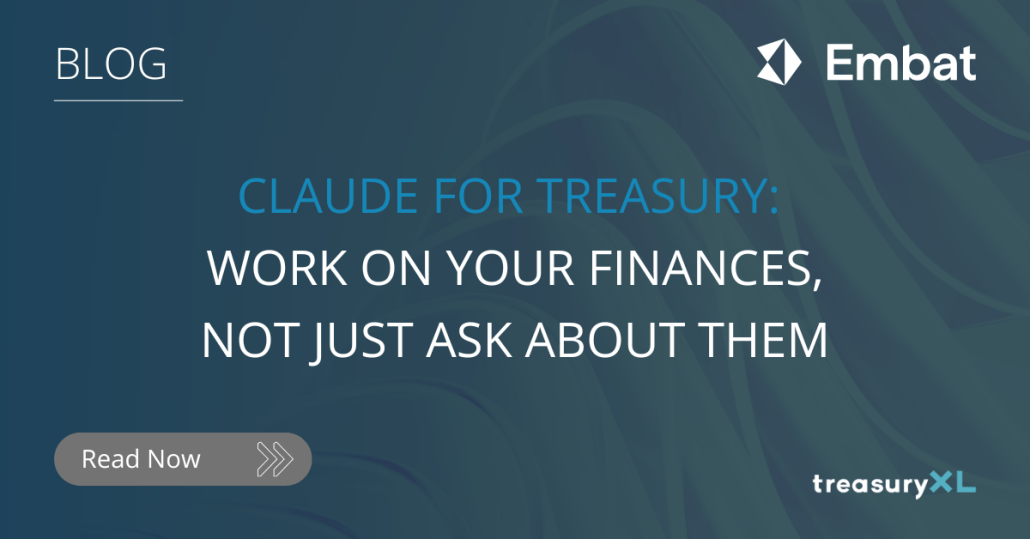
Finance can no longer be understood without AI and the question is no longer whether to adopt it, but where it should live in your workflow. That is why Embat-Claude connector is live and running, allowing CFOs and treasurers work on their full treasury from inside Claude. How? Embat’s AI agent for corporate treasury, TellMe, works in three modes: Silent for autonomous execution of routine tasks, Guided for suggestions that require human approval, and Ask for on-demand queries and actions initiated in natural language. Ask mode is the foundation that makes the Embat-Claude connector possible, giving CFOs and treasurers a place to work on their full treasury from inside Claude, without leaving the tools they already use.
The integration authenticates through existing Embat credentials, retaining the exact same data-level permissions the user already has, backed by an enterprise-grade security infrastructure. The connector is live and works seamlessly with Anthropic’s Claude.
A group treasurer opens Claude and types: “What’s our consolidated cash position across all entities right now?” Three seconds later, the answer appears, but not from Claude’s training data. It is pulled directly from the company’s live treasury system through a secure connector to Embat’s intelligent treasury management platform.
A few seconds later, she asks as a follow-up: “Show me which entities are below their minimum balance thresholds.” Claude delivers another answer with accurate numbers instantly, without requiring the user to open a dashboard or formulate a SQL query. And this is just the beginning: the same conversation that surfaces your cash position will soon let you act on it, initiating payments, flagging approvals, or triggering workflows, all from within Claude.

Specifications in detail: what is the Embat-Claude connector and how does it work?
The Embat-Claude connector brings TellMe Ask mode, Embat’s conversational AI agent for treasury, directly into Anthropic’s Claude AI foundation model and their apps. The connector is built on the Model Context Protocol (MCP), an open source standard that connects AI agents to the systems where data actually lives. Originally developed by Anthropic, MCP is now universal.
Think of it as the USB-C of AI systems: one protocol that works across Claude, ChatGPT, Gemini, and any other MCP-compatible agent. Through MCP, any connected AI can gain governed, real-time access to a company’s treasury data without ever exporting that data from Embat’s infrastructure, other company systems, or feeding it into model training. It is like uploading data into Claude manually, but without the risks of manual data export, uploads and downloads, or tedious data-reformatting exercises.
For context, TellMe is Embat’s AI agent for corporate treasury. It works in three modes: Silent (autonomous execution of routine tasks), Guided (suggestions requiring human approval), and Ask (on-demand queries and actions you initiate).
The Claude connector runs exclusively on Ask mode, which means every interaction starts with an explicit employee initiation, stays transparent, and keeps a human in control.
User-friendly UX and UI
The user flow is designed to be frictionless. A CFO or treasurer connects the MCP server in Claude (via the plugins search box), authenticates once, then asks questions in plain language.
Claude routes the query to the Ask mode AI agent, which retrieves the relevant data from the platform’s live treasury system and returns a cited answer from the user’s own live financial data.
Embat runs on real-time data from 15,000+ financial institutions, connected via PSD2 APIs, EBICS, host-to-host protocols, and SWIFT, with event-driven sync typically every few minutes rather than overnight batch files. When a treasurer asks Claude about the cash position, the answer reflects the state of the accounts as of the last sync, not end-of-day or opening balance.
What Claude adds on top of Ask mode comes from its native capabilities. Inside the same conversation, Claude can reason over the numbers returned, generate charts and visualisations, synthesise treasury data with documents the user uploads such as board memos or debt schedules, and maintain context across a long-running session.

Use cases: what you can do
The connector handles any query that TellMe’s Ask mode can answer, which means across all Embat modules: banking, payments, accounting, reconciliation, forecasting, and more.
Four practical examples:
1. Cash position across entities (Treasurer)
“What is our current cash position broken down by legal entity and currency?”
Claude retrieves the live consolidated view, complete with per-entity and per-account balances. Follow-up: “Which accounts are below their minimum threshold?” You get a filtered list with context.
2. Pending payments above a threshold (Payments team)
“Show me all pending payments over £50,000 due in the next seven days.”
Claude returns the list with beneficiary, amount, currency and due date, sourced from the payments module. The user can then ask Claude to generate a summary table or export the data for further review.
3. Anomalies in recent transactions (CFO)
“Flag any unusual transactions in the past 48 hours.”
The AI agent analyses recent bank movements against learned patterns, surfaces outliers, and Claude explains why each one was flagged, both the data and the reasoning, in natural language.
4. Combining treasury data with other Claude plugins
A management accountant can pull monthly cash flow by entity from the treasury platform, then tells Claude to visualise it as a stacked area chart or cross-reference it with a Google Sheet containing budget targets. Because Claude can access multiple connectors in the same session, treasury data becomes a building block for broader financial analysis.
The defining characteristic across all use cases is that every query and action is grounded in the company’s own live data, scoped strictly by the user’s permissions, and executed through a fully governed connector: not a chatbot, but a working layer on top of your treasury.
Security and data access
CFO AI tools that touch live financial data must meet a higher bar than querying an AI chatbot for holiday recommendations. Regulatory bodies, including the European Central Bank, the Bank for International Settlements (BIS), and the Financial Stability Board (FSB), have consistently highlighted that the operational benefits of generative AI in finance must be rigorously balanced with stringent controls around data access, model behaviour, and governance.
The Claude connector was engineered with these expectations in mind. Authentication uses the same credentials as the treasury app: no new login or setup is required once the connector is added.
Permissions are enforced at the data level, not just in the user interface. A user querying through Claude can only access the companies and modules they have permission to see in the platform. This mirrors the row-level security pattern that enterprise platforms recommend for conversational analytics: even if the language model writes a query, it cannot return rows the user is not entitled to see.
Embat’s enterprise-grade security infrastructure wraps the entire experience. The platform is ISO 27001 certified, SOC 2 Type II audited, and GDPR compliant.
Anthropic’s side of the stack is independently attested through SOC 2 controls and the artefacts published in its Trust Center. Claude Enterprise adds the governance, data controls, and admin infrastructure that IT and security teams require for organisation-wide deployment.
Crucially, Claude can not act autonomously via the connector. The AI merely retrieves, synthesises, and surfaces information. A human employee approves, modifies, or rejects every action. TellMe learns from the user to make grounded suggestions, but it operates firmly within defined parameters.
The strategic dimension for the modern CFO
The strategic context is documented. Recent market research, such as McKinsey’s 2025 State of AI report, highlights that a vast majority of global organisations have now adopted AI, with generative AI adoption more than doubling over the past two years.
What the Embat-Claude connector solves for a CFO is concrete:
Speed of answer
The Embat platform already runs on real-time data from a company’s financials, with access to 15,000+ financial institutions. The Claude connector turns that infrastructure into a one-sentence query. A cash position that previously required navigating multiple bank portals and consolidating spreadsheets now takes three seconds.
Accuracy grounded in your own data
Large language models perform best on financial questions when grounded in structured, verified enterprise data rather than generic text. The Embat connector provides exactly that grounding. Every answer cites the source data within Embat, and every number can be traced back to the originating bank account or forecast entry.
Zero tab-switching
CFOs and treasurers spend significant time stitching together bank portals, ERPs and spreadsheets. The Embat-Claude connector keeps the question, the answer and the follow-up reasoning inside a single conversation. Context persists across the session, so the CFO can move from question to action without starting over, and without switching tools.”
Governance and auditability
The Embat connector preserves Embat’s logging and reversibility, while Anthropic adds per-tool permissions, credential vaults, and full audit logs in the Claude Console.
From answers to actions
The Embat-Claude connector is live, secure, and built for finance teams who need more than answers, they need a place to work.
Today, Ask mode lets you query your full treasury in natural language, directly from Claude. But the connector was never designed to stop there. The roadmap is clear: as TellMe’s capabilities evolve through 2026, Claude will become a surface where you can execute treasury operations, not just retrieve them. Initiate payments. Review and approve transactions. Trigger reconciliation workflows. All from the same conversation where you asked the question.
The human stays in control at every step. TellMe does not act autonomously, it surfaces, suggests, and executes only when you say so.

Can’t get enough? Check out these latest items
 https://treasuryxl.com/wp-content/uploads/2026/09/XLCompass-featured-2.png
200
200
treasuryXL
https://treasuryxl.com/wp-content/uploads/2018/07/treasuryXL-logo-300x56.png
treasuryXL2026-09-23 08:12:522026-09-24 16:16:11XLcompass: FX risk, hiring and automation: how treasury teams are handling it
https://treasuryxl.com/wp-content/uploads/2026/09/XLCompass-featured-2.png
200
200
treasuryXL
https://treasuryxl.com/wp-content/uploads/2018/07/treasuryXL-logo-300x56.png
treasuryXL2026-09-23 08:12:522026-09-24 16:16:11XLcompass: FX risk, hiring and automation: how treasury teams are handling it https://treasuryxl.com/wp-content/uploads/2025/10/MEET-OUR-PARTNERS.png
200
200
treasuryXL
https://treasuryxl.com/wp-content/uploads/2018/07/treasuryXL-logo-300x56.png
treasuryXL2026-09-08 11:08:422026-09-09 13:01:10EuroFinance 2026: Key Connections to Make
https://treasuryxl.com/wp-content/uploads/2025/10/MEET-OUR-PARTNERS.png
200
200
treasuryXL
https://treasuryxl.com/wp-content/uploads/2018/07/treasuryXL-logo-300x56.png
treasuryXL2026-09-08 11:08:422026-09-09 13:01:10EuroFinance 2026: Key Connections to Make https://treasuryxl.com/wp-content/uploads/2026/09/Embat-BLOGS-featured-3.png
200
200
treasuryXL
https://treasuryxl.com/wp-content/uploads/2018/07/treasuryXL-logo-300x56.png
treasuryXL2026-09-03 11:49:342026-09-07 10:51:01Liquidity Risk Management: Resilience Without Excess Cash
https://treasuryxl.com/wp-content/uploads/2026/09/Embat-BLOGS-featured-3.png
200
200
treasuryXL
https://treasuryxl.com/wp-content/uploads/2018/07/treasuryXL-logo-300x56.png
treasuryXL2026-09-03 11:49:342026-09-07 10:51:01Liquidity Risk Management: Resilience Without Excess Cash https://treasuryxl.com/wp-content/uploads/2024/10/Embat-BLOGS-featured-2.png
200
200
treasuryXL
https://treasuryxl.com/wp-content/uploads/2018/07/treasuryXL-logo-300x56.png
treasuryXL2026-08-27 07:00:532026-08-26 14:36:34Treasury Management System Comparison for Multi-Entity Groups
https://treasuryxl.com/wp-content/uploads/2024/10/Embat-BLOGS-featured-2.png
200
200
treasuryXL
https://treasuryxl.com/wp-content/uploads/2018/07/treasuryXL-logo-300x56.png
treasuryXL2026-08-27 07:00:532026-08-26 14:36:34Treasury Management System Comparison for Multi-Entity Groups https://treasuryxl.com/wp-content/uploads/2026/07/XLconnect-with-payoff-4.png
200
200
treasuryXL
https://treasuryxl.com/wp-content/uploads/2018/07/treasuryXL-logo-300x56.png
treasuryXL2026-08-17 07:00:372026-08-14 07:44:05Recap & Recording: XLcompass – Building Successful Treasury Teams
https://treasuryxl.com/wp-content/uploads/2026/07/XLconnect-with-payoff-4.png
200
200
treasuryXL
https://treasuryxl.com/wp-content/uploads/2018/07/treasuryXL-logo-300x56.png
treasuryXL2026-08-17 07:00:372026-08-14 07:44:05Recap & Recording: XLcompass – Building Successful Treasury Teams https://treasuryxl.com/wp-content/uploads/2026/07/XLcompass-200.png
200
200
treasuryXL
https://treasuryxl.com/wp-content/uploads/2018/07/treasuryXL-logo-300x56.png
treasuryXL2026-07-28 07:00:032026-07-30 14:37:05Live Session: XLcompass: Building Successful Treasury Teams
https://treasuryxl.com/wp-content/uploads/2026/07/XLcompass-200.png
200
200
treasuryXL
https://treasuryxl.com/wp-content/uploads/2018/07/treasuryXL-logo-300x56.png
treasuryXL2026-07-28 07:00:032026-07-30 14:37:05Live Session: XLcompass: Building Successful Treasury Teams https://treasuryxl.com/wp-content/uploads/2025/02/Embat-BLOGS-featured-3.png
200
200
treasuryXL
https://treasuryxl.com/wp-content/uploads/2018/07/treasuryXL-logo-300x56.png
treasuryXL2026-07-01 07:00:292026-06-30 20:30:24Embat becomes the first treasury management system available to Sage Intacct’s customers
https://treasuryxl.com/wp-content/uploads/2025/02/Embat-BLOGS-featured-3.png
200
200
treasuryXL
https://treasuryxl.com/wp-content/uploads/2018/07/treasuryXL-logo-300x56.png
treasuryXL2026-07-01 07:00:292026-06-30 20:30:24Embat becomes the first treasury management system available to Sage Intacct’s customers https://treasuryxl.com/wp-content/uploads/2026/06/Embat-BLOGS-featured-2.png
200
200
treasuryXL
https://treasuryxl.com/wp-content/uploads/2018/07/treasuryXL-logo-300x56.png
treasuryXL2026-06-24 07:00:482026-06-23 12:47:38Interview – Embat on AI, Growth, and the Future of Treasury
https://treasuryxl.com/wp-content/uploads/2024/10/Embat-BLOGS-featured-2.png
200
200
treasuryXL
https://treasuryxl.com/wp-content/uploads/2018/07/treasuryXL-logo-300x56.png
treasuryXL2026-06-02 07:00:062026-06-01 15:44:31Cash Management in Hospitality: From Survival to Strategy
https://treasuryxl.com/wp-content/uploads/2026/06/Embat-BLOGS-featured-2.png
200
200
treasuryXL
https://treasuryxl.com/wp-content/uploads/2018/07/treasuryXL-logo-300x56.png
treasuryXL2026-06-24 07:00:482026-06-23 12:47:38Interview – Embat on AI, Growth, and the Future of Treasury
https://treasuryxl.com/wp-content/uploads/2024/10/Embat-BLOGS-featured-2.png
200
200
treasuryXL
https://treasuryxl.com/wp-content/uploads/2018/07/treasuryXL-logo-300x56.png
treasuryXL2026-06-02 07:00:062026-06-01 15:44:31Cash Management in Hospitality: From Survival to Strategy
