Tag Archive for: EUR

The end of the Euro as we know it – when the party ends?

| 4-5-2017 | Lionel Pavey |


The papers are full of stories about the level of Government debt within the Eurozone (Italy has a debt to GDP ratio of more than 130%), probable new bailouts for Greece, lack of suitable bonds to purchase for Quantitive Easing, Brexit, the rise of populist rightwing politics etc. Well at least we have all the bad news out in the open – don’t we?

Target 2

A new problem has arisen that was partly accelerated by QE – namely the outstanding national balances within Target 2. This is the “Trans European Automated Real-time Settlement Express Transfer System” foe the Eurozone. The key word is “Settlement” as I shall explain.
When a financial transaction is agreed 2 actions have to happen – clearing and settlement. Clearing entails all the actions that must be undertaken up to settlement, such as delivery of bonds, securities or shares. Settlement means the exchange (transfer) of money for goods or bonds etc.

When a party in Italy buys goods from the Netherlands, they instruct their bank to debit their account and credit the account of the seller. This is a cross-border transaction. But, within the Eurozone monetary settlement does immediately take place between banks. The Italian bank will have its balance reduced at the Banca D’Italia and the Dutch bank will have its balance credited at de Nederlandsche Bank. However, the balance is not settled between the 2 central banks – a new claim is shown on their books.

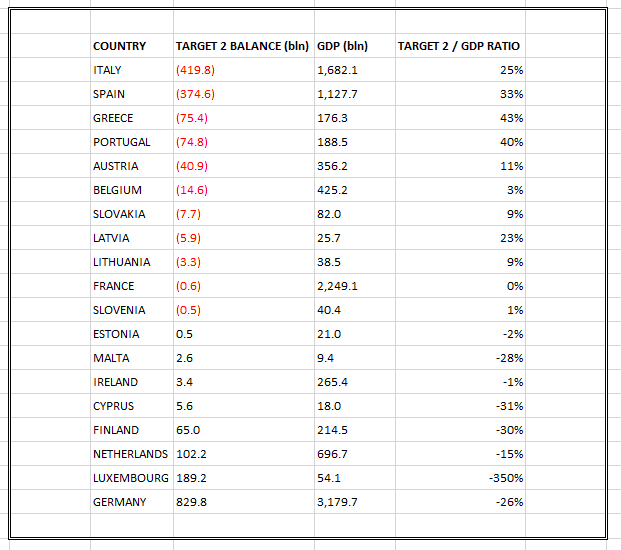
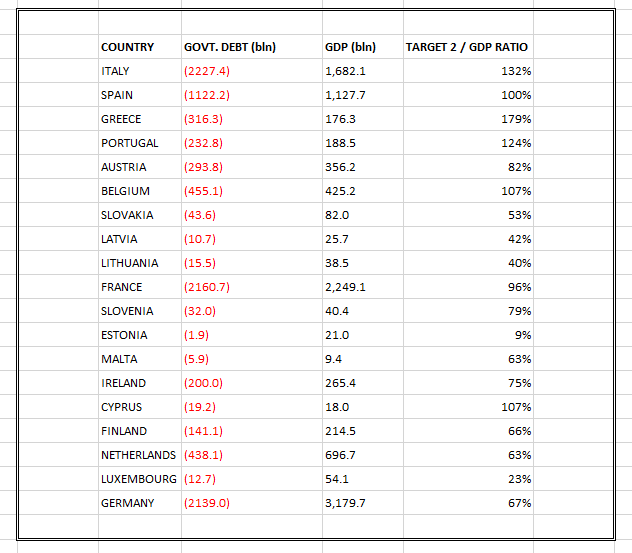
At the end of 2016, according to the Euro statistics website Italy has a negative Target 2 balance of EUR 420 billion with other countries in the Eurozone. This amount has been accumulated over the years since 1999 and now represents more than 25% of GDP. This is on top of the Italian Government debt of 130% of GDP. If a country were to leave the Eurozone they would be liable to immediately settle their Target 2 balances – something that is not realistic. Under the current agreement the other countries within the Eurozone would be liable to cover the debt. Target 2 balances do not have to be settled as countries would never default appears to be the thinking.

At the other end of the scale, Germany has an outstanding claim on other Eurozone countries of EUR 830 billion. At the moment these amounts are shown at full face value in the books – it would appear that politically, no one wants to acknowledge that the claims can not be settled in full under the current constraints within the Eurozone. If the Eurozone are 100% committed to supporting the Euro and, the balances are not going to be settled within the foreseeable future then, eventually, something will have to break.

Emperor with no clothes

Confession time – I am English (and proud of it). If I had been able to vote in last year’s referendum in the UK, then I would also have voted for Brexit. This does not make me anti-European; rather the reality of the Eurozone is very much like the fable of the Emperor with no clothes. Everyone sees it, but no one will say it. Perhaps, a solution can be found that does not mean debt forgiveness, writedowns, defaults or exits, but common sense would imply that this is wishful thinking.

When I was a young boy at Grammar School I had to learn some poetry for my English Literature exam – it included D.H. Lawrence. As a wild youth I could cope with Shakespeare, had a hard time with Chaucer, but fell in love with a poem by Lawrence entitled “A Sane Revolution”. He told us to make a revolution for fun and not in seriousness. Also I knew the poem as it was quoted by Mott the Hoople who got me through my teenage years with their music.

The creation of the Euro is a revolution in European history, but could it ever be called sane?

TARGET 2 BALANCES

Source: http://sdw.ecb.europa.eu/reports.do?node=1000004859


GOVERNMENT DEBT

Source: http://www.debtclocks.eu/select-an-eu-member-state.html

Lionel Pavey


Lionel Pavey

Cash Management and Treasury Specialist


The Euro from a treasury perspective

| 10-4-2017 | Hans de Vries |

In a perfect world, one currency is the ultimate dream for every Treasurer. The introduction of the Euro has been a major leap forward in that direction. However, current anti-euro sentiments boosted by populist movements all over Europe, seriously threaten to hamper this unique and visionary European accomplishment.  This article focusses on what impact the introduction of the Euro had for the corporate treasurers and what will happen if the Euro gets skipped.

Let’s start with the beginning. One must be aware that the introduction of the Euro is the world’s largest economic policy experiment so far with heavy repercussions on the autonomy of the countries involved with regard to their monetary regimes.  So naturally this expedition has met a lot of criticism ever since the beginning, the creation of the European Monetary System (EMS) on March 13,1979.

The Euro skeptics mostly feared that the wide-spread adoption of the Euro would deteriorate the economies of countries that accepted this currency and was in favor of the larger countries, like France and Germany, that now could easily manipulate the Euro’s puppet strings. Main belief was that the Euro would weaken instead of strengthen the European economy.

 As from the start, Euro stronger than expected

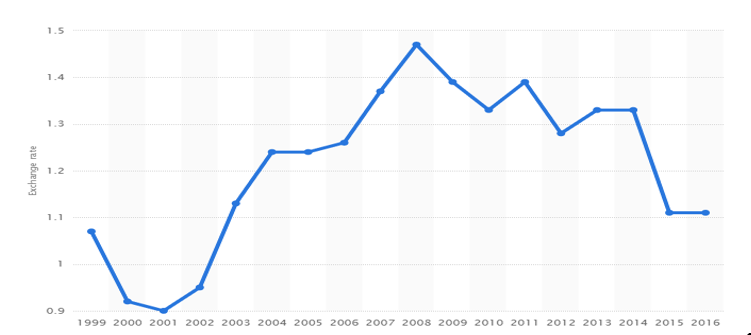
Although the Euro met quite some negative public attention, looking at more than 15 years of Euro, the track record has not been that bad at all. As the graph shows, after a relatively weak position against the USD at the beginning of this century, the Euro has held a strong position against the USD as from 2003 on, although weakening after 2014 in the aftermath of the banking and economic crisis that followed it. However, the predicted downfall of the Euro never took place. Remarkable phenomenon was that when the value of the dollar was higher, it was regarded in the media as a sign of weakness of the Euro against a “strong” Dollar and when the value of the Euro was stronger than the USD it was regarded by the analysts as a sign of weakness of the Dollar.

More important is that the introduction of the Euro as per January 1, 1999 has indeed brought the predicted transparency to the European market but also to the global market. This transparency has contributed to the substantial growth (5-40% according to Bun and Klaassens) of the internal trade flows within the EU countries due to the fact that the Euro has lowered the fixed and/or variable costs of exports. Prices can be compared across the whole Eurozone, allowing companies to choose the most price-competitive suppliers. The newly exported goods are of lower unit values than those previously exported because the Euro has made exporting them profitable, particularly for small exporters. Don’t forget that with 28 member states in 2014 Europe was the strongest economic player on global level taking care of 17,1% of the World GDP whereas the USA had a share of 15,9% and Russia 3,3%.
From a more monetary viewpoint the Euro brought price stability. Inflation in the Eurozone has been around 2-2.5% for most of the time since its creation.
A strong Euro mitigated the impact of the volatility of dollar-denominated commodity prices.This advantage was particularly visible before the beginning of the financial and economic crisis, when the oil price and the price of some other important food commodities reached unprecedented peaks. Due to the Strong Euro or weak USD, the consequences for the European market were relatively minor.

Euro leads to transparent treasury operations and substantial cost reductions

In today´s Euro environment, most Treasurers in Europe only have to deal with the USD, GBP and sometimes CHF and the Nordic Currencies. This makes live quite overseeable and has substantially enhanced their risk portfolio. The same applies for the Treasurers outside the Euro zone, who are now freed from the hassle of the past European currency palette.

Although a number of Euro critics pointed their finger at the Euro as direct cause for the Banking crisis a few years ago, it is almost impossible to imagine the consequences of the crisis in and outside Europe if every European country had been dealing with their own currencies. This would have resulted in a pandemonium of devaluations and revaluations with even more severe consequences for the values of all national and international operating companies and even more bank bankruptcies. Not to mention the impact this might have had on pension funds and other investment vehicles on short and longer terms.

From a corporate perspective, the benefits of the introduction of the Euro are therefore quite clear.

But also the consumers more and more are sharing the benefits of the common Euro market. Not only during travels abroad but also internet shopping becomes more and more international with new initiatives on the way to support payments like the Fast Payment project.

Looking at all these benefits, the current anti Euro sentiment in a number of European member states is from an economic point of view hard to understand and might pose a serious threat on the future European economic development.

Consequences of a Euro exit from a treasury and cash management perspective

Imagine getting back to the world without the Euro. This means an enormous rise of the operational costs considering:

  • The daily currency shifts that influence directly the position of the corporate’s accounts receivable/ and accounts payable and therefore the short time profit/loss situation. To minimize the impact substantial investment in systems and manpower will be needed;
  • The monetary developments as result of the internal economic/ political situation per country resulting in overnight currency devaluation/ revaluation and it’s inter currency reaction’s. (The recent takeover of Opel by Peugeot was merely a result of the strong decline of the GBP against the Euro which had severe consequences on the UK based Vauxhall subsidiary and shows the impact of the monetary developments on the corporate world.)
  • The banking costs involved in setting up swaps/ hedges/ Long term deposits etc.
  • The banking costs involved in buying and selling the various currencies;
  • The impact on money transfers which will be treated as international payments again with different clearing systems, correspondent banks, local payment instruments and formats etc. resulting in delayed payments and receipts and therefore threatening the growth of the economies.
  • The impact on international trade that will strongly diminish due to the lack of transparency of the international markets, the rise of costs and the loss of trust.
  • Re-opening of local accounts to support local business

Banking industry as sole winner

The only party that will benefit from this skip of the Euro development is the banking industry, because of the margin to be made on currency exchange, swaps and other derivates, and the backshift to a Non-Sepa/ international payments environment with substantial higher transaction costs. Looking at the public opinion on banks in general ever since the bank crisis, it’s hard to believe that the populist movements in Europe are in favour of this development.

Take the loss or start a counter movement?

This leaves us with the question, what benefits are there to gain by consumers and businesses alike by leaving Europe and the Euro? Looking at the economic development of the Euro countries today and all the benefits the Euro has brought the corporates and consumers,  there is no clue why we should not stick to the current status quo and enhance it in any possible way.

It is therefore high time to start advocating the true merits a United Europe has been gaining thanks to the pan European ideals: a unprecedented war free community already lasting for more than seventy years combined with an enormous economic and cultural development.

Hans de Vries

Treasury/ Cash Management Consultant

Brexit: It is the economy stupid!

| 5-4-2017 | Theo Paardekooper |

Brexit: It is the economy stupid! (quote van James Carville, adviseur van de voormalig president van de USA, Bill Clinton). Op 23 juni 2016 werd in de UK een raadgevend referendum gehouden waarin aan de bevolking werd gevraagd om steun voor het lidmaatschap van de Europese Unie. Een kleine meerderheid van 51,6% van de kiezers heeft tegen het lidmaatschap gestemd. Op donderdag 3 november 2016 heeft de Hoge Raad in de UK bepaald dat eerst het Britse parlement moest instemmen met het verzoek tot uittreding. Na parlementaire goedkeuring heeft op 29 maart de Britse regering het officiële verzoek tot uittreding uit de statengemeenschap van de Europese Unie ingediend. De vraag is wat de economische effecten zijn van deze Brexit voor de UK en de EU. Om een antwoord op deze vraag te geven, gaat dit artikel in op wat heeft geleid tot een Brexit referendum, de argumentatie van den tegenstanders en de economische effecten op korte en lange termijn.

Waarom een referendum in UK?

Op 27 mei 2015 kondigde de Britse Minister President David Cameron een “in/uit”- referendum aan tijdens de Queen’s Speech (Troonrede). Voordat het referendum werd gehouden heeft Cameron betere voorwaarden voor de UK in Brussel weten te bewerkstelligen. Met betere afspraken verwachtte hij dat het “remain” kamp, waartoe Cameron behoorde, een overwinning zou behalen. Dat het Brexit referendum zeer beladen was, manifesteerde zich een week voor de verkiezingen met de politieke moord op de Labour-politica Jo Cox, behorend tot het “remain”-kamp.

Argumenten vóór een Brexit

Independence Party (UKIP) is in 1993 opgericht met als doel om de UK de EU te laten uittreden. Hoewel in de landelijke politiek de partij geen rol van betekenis speelt, werd deze partij uiteindelijk bij de verkiezingen voor het Europees Parlement de grootste fractie van de UK. De voornaamste argumenten voor de Brexit van deze partij liggen op het gebied van soevereiniteit. Daarnaast spelen met name economische argumenten een rol. Door Brusselse regelgeving wordt de concurrentiepositie van de UK negatief beïnvloed. UK is een netto “betaler” aan de EU. In 2014 werd £8,6 mrd netto aan de begroting van de EU door de UK betaald. UKIP ziet veel meer mogelijkheden om dit bedrag in eigen land te besteden (o.a. aan zorg). Door vrij verkeer van goederen en personen wordt de Britse arbeidsmarkt “overspoeld” met goedkope buitenlandse arbeiders. Officiële data maken melding van 1,1 miljoen buitenlandse EU migranten. UKIP stelt dat de arbeidsmarktpositie van de Britse arbeider wordt ondermijnd door deze concurrenten. Tevens leggen deze arbeiders beslag op publieke faciliteiten, zonder daarvoor een bijdrage te leveren aan deze voorzieningen. Net als in andere Europese landen, vormt de immigratie een heet hangijzer. Bij dit referendum is dit het voornaamste (populistische) item. Naast arbeidsmigratie speelt hier de verdeling van asielzoekers over de EU lidstaten ook een voorname rol.

De korte termijn economische effecten van de Brexit

Effecten op de valuta markt De korte termijn effecten waren feitelijk al zichtbaar voor het referendum werd gehouden. Marktpartijen houden bij hun investeringsbeslissingen rekening met een Brexit scenario. In welke mate is bijvoorbeeld te meten in Foreign direct Investments (FDI). Door afname van de FDI daalt de economische groei en uit dien hoofde de overheidsinkomsten. Dit effect is direct waarneembaar in de wisselkoers van het Britse Pond. Na de Brexit is de koers van het Britse Pond met zo’n 12% gedaald. Op de valuta markten is een dergelijke koerswijziging zeer materieel. Door afname van de korte termijninvesteringen en desinvesteringen door beleggers, bedrijven en speculanten worden de vrijgekomen GBP verkocht en omgezet naar de eigen valuta. De forse aanbodtoename van GBP op de valutamarkt leidt tot deze forse koersdaling. Paradoxaal geeft een lagere wisselkoers een concurrentievoordeel voor bedrijven uit de UK. De goederen en diensten zijn 12% goedkoper geworden en derhalve aantrekkelijker te exporteren. Het korte termijn resultaat is dus een opleving van de Britse economie a.g.v toename van de export.

GRAFIEK: GBP valuta-koers ontwikkeling. Duidelijk is de waardestijging van EUR en USD na het referendum.
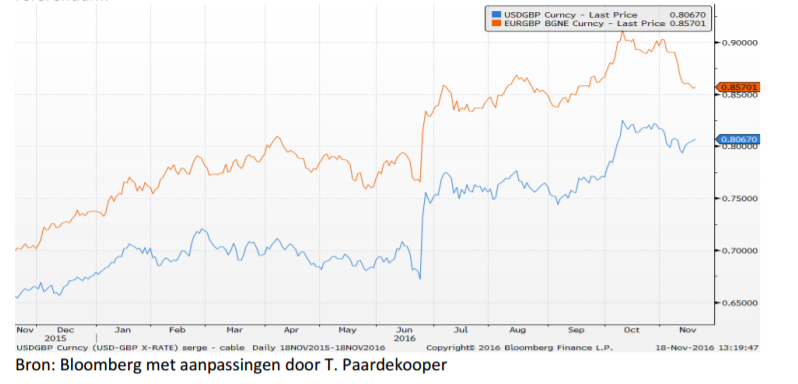
Euro/GBP en USD/GBP valuta-koers ontwikkeling over de afgelopen 12 maanden
Normaliter wordt het valuta-paar in GBP/USD aangegeven. Om de overeenkomsten tussen de koersontwikkelingen beter duidelijk te maken is gekozen voor notatie in USD/GBP

Effecten op de obligatie markt

De verwachte daling van de obligatiekoersen als gevolg van een verminderde belangstelling voor Brits schuldpapier is uitgebleven. De rente op de obligatie markt was al sterk gedaald naar 0,5% voor 10-jaars staatsschuldpapier. De Engelse Centrale Bank heeft na het Brexit referendum haar tarieven laten dalen naar een historisch laag niveau van 0,25% en tevens heeft ze steunaankopen op de obligatie markt verricht. Dit heeft een stabiliserend effect op obligatiekoersen. Door de korte termijn verbetering van de export als gevolg van lagere koers van de Britse Pond wordt een verbetering van de economische groei verwacht in 2017 van 0,8% naar 1,4% . Verdere steunmaatregelen blijven derhalve vooralsnog uit. Per factor kan de impact van de Brexit als volgt worden beoordeeld: Door het ontstaan van handelsbarrières bij uittreding uit de EU kan de exportpositie van de UK worden aangetast. De UK kan bilaterale overeenkomsten aangaan met haar handelspartners, maar daarbij zal ze een veel minder grote machtsfactor kunnen spelen in de onderhandelingen. Immers, de grote economische machtsblokken (EU, China, USA) kennen een veel lagere urgentie om tot een akkoord te komen. Hierdoor is de Britse economie veel vatbaarder voor protectionistische maatregelen, zowel op het gebied van direct importheffingen als van non-tarief matige maatregelen. Na een eerste opleving als gevolg van de waardedaling van het Britse Pond zal naar verwachting een verlaging van de export/import quote tot een afname van de economische groei leiden.

Overheidsuitgaven

De Britse overheid is een netto betaler aan de EU. (£8,6 mrd). Bij een overheidstekort van ca £89 mrd en een totaal GDP van £1870 mrd zal de aanwending van deze middelen maar een bescheiden positieve bijdrage kunnen leveren aan de economische groei. Afhankelijk van het uiteindelijke Brexit scenario zal een deel van deze besparing weer ingezet moeten worden ter compensatie voor enige toegang tot de Europese markt. Tevens zal door de Brexit de overheid worden geconfronteerd met fiscale stimulatie om bijvoorbeeld het investeringsklimaat voor buitenlandse partijen aantrekkelijk te maken. Door het wegvallen van de toegang tot de interne markt van de EU zullen veel bedrijven hun investeringen in de UK heroverwegen. Bijvoorbeeld voor het behoud van de auto industrie, een belangrijk sector in de Britse economie, heeft de overheid al stimulerende maatregelen afgekondigd.

Investeringen

De investeringen betreffen zowel de investeringen om de groei te faciliteren als investeringen van buitenlandse partijen (Foreign Direct Investments, FDI) in de UK. Als de groei afneemt of als er zelfs sprake is van economische krimp, dan zal dit leiden tot een sterke verlaging van de investeringen. De FDI zullen, gevoed door onzekerheid en door beperking van toetreding tot de Europese markt via de UK, naar verwachting verlaagd worden.

 Consumptie

Gestimuleerd door een lage rente die door de Centrale Bank wordt gefaciliteerd door monetaire maatregelen zullen de consumptieve uitgaven in aanvang nog op peil blijven. Echter, als de export en de FDI zullen afnemen, dan zal dit uiteindelijk impact hebben op het beschikbare inkomen per capita met als resultaat een afname van de consumptie.

De lange termijn economische effecten van de Brexit

De UK staat op plaats 7 van de Global Competitiveness Index. De arbeidsmarkt is na de USA en Canada een van de meest flexibele ter wereld. De beoogde afname van de immigratie zou op termijn een negatief effect kunnen hebben op de populatie en dan met name in de leeftijdsopbouw van de Britse populatie. Net als de andere Europese landen vergrijst de bevolking van de UK. Om de beschikbaarheid van arbeidskrachten te waarborgen en om de zorg en sociale voorzieningen op peil te houden, is een evenwichtiger demografische beeld met een lager vergrijzingspercentage van belang. Er leven vooral veel oudere Britten als pensionado’s in de EU. De vraag is of deze groep na de Brexit zal moeten terugkeren naar de UK. Dit zal extra druk op de voorzieningen geven en leiden tot extra kosten voor het in stand houden van het nu nog gratis stelsel van gezondheidszorg in de UK.

Scenario’s voor uittreding

Als het uittredingsverzoek door de UK zal worden ingediend, dan staan zowel de UK als de EU voor een belangrijk besluit. Hoe wordt de onderlinge (handels) relatie tussen beide partijen in de toekomst vormgegeven?

Er zijn 5 scenario’s denkbaar:

  • Geen handelsverdrag met de EU
    Handel zal geschieden volgens de WTO-regeling als “Most Favoured Nation” (FMN). UK zal hetzelfde behandeld worden als ieder ander land met deze status. Er is een gelijk “level playing field” en geen concurrentie nadeel met betrekking tot de handel met de EU. Ieder MFN lid moet dezelfde markttoegang bieden aan de andere MFN leden.
  • Ondertekening van het EFTA verdrag, net als Noorwegen, IJsland en Liechtenstein.
    Met ondertekening van dit verdrag blijft UK lid van de EEA (European Economic Area) en blijft vrij verkeer van goederen en personen gehandhaafd. De UK zal hier wel een vergoeding voor moeten betalen aan de EU. Tevens moet worden voldaan aan alle wetten een regelgeving die door Brussel wordt opgelegd.
  • Ondertekening van het EFTA-verdrag zonder lidmaatschap van de EEA, net als Zwitserland. Zwitserland heeft toegang tot de interne markt, zonder dat er vrij verkeer is van personen. De bank- en dienstverlenende sector heeft geen vrije toegang tot de EU. Wel is sprake van een financiële bijdrage door Zwitserland aan de EU.
  • Een bilateraal handelsverdrag, zoals het CETA verdrag met Canada. Hierbij wordt meer in detail vastgelegd welke goederen en diensten vrij verhandelbaar zijn en hoe wordt omgegaan met regelgeving die import/export belemmerend kan werken.
  • Ondertekening van een douane-unie verdrag, zoals de EU heeft met Turkije.
    Er is sprake van vrije handel van industriële goederen, maar geen vrije handel van agrarische producten of diensten. Er zijn geen afspraken over non-tarifaire maatregelen als grenscontroles, productstandaarden en veiligheidseisen.

Impact voor de EU

De Europese economie zal ook enig nadeel ondervinden van de Brexit. Met name het signaal dat is afgegeven als gevolg van het Brexit referendum heeft impact op het vertrouwen in de duurzaamheid van het huidige Europese model. Europese leiders zullen gefocust blijven op het behoud van het Europese model en hierdoor zal mogelijk de polarisatie tussen de pro- Europeanen en de nationalistische partijen in Europa toenemen. De EU zal geconfronteerd gaan worden met individuele eisen van landen, onder het dreigement van het houden van een vergelijkbaar exit- referendum.
Als de Brexit een positieve effect zal hebben op de economie of op deelsectoren van de UK a.g.v. deregulering of belastingverlaging, dan zal de roep om dergelijke maatregelen ook te horen zijn in Europa. Zo kan uittreding van de Britten uit de EU de start worden van een verder uiteenvallen van de Europese Unie als economisch en politiek blok.

Conclusie

De Europese Unie en haar voorgangers zijn ooit opgericht om een einde te maken aan de al eeuwen durende gewapende rivaliteit tussen de Europese naties. Door de economische barrières te verwijderen is uiteindelijk een grote vrijhandelszone ontstaan met grote aantrekkingskracht op landen aan de grens van de EU.
De impact op de economie na de Brexit zal sterk bepaald worden door het uittredingsscenario. De verwachting is dat hoe “harder” de Brexit, hoe groter de daling van de GDP. Effecten aan de vraagzijde van de economie, t.w. Import/Export, Investeringen en Consumptie zullen hard geraakt worden. Sterke overheidsstimulering in combinatie met een sterk nationaal zelfbewustzijn zal nodig moeten zijn om de UK in staat te stellen om een hard scenario om te zetten in positieve economische effecten. Daar UK een veel kleinere markt is dan de EU, met een beperkte negatieve handelsbalans, maar waar 2/3 deel van de economie betrekking heeft op import of export, zal de uittreding uit de Europese markt de economie flink gaan raken; het effect op de UK zal groter zijn dan op de EU. De Brexit is een feit, maar ook in exit strategieën bestaan veel varianten.

 

Theo Paardekoper 

Independent treasury specialist


Eerdere artikelen over de Brexit op treasuryXL:

Brexit: Winnaars en verliezers

Brexit en GBP: Een historische dag



To be or not to be – what happens next to the Euro?

| 22-11-2016 | Lionel Pavey |


In the last few weeks, there have been many news articles published, by well-known people, about the state of the union:

  • Frits Bolkestein (former European Commissioner) – monetary union has failed. In 10 years there will be a large D-mark block in northern Europe
  • Joseph Stiglitz (Nobel prize winner Economics) – the euro’s days are numbered
  • Otmar Issing (former chief economist ECB) – one day the Euro “house of cards” will collapse
  • Jacques Delors (former president of the EC) –  at some point, Europe will be hit by a new economic crisis. We do not know whether this will be in six weeks, six months, or six years. But in its current set-up, the euro is unlikely to survive that coming crisis.

End of the Euro?

More than 15 years after its creation, has the Euro run its course? After countries put all their effort into meeting the convergence criteria, did they forget to look at the diverging competitiveness between themselves?

There are numerous political elections and referendums in the next year – Italian constitutional referendum, elections in Austria, France, Germany and the Netherlands. There appears to be a rise in anti-European sentiment expressed by both voters and politicians. After the perceived surprise results in the Brexit referendum and the presidential elections in America, it would be prudent to consider all possible outcomes.

So what would happen if the currency union ceased to exist? We can look back in recent history to the breakup of both the Soviet Union in the 1990’s and the Austro-Hungarian Empire in the 1920’s. A split in the current Eurozone would appear to follow a North-South divide, leading to a revaluation of the currencies in the North and a devaluation in the South. Thanks to modern technology it would be possible to sell bonds of southern countries and move the proceeds to the north almost instantaneously. Despite the huge upheaval – rising inflation and unemployment, declining growth and investment, the situation would eventually normalize as can be seen in the new countries that were previously part of the Soviet Union. But this would all come at a very large price.

Consequences for companies

But what about the consequences for companies? If a contract existed between a Dutch company and an Italian company many questions would need to be answered – which contract law takes preference, in what currency should the contract continue, who bears the risks involved? What happens to a loan extended to a Spanish company by an Austrian bank and denominated in Euros that are no longer legal tender? It would be prudent to look at all the possible risks that a company could face if the Euro were to replaced by national currencies – what cross border contracts do they have, what is the impact to the company’s profit if the new currency devalues, what are the terms and conditions in existing loan documentation regarding covenants, how many new bank accounts would need to be opened to allow trading to continue.

Can the Euro survive? Personally, whilst the idea was good, the reality has been different. It requires a complete “One Europe” – monetary, fiscal, political, defence, law etc. Could this ever be achieved and do the people of Europe really wants this – now that is the question.

Lionel Pavey


Lionel Pavey

Cash Management and Treasury Specialist – Flex Treasurer


FX volatility creates opportunities

currencies| 18-10-2016 | Victor Macrae |

The British pound has strongly decreased in value against other major currencies such as the US dollar and the euro. Such FX movements can negatively impact firms’ financial statements and destroy firm value. On the other hand, they can also create opportunities. I would like to demonstrate this on the basis of a real case of a European based industrial firm which has the euro as functional currency. We’ll discuss two scenarios.

First, some time ago the firm was negotiating a takeover of a British firm. In anticipation of the M&A transaction it purchased British pounds against euros. However, the deal was unexpectedly cancelled. As a result the firm had to sell the pounds again. Luckily, the pound had strengthened against the euro in the meantime and the firm ‘gained’ millions due to the failed acquisition. This could however easily have been a ‘loss’ in case of a weakening of the pound. The ‘no FX strategy’ was in the firm’s favour this time, but I wouldn’t bet on it.
If you are thinking about a takeover in the UK (or any other country where the local currency is under pressure) it is wise to consider multiple FX hedging strategies. For instance, using options for these type of transactions not only provides you with a way out if the acquisition is not closed as an option gives you the right but not the obligation to purchase the FX. Furthermore, when the payment is due it also gives you the opportunity to buy the currency at the option’s strike price or at the lower prevailing market rate if the case.

Second, a characteristic of this industrial firm is that it is very dominant in its core markets. Due to this position, the firm predominantly sells its products in euro, also to customers with a different home currency. While it may seem that there is no FX risk, this strategy has led to currency issues, for instance in the Russian market. Due to the weakening of the Russian rouble against the euro, the firm’s products have become more expensive up to a point where sales in Russia have nearly ceased to exist. Russian customers cannot afford to pay the euro prices and demand pricing in roubles or a discount on the euro price.
This is an example where a firm’s exchange rate policy influences its core business activities. A solution could be to move production to Russia, and possibly to produce for other regions as well, although this has consequences far beyond the FX issue which have to be taken into account.

Both examples show that FX volatility can create opportunities. FX risk management should support the core activities of a firm and not the other way around. But if creative FX management helps create firm value, why not benefit?


Victor Macrae


Victor Macrae

Owner of Macrae Finance