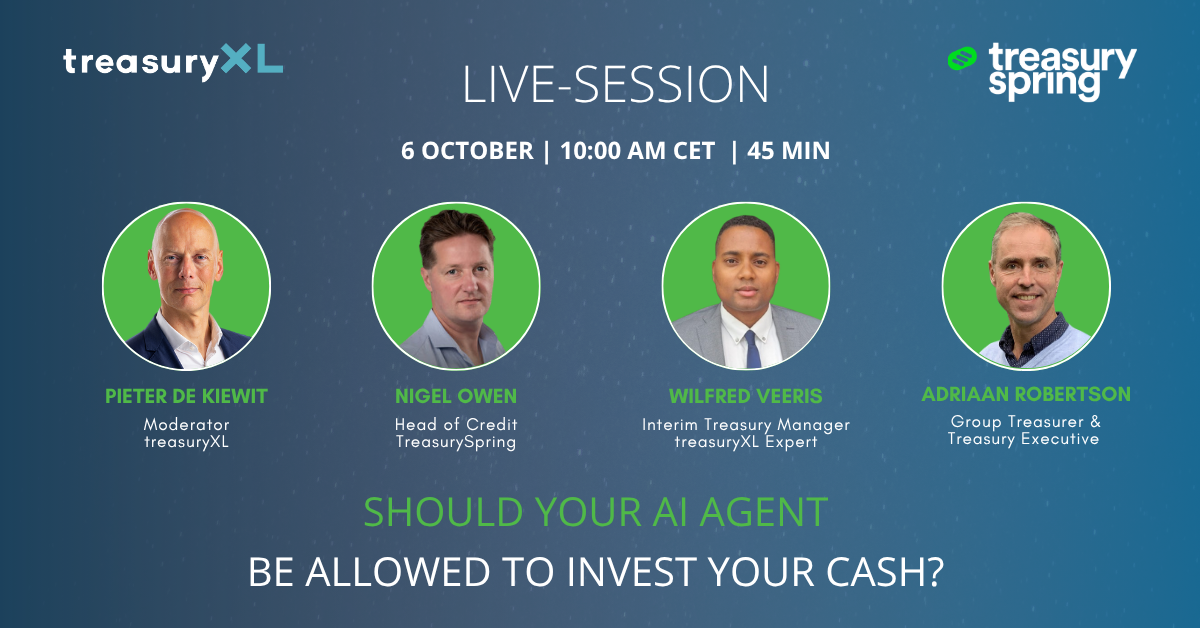
Bond and TreasurySpring recently announced a partnership at the intersection of two shifts in treasury: the rise of agentic AI and the need to turn cash insight into controlled execution. For corporate treasurers, the focus is no longer only visibility, but a clearer path from identifying surplus liquidity to placing it in institutional cash investments. As both are partners at treasuryXL, we of course had to delve deeper into the collaboration and what it signals for the market, in conversation with Tom Ryan (Global Head of Partnerships at TreasurySpring) and Stefan Piskadlo (Co-Founder of Bond).
In a market where cash is often spread across entities, banks, and systems, the question is whether AI can help treasury teams act faster without weakening governance, control, or investment discipline. This interview goes beyond the announcement and explores what the collaboration could mean for treasury operating models, automation, and execution.
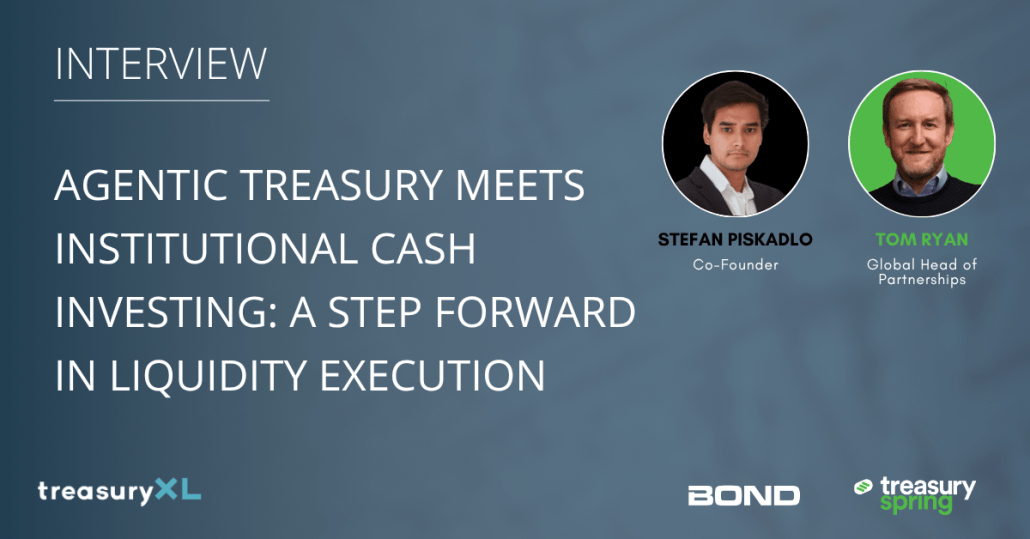
Bond describes itself as an agentic treasury platform. What treasury tasks can the agent handle today, and where does human approval stay required?
– Stefan Piskadlo –
Bond currently operates nine agents across the treasury workflow:
- Optimization Agent — Analyses cash positions, liquidity, and idle balances, recommends funding and allocation decisions, and executes payments to improve yield and efficiency.
- FX Agent — Monitors currency exposures in real time and executes spot, forward, and hedging transactions within predefined limits.
- Reconciliation Agent — Automatically matches transactions across banks, ERPs, and ledgers.
- Payments Agent — Executes payments across different rails with built-in fraud controls.
- Investment Agent — Manages investment subscriptions, deposits, and maturity ladders.
- Risk Agent — Continuously monitors counterparty, liquidity, and interest rate risk.
- Policy Enforcer — Checks every transaction against internal policies, sanctions screening, and regulatory requirements.
- Forecasting Agent — Produces rolling cash flow forecasts, scenario analysis, and variance alerts.
- Reporting Agent — Generates cash positions, compliance reporting, and board packs on demand or on schedule.
Human approval remains part of the execution layer. Transactions are queued for treasurer sign-off before going live, while FX and investment activities operate within mandates and limits defined by the treasury team.
Why did TreasurySpring make sense as a partner at this stage of Bond’s development, and what does it add that would be difficult to build internally?
– Stefan Piskadlo –
We are expanding our investment product depth with TreasurySpring.The partnership extends that into a broader range of institutional cash investment solutions within the same workflow.
TreasurySpring brings deep expertise and established infrastructure in that space, the kind that takes years to build well. Partnering with the best specialists in each segment is how we extend the investment universe without compromising on quality or speed to market.
What gap in treasury operations does this partnership target that existing visibility, payment, or investment tools still leave open?
– Stefan Piskadlo –
Most treasury teams already have visibility and investment access. What they’re missing is a simple, governed way to put surplus cash to work across a wider instrument set without stepping outside their core workflow. The gap is operational, a recommendation in one platform, execution in another, approval over email, and reconciliation done manually. That’s where governance breaks down and yield gets left on the table.
What AI changes is that Bond’s agents can continuously simulate trade scenarios forward, stress-test them against risk and governance limits, and surface the optimal action in real time, not as a periodic analysis a human has to run, but as an always-on process. The partnership means that when the agent identifies the right move, the execution is right there. The intelligence and the action are finally in the same place.
What changes for treasury teams when institutional cash investment access is embedded into an agentic workflow like Bond rather than used as a separate platform?
– Tom Ryan –
It brings the investment opportunity closer to the moment the decision is made. Treasurers are not short of data. The harder part is turning that data into a timely, well-controlled action. Bond’s agents are perpetually identifying surplus cash, and TreasurySpring provides access to suitable institutional cash investment options within the client’s policy parameters, whether it’s for a 2-day term or a year out.
That is powerful because it reduces the handoff. The treasurer still owns the decision, but the route from insight to action becomes much cleaner.
What led you to work with Bond now, and how does their agent model affect how your investment solutions are used?
– Tom Ryan –
Bond is building around how treasury actually works: live positions, competing priorities, approvals, policy limits and time pressure. That matters to us because investment access is most useful when it appears at the right point in the workflow.
TreasurySpring gives institutions a broader set of cash investment options from 120+ different A-rated and up counterparties across 8 currencies; Bond helps surface the moments where those options may be relevant.
For us, the partnership is about meeting treasurers where they already are, rather than asking them to step out of their workflow to act.
Where do treasury teams feel the most friction today around surplus cash: identifying positions, making decisions, or executing investments?
– Tom Ryan –
Execution is where the friction usually shows up. A team may know it has surplus cash and understand its policy, but still needs to confirm tenor, check limits, review counterparties, get approval, place the investment and record the result. That is a lot of process around what can be a time-sensitive decision.
The opportunity here is to make that process more connected and to take advantage of the sweet spots of both Bond and TreasurySpring, to spend less time moving information around and more time executing informed decisions.
What does this partnership change in how treasury teams move from decision to execution?
Stefan: It makes institutional cash investment a single governed action inside Bond. Alongside treasury managers, the agents can identify the opportunity, surface options with live pricing, the treasurer approves within Bond’s existing approvals workflow, the trade executes, and confirmation flows straight back into the ledger and corresponds with the wider system. Further to that, modelling how the position will land against risk limits, counterparty exposure, and liquidity requirements before and after it settles. No platform-switching, no manual reconciliation, and a complete audit trail throughout. For teams managing fragmented cash under increasing governance pressure, that’s a material change to how the day actually runs.
Tom: It brings two parts of the process closer together: the treasury decisions and the ability to act on them. In a lot of organisations, those two things are still separated by manual steps. Now, Bond delivers the ‘always on’ intelligence and workflows, and TreasurySpring provides the institutional product set to match the outcomes. It’s a powerful combination.

Tom Ryan
Global Head of Partnerships
TreasurySpring
“Execution is where the friction usually shows up. A team may know it has surplus cash and understand its policy, but still needs to confirm tenor, check limits, review counterparties, get approval, place the investment and record the result.“

Stefan Piskadlo
Co-Founder
Bond
“What AI changes is that Bond’s agents can continuously simulate trade scenarios forward, stress-test them against risk and governance limits, and surface the optimal action in real time.“


Can’t get enough? Check out these latest items
 https://treasuryxl.com/wp-content/uploads/2026/09/XLCompass-featured-2.png
200
200
treasuryXL
https://treasuryxl.com/wp-content/uploads/2018/07/treasuryXL-logo-300x56.png
treasuryXL2026-09-23 08:12:522026-09-24 16:16:11XLcompass: FX risk, hiring and automation: how treasury teams are handling it
https://treasuryxl.com/wp-content/uploads/2026/09/XLCompass-featured-2.png
200
200
treasuryXL
https://treasuryxl.com/wp-content/uploads/2018/07/treasuryXL-logo-300x56.png
treasuryXL2026-09-23 08:12:522026-09-24 16:16:11XLcompass: FX risk, hiring and automation: how treasury teams are handling it https://treasuryxl.com/wp-content/uploads/2026/09/Live-Session-TreasurySpring.png
200
200
treasuryXL
https://treasuryxl.com/wp-content/uploads/2018/07/treasuryXL-logo-300x56.png
treasuryXL2026-09-21 15:21:422026-09-29 15:04:16Live Session: Should Your AI Agent Be Allowed to Invest Your Cash?
https://treasuryxl.com/wp-content/uploads/2026/09/Live-Session-TreasurySpring.png
200
200
treasuryXL
https://treasuryxl.com/wp-content/uploads/2018/07/treasuryXL-logo-300x56.png
treasuryXL2026-09-21 15:21:422026-09-29 15:04:16Live Session: Should Your AI Agent Be Allowed to Invest Your Cash? https://treasuryxl.com/wp-content/uploads/2025/10/MEET-OUR-PARTNERS.png
200
200
treasuryXL
https://treasuryxl.com/wp-content/uploads/2018/07/treasuryXL-logo-300x56.png
treasuryXL2026-09-08 11:08:422026-09-09 13:01:10EuroFinance 2026: Key Connections to Make
https://treasuryxl.com/wp-content/uploads/2025/10/MEET-OUR-PARTNERS.png
200
200
treasuryXL
https://treasuryxl.com/wp-content/uploads/2018/07/treasuryXL-logo-300x56.png
treasuryXL2026-09-08 11:08:422026-09-09 13:01:10EuroFinance 2026: Key Connections to Make https://treasuryxl.com/wp-content/uploads/2026/07/XLconnect-with-payoff-4.png
200
200
treasuryXL
https://treasuryxl.com/wp-content/uploads/2018/07/treasuryXL-logo-300x56.png
treasuryXL2026-09-07 13:11:482026-09-07 13:13:08Recap & Recording: XLcompass – Treasury Automation That Works
https://treasuryxl.com/wp-content/uploads/2026/07/XLconnect-with-payoff-4.png
200
200
treasuryXL
https://treasuryxl.com/wp-content/uploads/2018/07/treasuryXL-logo-300x56.png
treasuryXL2026-09-07 13:11:482026-09-07 13:13:08Recap & Recording: XLcompass – Treasury Automation That Works https://treasuryxl.com/wp-content/uploads/2026/07/XLcompass-200.png
200
200
treasuryXL
https://treasuryxl.com/wp-content/uploads/2018/07/treasuryXL-logo-300x56.png
treasuryXL2026-08-13 08:12:272026-08-14 08:37:32Live Session: XLcompass – Treasury Automation That Works
https://treasuryxl.com/wp-content/uploads/2026/07/XLconnect-with-payoff-4.png
200
200
treasuryXL
https://treasuryxl.com/wp-content/uploads/2018/07/treasuryXL-logo-300x56.png
treasuryXL2026-07-14 07:00:342026-07-14 09:35:34Recap & Recording: XLcompass – FX & Treasury Risks Under Pressure
https://treasuryxl.com/wp-content/uploads/2026/07/XLcompass-200.png
200
200
treasuryXL
https://treasuryxl.com/wp-content/uploads/2018/07/treasuryXL-logo-300x56.png
treasuryXL2026-08-13 08:12:272026-08-14 08:37:32Live Session: XLcompass – Treasury Automation That Works
https://treasuryxl.com/wp-content/uploads/2026/07/XLconnect-with-payoff-4.png
200
200
treasuryXL
https://treasuryxl.com/wp-content/uploads/2018/07/treasuryXL-logo-300x56.png
treasuryXL2026-07-14 07:00:342026-07-14 09:35:34Recap & Recording: XLcompass – FX & Treasury Risks Under Pressure https://treasuryxl.com/wp-content/uploads/2026/03/Bond-Featured-1.png
200
200
treasuryXL
https://treasuryxl.com/wp-content/uploads/2018/07/treasuryXL-logo-300x56.png
treasuryXL2026-07-08 07:00:592026-07-08 10:46:12Bond X Adura: Powering the AI Transformation
https://treasuryxl.com/wp-content/uploads/2026/03/Bond-Featured-1.png
200
200
treasuryXL
https://treasuryxl.com/wp-content/uploads/2018/07/treasuryXL-logo-300x56.png
treasuryXL2026-07-08 07:00:592026-07-08 10:46:12Bond X Adura: Powering the AI Transformation https://treasuryxl.com/wp-content/uploads/2026/07/TreasurySpring-Template-3.png
200
200
treasuryXL
https://treasuryxl.com/wp-content/uploads/2018/07/treasuryXL-logo-300x56.png
treasuryXL2026-07-07 07:00:192026-07-06 13:35:49AI in Treasury Report 2026
https://treasuryxl.com/wp-content/uploads/2026/03/Bond-Featured-1.png
200
200
treasuryXL
https://treasuryxl.com/wp-content/uploads/2018/07/treasuryXL-logo-300x56.png
treasuryXL2026-06-04 07:00:142026-06-03 14:48:08Grain LNG Selects Bond to Support Treasury Operations
https://treasuryxl.com/wp-content/uploads/2026/07/TreasurySpring-Template-3.png
200
200
treasuryXL
https://treasuryxl.com/wp-content/uploads/2018/07/treasuryXL-logo-300x56.png
treasuryXL2026-07-07 07:00:192026-07-06 13:35:49AI in Treasury Report 2026
https://treasuryxl.com/wp-content/uploads/2026/03/Bond-Featured-1.png
200
200
treasuryXL
https://treasuryxl.com/wp-content/uploads/2018/07/treasuryXL-logo-300x56.png
treasuryXL2026-06-04 07:00:142026-06-03 14:48:08Grain LNG Selects Bond to Support Treasury Operations