
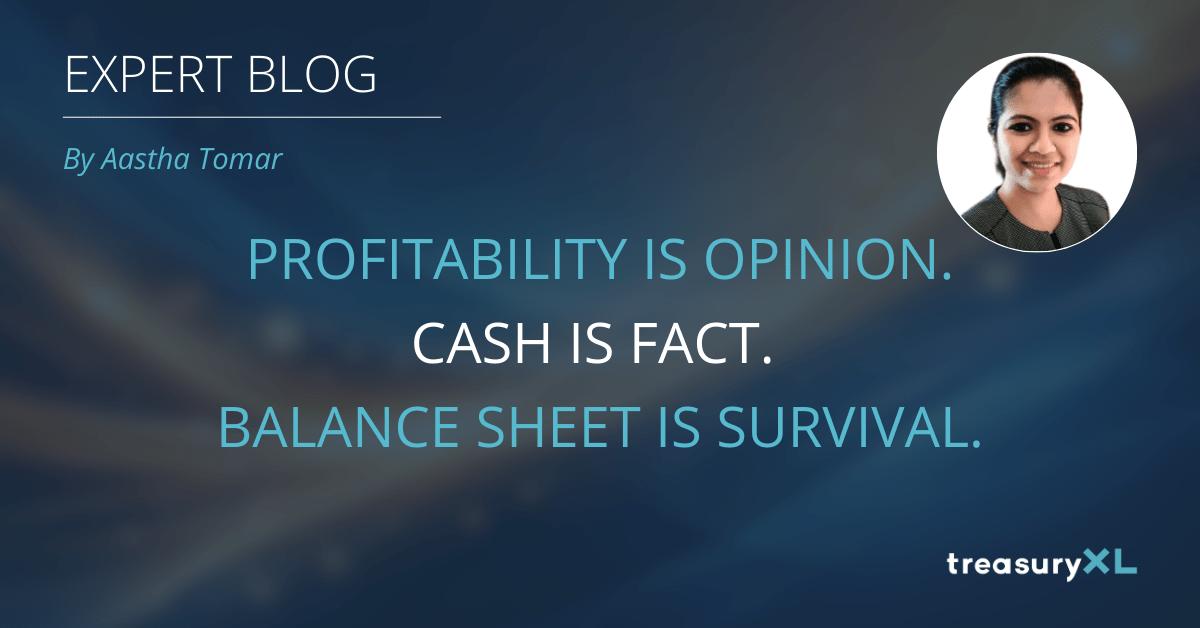
This idea has always stayed with me.
Profitability, liquidity, and growth matter to corporates, lenders, and investors alike. But in times of stress, survival does not depend on earnings narratives or short-term cash movements it depends on the strength of the balance sheet.
Having started my career in banking treasury and later moving into corporate treasury, I’ve had the opportunity to see risk from both sides. While banking and corporate balance sheets may look structurally different, the underlying vulnerabilities and the strategic responses required to manage them are often strikingly similar.
In today’s environment of economic uncertainty and geopolitical volatility, treasury’s role is no longer just performance driven. It is resilience driven. At its heart, treasury exists to ensure that institutions continue to operate even when markets behave in ways we did not anticipate.
What is Balance Sheet Risk, really?
Balance sheet risk arises when:
- Assets lose value
- Liabilities become more expensive or harder to refinance
- Equity buffers become insufficient to absorb shocks
This is different from operating or P&L risk such as declining revenues or margin compression. Those only become balance sheet risks when they begin to erode equity and push leverage to a point where solvency itself is questioned. Put simply, balance sheet risk answers one fundamental question :
Can the institution absorb losses, meet its obligations, and remain viable under both normal and stressed conditions ?
From a banking perspective, long-term resilience rests on four structural pillars:
- Liquidity & Funding Risk
- Capital Adequacy Risk
- Interest Rate Risk in the Banking Book (IRRBB)
- Structural FX Risk
Credit risk remains critical but, in this framework, it largely acts as a transmission mechanism into capital erosion rather than a standalone structural pillar. The relative importance of these risks’ shifts depending on the macroeconomic regime. Below image shows how with environment change priorities change for Treasury teams.

Why IRRBB Matters Today
In the current environment marked by rate volatility, uncertain deposit behavior, and repricing asymmetry IRRBB has moved beyond an earnings discussion. It is now a balance sheet discussion. IRRBB reflects the risk that movements in interest rates will adversely affect:
- Net Interest Income (NII)
- Economic Value of Equity (EVE)
It arises because institutions structurally lend long-term and fund short-term. When interest rates move sharply, assets and liabilities do not reprice at the same time. That mismatch creates exposure and that exposure is IRRBB.
The Three Forms of IRRBB
- Gap Risk → Timing mismatch in repricing
- Basis Risk → Different benchmarks repricing differently
- Option Risk → Customer behavior (prepayments, withdrawals) altering expected cash flows
These dynamics affect both:
- Earnings (via NII)
- Long-term economic value (via EVE)
For corporate treasuries, the parallels are clear:

IRRBB is therefore no longer just about earnings volatility. It is about capital resilience. A material EVE shock can:
- Alter leverage metrics
- Constrain lending or investment capacity
- Invite supervisory or stakeholder scrutiny
This shifts the strategic conversation for Boards and ALCOs from : “Are earnings protected?” to “Is our capital exposure to rates aligned with our risk appetite?”
Managing IRRBB: Structural Before Tactical
A well-managed IRRBB is built structurally before it is hedged tactically. The following are the structural Approaches which banks follow:
- Maturity alignment of assets and liabilities
- Product pricing that reduces behavioral volatility
- Stable funding mix
- Natural asset-liability matching
- Strong behavioral modelling
- Governance frameworks and limits
- Scenario-driven stress testing
These reshape the balance sheet itself.
Hedging is also a tool available for managing IRRBB, once the structural alignment is in place, derivatives become tools not solutions, following structures are the ones that can be used for hedging IRRBB.
- Interest Rate Swaps → Duration management
- Caps → Protection in rising rate environments
- Floors → Protection in falling rate cycles
- Swaptions → Optionality management
- FRAs / Futures → Short-term repricing control
Hedging supports resilience, but it does not replace it.
The Real Objective
IRRBB management is not about predicting rates correctly. It is about preparing the balance sheet so that when predictions prove wrong, the institution remains stable. Treasury does not control markets. It controls preparedness. Through structure, governance, behavioral insight, and selective hedging, treasury ensures that rate movements translate into manageable outcomes not existential stress.
Because balance sheet resilience is rarely built in moments of crisis. It is built quietly, through consistent decisions made long before one arrives. And perhaps that is what makes treasury meaningful. Much of its success remains invisible when done well. Profitability may reflect performance. Cash may reflect timing.
But survival always reflects balance sheet strength.

Can’t get enough? Check out these latest items
 https://treasuryxl.com/wp-content/uploads/2025/11/Aastha-blog.png
200
200
treasuryXL
https://treasuryxl.com/wp-content/uploads/2018/07/treasuryXL-logo-300x56.png
treasuryXL2026-03-02 07:00:522026-02-27 14:45:28Profitability is Opinion. Cash is Fact. Balance Sheet is Survival.
https://treasuryxl.com/wp-content/uploads/2025/11/Aastha-blog.png
200
200
treasuryXL
https://treasuryxl.com/wp-content/uploads/2018/07/treasuryXL-logo-300x56.png
treasuryXL2026-03-02 07:00:522026-02-27 14:45:28Profitability is Opinion. Cash is Fact. Balance Sheet is Survival. https://treasuryxl.com/wp-content/uploads/2023/02/aastha-blog-200x200-1.png
200
200
treasuryXL
https://treasuryxl.com/wp-content/uploads/2018/07/treasuryXL-logo-300x56.png
treasuryXL2026-02-23 07:00:152026-03-30 08:26:53What is Treasury in Banking?
https://treasuryxl.com/wp-content/uploads/2025/11/Aastha-blog.png
200
200
treasuryXL
https://treasuryxl.com/wp-content/uploads/2018/07/treasuryXL-logo-300x56.png
treasuryXL2026-02-16 07:00:142026-02-13 15:38:01MiCA turns crypto from a “use case” into a treasury risk decision.
https://treasuryxl.com/wp-content/uploads/2025/11/Aastha-blog.png
200
200
treasuryXL
https://treasuryxl.com/wp-content/uploads/2018/07/treasuryXL-logo-300x56.png
treasuryXL2026-01-28 07:00:072026-01-27 15:49:35GENIUS Act: A Treasurer’s Perspective on Stable coins
https://treasuryxl.com/wp-content/uploads/2025/11/Aastha-blog.png
200
200
treasuryXL
https://treasuryxl.com/wp-content/uploads/2018/07/treasuryXL-logo-300x56.png
treasuryXL2025-11-27 07:00:432025-11-26 09:39:58Africa’s Critical Minerals Boom and What It Means for Treasury
https://treasuryxl.com/wp-content/uploads/2025/11/Aastha-blog.png
200
200
treasuryXL
https://treasuryxl.com/wp-content/uploads/2018/07/treasuryXL-logo-300x56.png
treasuryXL2025-11-10 07:00:572025-11-07 16:53:27Africa’s AI Opportunity: A New Era for Treasury and Innovation
https://treasuryxl.com/wp-content/uploads/2023/02/aastha-blog-200x200-1.png
200
200
treasuryXL
https://treasuryxl.com/wp-content/uploads/2018/07/treasuryXL-logo-300x56.png
treasuryXL2026-02-23 07:00:152026-03-30 08:26:53What is Treasury in Banking?
https://treasuryxl.com/wp-content/uploads/2025/11/Aastha-blog.png
200
200
treasuryXL
https://treasuryxl.com/wp-content/uploads/2018/07/treasuryXL-logo-300x56.png
treasuryXL2026-02-16 07:00:142026-02-13 15:38:01MiCA turns crypto from a “use case” into a treasury risk decision.
https://treasuryxl.com/wp-content/uploads/2025/11/Aastha-blog.png
200
200
treasuryXL
https://treasuryxl.com/wp-content/uploads/2018/07/treasuryXL-logo-300x56.png
treasuryXL2026-01-28 07:00:072026-01-27 15:49:35GENIUS Act: A Treasurer’s Perspective on Stable coins
https://treasuryxl.com/wp-content/uploads/2025/11/Aastha-blog.png
200
200
treasuryXL
https://treasuryxl.com/wp-content/uploads/2018/07/treasuryXL-logo-300x56.png
treasuryXL2025-11-27 07:00:432025-11-26 09:39:58Africa’s Critical Minerals Boom and What It Means for Treasury
https://treasuryxl.com/wp-content/uploads/2025/11/Aastha-blog.png
200
200
treasuryXL
https://treasuryxl.com/wp-content/uploads/2018/07/treasuryXL-logo-300x56.png
treasuryXL2025-11-10 07:00:572025-11-07 16:53:27Africa’s AI Opportunity: A New Era for Treasury and Innovation https://treasuryxl.com/wp-content/uploads/2024/12/Treasury-Chests-Featured.png
200
200
treasuryXL
https://treasuryxl.com/wp-content/uploads/2018/07/treasuryXL-logo-300x56.png
treasuryXL2024-12-24 07:00:362025-07-14 09:07:49Opening Treasury Chests!
https://treasuryxl.com/wp-content/uploads/2024/12/Treasury-Chests-Featured.png
200
200
treasuryXL
https://treasuryxl.com/wp-content/uploads/2018/07/treasuryXL-logo-300x56.png
treasuryXL2024-12-24 07:00:362025-07-14 09:07:49Opening Treasury Chests! https://treasuryxl.com/wp-content/uploads/2024/01/Kopie-van-Poll-tXL.png
200
200
treasuryXL
https://treasuryxl.com/wp-content/uploads/2018/07/treasuryXL-logo-300x56.png
treasuryXL2024-01-11 07:00:482025-07-14 09:07:45The Top 5 Most Popular Articles of 2023 on treasuryXL!
https://treasuryxl.com/wp-content/uploads/2024/01/Kopie-van-Poll-tXL.png
200
200
treasuryXL
https://treasuryxl.com/wp-content/uploads/2018/07/treasuryXL-logo-300x56.png
treasuryXL2024-01-11 07:00:482025-07-14 09:07:45The Top 5 Most Popular Articles of 2023 on treasuryXL! https://treasuryxl.com/wp-content/uploads/2020/12/singapore-city-skyline-5k-kb-2048x1152-1.jpg
1152
2048
treasuryXL
https://treasuryxl.com/wp-content/uploads/2018/07/treasuryXL-logo-300x56.png
treasuryXL2020-12-31 07:00:282021-12-28 12:21:33Top 5 most read articles at treasuryXL.com and LinkedIn of 2020
https://treasuryxl.com/wp-content/uploads/2020/12/singapore-city-skyline-5k-kb-2048x1152-1.jpg
1152
2048
treasuryXL
https://treasuryxl.com/wp-content/uploads/2018/07/treasuryXL-logo-300x56.png
treasuryXL2020-12-31 07:00:282021-12-28 12:21:33Top 5 most read articles at treasuryXL.com and LinkedIn of 2020
