
In this interview, Juan Perez, Director of Trading at Monex USA, discusses FX forecasting, currency volatility and the market developments shaping treasury decisions in 2026.
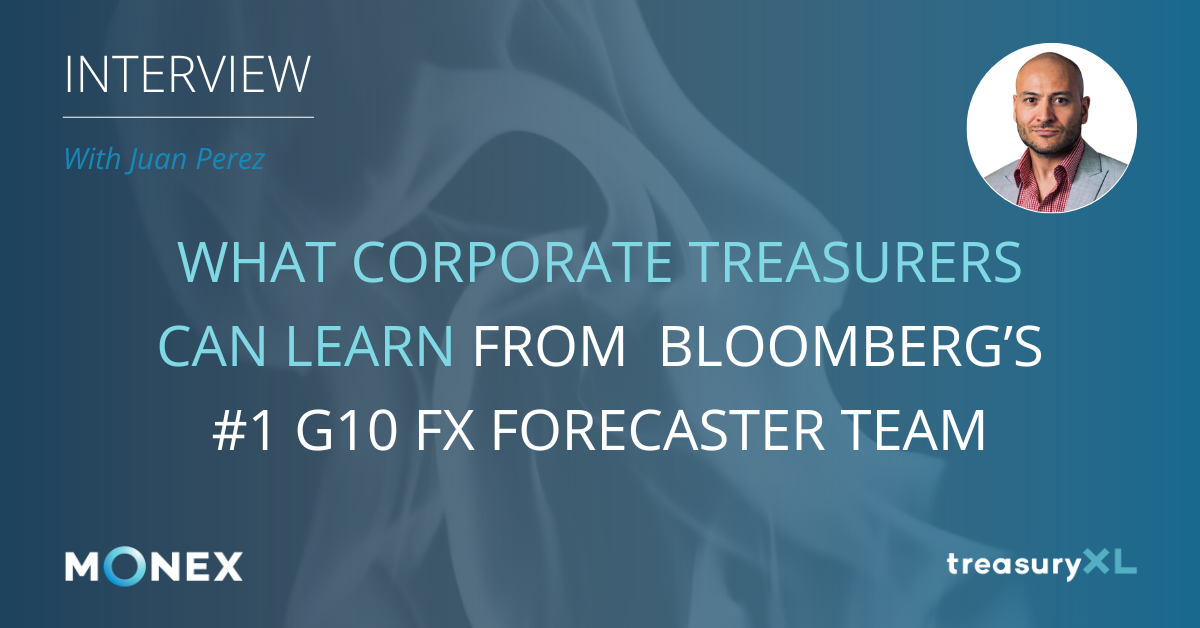
Monex has been recognized as Bloomberg’s #1 Overall G10 FX Forecaster for Q2 2026, ranking first based on forecast accuracy across major G10 currencies. In this exclusive treasuryXL interview, we look beyond the ranking and discuss how FX forecasts are developed, what current market movements mean for corporate treasurers, and how market analysis can support hedging decisions.
Congratulations on the Bloomberg recognition. What does achieving the #1 Overall ranking mean for Monex and your FX research team?
It certainly feels quite an honor to be recognized by the financial intelligence authority of the globe. At Monex, we love our clients, but more importantly, we want to be able to navigate through difficulty and turbulence.
2026 has delivered plenty of that, which has in turn affected how our clients feel when making a projection or adjusting their expectations, so the idea that we can be accurate and follow the narrative as best we can, assures clients they are in safe hands and that their accounts are being held at a highly respected FinTech firm. It is also humbling since no one has a crystal ball lining up the future, but it demonstrates our focus on evaluating market developments and potential FX implications. We also are not the biggest name in FX, but aiming to be, so it helps.
Bloomberg evaluates forecasts on margin of error, timing and directional accuracy. How does your team approach FX forecasting to perform consistently across these measures?
At the start of the year, all FX traders come up with a yearly forecast and an outlook forming a narrative of how things may play out. While we do look and compare to some technical takes on what may occur, we focus primarily on the fundamentals and are often driven by the dynamics of how GDP plays out in nations, advanced or emerging.
Our team’s approach certainly takes some mathematics into account, but our strong educational background is in the fundamentals and we are very much tied to the winds of DC/Global politics being so close to the White House. It is inescapable that we use a very international-affairs mentality while looking for counterintuitive measures globally that can predict losses for poor management. After all, FX is how we judge the administration of nations.
Currency markets have seen plenty of volatility this year. Which developments have had the biggest impact on your forecasts, and what has been the most difficult to anticipate?
The U.S. Dollar had a historic moment as the first six months of 2025 represented the weakest run for the Buck since rates have been tracked, 1973!!!
The White House has gone from domestic focus to global influence, trying to also dictate trade terms and using tariffs as a way to negotiate concessions. More importantly, the U.S. is actively engaging in armed conflict, which is causing tremendous chaos across the Middle East.
Meanwhile, the globe entered an energy crisis while the obsession with artificial intelligence continues in stock indices. LATAM assets, since we are HQ’d in Mexico, has grown in importance and significance, which has forced us to seek more liquidity providers as American manufacturing and services exercise “near-shoring” instead of “off-shoring.”
A change of the guard in the Federal Reserve has also made economists jittery since the new norm of communications differs greatly from a very talkative and transparent Jerome Powell to a more tight-lipped Kevin Warsh. The last week of July marked a moment in which markets seemed to lose faith in the Fed’s ability to rein in inflation.
From your conversations with corporate clients, what FX challenges are treasury teams dealing with most often at the moment?
Corporate treasuries have dealt with changing narratives throughout 2026 as there has been a trend of “escalation then de-escalation.” War does not make people feel comfortable, plus you add economic anxiety over the future of global trade if countries want to exercise nationalistic protectionist measures. It is a very challenging time to look into the future, I mean short-term 3 months as well as long-term such as 1-year.
We have experienced less hedging and more of a need to keep close eyes on updates in order to offer treasuries a reprieve. Treasurers have enjoyed repatriating funds as EM Fx has grown in value, rising by 2.0% per the MSCI Emerging-Markets Currency Index while some are limiting their exposure to MXN since it has remained expensive, up 2.3% this year.
How should treasury professionals use FX forecasts when making hedging decisions? Where do forecasts add the most value, and where should they be used with caution?
The most important tool is understanding what your stop/loss is, meaning at what level do you know mathematically you can handle the worst price at. If you know that there is indeed a level of losing money and we predict that it may arrive, setting up one-cancel-the-other orders is a good way to use the FX forecasts median and then decide what strike price you set, the ideal, and your limit so that the market will not negatively impact you.
There is also a narrative tied to the predictions so we encourage asking us why, the factor and details behind the currency pair, especially at a time in which FX currencies are moving idiosyncratically. It is also crucial to look at forecasts and determine that if there is a need for hedging, how do FWD points added or subtracted match the estimates. Back-rate comparisons and money-to-market analysis can also be used while looking at institutional thinking.
Monex publishes monthly FX forecast reports, which treasuryXL regularly shares with its community. What can readers expect from these publications, and how do you recommend corporate treasury teams use them throughout the year?
We have a plethora of analysis gauging G-10 movements and graphs, but we also have a monthly write-up that gives a 2-page take on what happened the month prior and what may materialize next. Yearly forecasts are 12-pages of wonderful long-term outlooks, but we have a 2-page monthly update that chews things down, makes it easily accessible to anyone just hoping to understand what is going on with USD dynamics and how it relates to the bigger picture.
The writing is from a business perspective, not as technical as others, which has also historically helped study groups in colleges such as George Mason University and the University of Virginia. We are FX experts, so we also tailor and customize analysis on a case-by-case basis. We also have a very keen eye on International Relations, which helps navigate opportunities that treasuries may not have considered.
Looking ahead, which currencies, themes or economic developments should corporate treasury professionals keep on their radar during the coming months?
It is important to recognize that we are living in a time when the U.S. Dollar’s dominance in the financial system is being questioned. Protectionism has entered the policymaking of not just the U.S., but many countries that are questioning expanding their supply-chains a bit too far from home. As a result, it is crucial to pay attention to LATAM FX since the idea is to align the hemisphere more to keep China’s influence and money away. Mining for fossil fuels as well as key rare metals for tech will be coming from below the equator as the U.S. hopes to achieve less interdependence with Chinese manufacturing, services, and resources. Naturally, this creates a world with much heightened FX volatility as Europeans also start looking more inward and relying less on American backing in all aspects.
For what remains of 2026, the Federal Reserve’s decision to tackle or not tackle inflation via higher interest rates is going to deeply influence the perspective of the Buck long-term, which is highly dependent on the global admiration and respect for the officials. If doubts grow that the current decision-making body is incapable of handling inflationary and financial challenges, the Buck could go back to a steep decline as experienced in the first 6 months of 2025.

Juan Perez, Director of Trading at Monex USA
Can’t get enough? Check out these latest items
 https://treasuryxl.com/wp-content/uploads/2026/02/Monex-BLOGS-featured-1.png
200
200
treasuryXL
https://treasuryxl.com/wp-content/uploads/2018/07/treasuryXL-logo-300x56.png
treasuryXL2026-10-07 07:00:472026-10-06 16:26:20October 2026 FX Forecasts
https://treasuryxl.com/wp-content/uploads/2026/02/Monex-BLOGS-featured-1.png
200
200
treasuryXL
https://treasuryxl.com/wp-content/uploads/2018/07/treasuryXL-logo-300x56.png
treasuryXL2026-09-10 07:00:062026-09-09 15:02:51September 2026 FX Forecasts
https://treasuryxl.com/wp-content/uploads/2026/02/Monex-BLOGS-featured-1.png
200
200
treasuryXL
https://treasuryxl.com/wp-content/uploads/2018/07/treasuryXL-logo-300x56.png
treasuryXL2026-10-07 07:00:472026-10-06 16:26:20October 2026 FX Forecasts
https://treasuryxl.com/wp-content/uploads/2026/02/Monex-BLOGS-featured-1.png
200
200
treasuryXL
https://treasuryxl.com/wp-content/uploads/2018/07/treasuryXL-logo-300x56.png
treasuryXL2026-09-10 07:00:062026-09-09 15:02:51September 2026 FX Forecasts https://treasuryxl.com/wp-content/uploads/2025/10/MEET-OUR-PARTNERS.png
200
200
treasuryXL
https://treasuryxl.com/wp-content/uploads/2018/07/treasuryXL-logo-300x56.png
treasuryXL2026-09-08 11:08:422026-09-09 13:01:10EuroFinance 2026: Key Connections to Make
https://treasuryxl.com/wp-content/uploads/2026/02/Monex-BLOGS-featured-1.png
200
200
treasuryXL
https://treasuryxl.com/wp-content/uploads/2018/07/treasuryXL-logo-300x56.png
treasuryXL2026-08-12 07:00:212026-08-11 16:22:22August 2026 FX Forecasts
https://treasuryxl.com/wp-content/uploads/2025/10/MEET-OUR-PARTNERS.png
200
200
treasuryXL
https://treasuryxl.com/wp-content/uploads/2018/07/treasuryXL-logo-300x56.png
treasuryXL2026-09-08 11:08:422026-09-09 13:01:10EuroFinance 2026: Key Connections to Make
https://treasuryxl.com/wp-content/uploads/2026/02/Monex-BLOGS-featured-1.png
200
200
treasuryXL
https://treasuryxl.com/wp-content/uploads/2018/07/treasuryXL-logo-300x56.png
treasuryXL2026-08-12 07:00:212026-08-11 16:22:22August 2026 FX Forecasts https://treasuryxl.com/wp-content/uploads/2026/07/Monex-BLOGS-featured-3.png
200
200
treasuryXL
https://treasuryxl.com/wp-content/uploads/2018/07/treasuryXL-logo-300x56.png
treasuryXL2026-07-30 07:00:132026-07-29 12:05:04Interview – Money 20/20 Europe Takeaways
https://treasuryxl.com/wp-content/uploads/2026/02/Monex-BLOGS-featured-1.png
200
200
treasuryXL
https://treasuryxl.com/wp-content/uploads/2018/07/treasuryXL-logo-300x56.png
treasuryXL2026-07-21 07:00:422026-07-21 08:39:07July 2026 FX Forecasts
https://treasuryxl.com/wp-content/uploads/2026/07/Monex-BLOGS-featured-3.png
200
200
treasuryXL
https://treasuryxl.com/wp-content/uploads/2018/07/treasuryXL-logo-300x56.png
treasuryXL2026-07-30 07:00:132026-07-29 12:05:04Interview – Money 20/20 Europe Takeaways
https://treasuryxl.com/wp-content/uploads/2026/02/Monex-BLOGS-featured-1.png
200
200
treasuryXL
https://treasuryxl.com/wp-content/uploads/2018/07/treasuryXL-logo-300x56.png
treasuryXL2026-07-21 07:00:422026-07-21 08:39:07July 2026 FX Forecasts https://treasuryxl.com/wp-content/uploads/2026/06/live-session-may-12-2026-1.png
200
200
treasuryXL
https://treasuryxl.com/wp-content/uploads/2018/07/treasuryXL-logo-300x56.png
treasuryXL2026-06-17 07:00:532026-06-17 16:52:56Recap & Recording: Smarter FX Risk Management for Today’s Treasury Teams
https://treasuryxl.com/wp-content/uploads/2026/02/Monex-BLOGS-featured-1.png
200
200
treasuryXL
https://treasuryxl.com/wp-content/uploads/2018/07/treasuryXL-logo-300x56.png
treasuryXL2026-06-09 07:00:292026-06-10 09:14:08June 2026 FX Forecasts
https://treasuryxl.com/wp-content/uploads/2026/02/Monex-BLOGS-featured-1.png
200
200
treasuryXL
https://treasuryxl.com/wp-content/uploads/2018/07/treasuryXL-logo-300x56.png
treasuryXL2026-05-08 12:03:032026-06-08 11:23:49May 2026 FX Forecasts
https://treasuryxl.com/wp-content/uploads/2026/06/live-session-may-12-2026-1.png
200
200
treasuryXL
https://treasuryxl.com/wp-content/uploads/2018/07/treasuryXL-logo-300x56.png
treasuryXL2026-06-17 07:00:532026-06-17 16:52:56Recap & Recording: Smarter FX Risk Management for Today’s Treasury Teams
https://treasuryxl.com/wp-content/uploads/2026/02/Monex-BLOGS-featured-1.png
200
200
treasuryXL
https://treasuryxl.com/wp-content/uploads/2018/07/treasuryXL-logo-300x56.png
treasuryXL2026-06-09 07:00:292026-06-10 09:14:08June 2026 FX Forecasts
https://treasuryxl.com/wp-content/uploads/2026/02/Monex-BLOGS-featured-1.png
200
200
treasuryXL
https://treasuryxl.com/wp-content/uploads/2018/07/treasuryXL-logo-300x56.png
treasuryXL2026-05-08 12:03:032026-06-08 11:23:49May 2026 FX Forecasts
