Tag Archive for: prospects Europe

Dit zeggen Nederlandse bedrijven over hun renterisico

| 02-08-2019 | ICC Consultants | treasuryXL |

Recent heeft ICC een rente-enquête uitgevoerd onder haar relaties. In deze enquête werd één prangende vraag gesteld: Waarom dekt u uw renterisico (nog) niet in?

Hieronder ziet u hoe deze vraag beantwoord is:
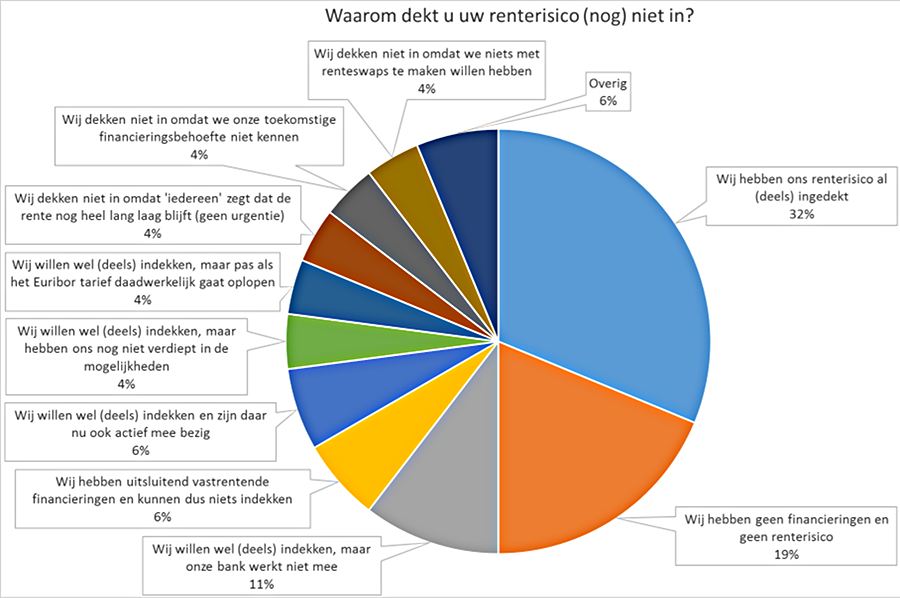
Circa de helft geeft aan op dit moment geen renterisico te hebben. Deze groep bestaat uit bedrijven die geen financiering hebben (19%) en organisaties die hun renterisico al (deels) ingedekt hebben (32%). ICC denkt overigens dat dit laatste percentage aanzienlijk hoger ligt dan het landelijk gemiddelde omdat het hier ICC relaties betreft. Meerdere bedrijven hebben de afgelopen periode gebruik gemaakt van de prachtige, historische lage, renteniveaus.

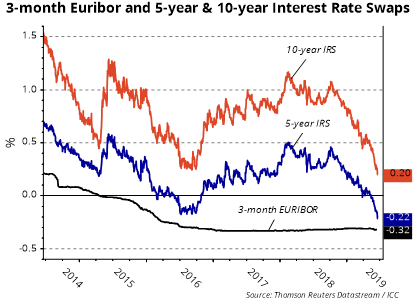
De overige 50% van de respondenten heeft wel een renterisico en de meningen binnen deze groep zijn zeer verdeeld. Voordat we hier verder op inzoomen willen we u er op wijzen dat de swaprentes recentelijk nog weer verder gedaald zijn. De 10-jaars swaprente staat nu op ca. 0,2%. Aangepast aan de modaliteiten (bijv. 3-maands Euribor en 3% aflossing per jaar) van uw onderliggende financiering zou de ‘kale’ swaprente zelfs rond de 0,1% uitkomen. Tel daar gemakshalve een kleine 0,2% bankmarge bij op en u kunt uw rentelasten voor de komende 10 jaar mogelijk fixeren onder de 0,3%.​

ICC geeft hieronder een paar kanttekeningen bij een aantal gegeven antwoorden:

‘Wij willen wel (deels) indekken, maar pas als het Euribor tarief daadwerkelijk gaat oplopen’

Het is een keuze, om te willen wachten en pas te acteren bij daadwerkelijk oplopende Euribor rentes. U krijgt echter, juist nù, de opportunity om zekerheid te verkrijgen van langdurige zeer lage rentekosten. Bovendien is de kans reëel dat de lange rentes (al) zijn opgelopen, wanneer u in de toekomst van een variabele rente naar een gefixeerde rente(last) wilt gaan.

‘Wij dekken niet in, omdat ‘iedereen’ zegt dat de rente nog heel lang laag blijft (geen urgentie)’

Dit zou goed kunnen, maar een aantal ontwikkelingen wijst op meer inflatie in de toekomst. De druk op overheden om meer uit te geven neemt toe en de arbeidsmarkt is krap waardoor de lonen stijgen. Ook neemt het protectionisme toe, wat kan leiden tot hogere importtarieven en minder concurrentie. Als er eenmaal sprake is van (een) hogere inflatie(verwachting), dan zal de ECB daar dankbaar gebruik van maken en de rente gaan verhogen. Hogere rentes betekent voor banken, dat het aantrekkelijker wordt om meer krediet te gaan verstrekken. Terwijl de ECB ‘monetaire munitie’ moet opbouwen – o.a. via renteverhogingen – om daarmee een volgende crisis te bestrijden.

Daarnaast bent u vermoedelijk geen rentespeculant. Als u als ondernemer voor continuïteit gaat, dan is het zo lang mogelijk zekerstellen van de laagst mogelijke operating costs misschien wel een beter beleid, dan het nastreven van de allerlaagste rentekosten op enig moment.

‘Wij willen wel (deels) indekken, maar onze bank werkt niet mee’

De redenen die wij hier voor horen zijn divers en verschillend per bank. Enerzijds heeft dit te maken met de cliëntkwalificatie en de verbonden Mifid-wetgeving, anderzijds met de (vereiste) aanwezige kennis binnen het bedrijf. ICC wordt dikwijls gevraagd om (vooraf) de (on)mogelijkheden hiervan te bekijken; met inbreng van onze kennis & ervaring weet u daadwerkelijk hoe ver u kunt komen en is er vaak meer mogelijk bij uw bank.

‘We dekken niet in omdat we niets meer met renteswaps te maken willen hebben’

Dit is een reden, die we vaak horen. Slechte ervaring vanuit het verleden en daarom doe ik het maar niet meer. Opgemerkt hierbij, dat de voor- en nadelen van renteswaps nu veel beter bekend zijn en u kunt zich hierover laten adviseren. Des te meer een opvallende reden, aangezien men in het verleden ‘massaal’ de rentes afdekte op een renteniveau van rond ca. 5%, terwijl de rentemarkt nu nagenoeg op 0% staat.

Sowieso is het risico op grote negatieve waardes op de huidige lage renteniveaus natuurlijk veel kleiner dan destijds in de periode 2006-2008. Daarnaast zijn er andere mogelijkheden om renterisico’s af te dekken, dan sec een renteswap. Hier liggen vaak interessante mogelijkheden, met meer flexibiliteit en hierdoor voor meerdere bedrijven een optimalere afdekking van het Euribor risico.

ICC RESEARCH

Ongetwijfeld leven er bij u meerdere overwegingen om uw renterisico’s (verder) wel/niet af te dekken. Het advies van ICC is om in ieder geval de renteontwikkelingen goed te volgen. U kunt dit doen door regelmatig de publicaties van ICC Research te lezen. Vraag hier uw gratis proefperiode aan.

Wilt u meer informatie over het afdekken van uw renterisico, neem dan contact op met ons via telefoonnummer: 030-2328200 of via email: [email protected].

Auke MiddelAuke Middel
Senior Consultant Market Risks | ICC Consultants

Historisch lage rente nu vastleggen in 5 stappen

| 25-6-2019 | ICC Consultants | treasuryXL |

Steeds meer bedrijven, investeerders en instellingen dekken hun renterisico’s (verder) in. De rentemarkten zijn hiervoor aantrekkelijk geprijsd. Gedurende de laatste twee kwartalen zijn de lange rentes zelfs nog iets verder gedaald en is de rentecurve verder vervlakt. Dit biedt mogelijkheden om ‘relatief goedkoop’ van een korte rente (lees Euribor-rente) naar een lange rente te gaan. Belangrijkste doel hierbij is het afgedekt zijn tegen stijgende rentelasten voor de onderneming.

Hoe realiseert u een optimale afdekking van uw renterisico’s? Voorstellen van uw huisbank(en) zijn vaak eenzijdig en moeilijk te beoordelen op de aangeboden pricing. Graag schetsen we hoe u in 5 heldere stappen veel tijd, geld en frustraties kunt besparen.

1    WELKE RENTERISICO’S LOOPT U?

Allereerst zult u voor uzelf een beeld moeten vormen welke renterisico’s u loopt. Wat is de actuele ‘hedgeratio’? Welk deel van de financieringsportefeuille is afgedekt en voor hoe lang (nog)? En wat is de impact van een procentpunt rentestijging op uw resultaat? Hoe zeker is de onderliggende kredietbehoefte en gaat deze toe- of afnemen? Hoe lang heeft uw financier een financieringscommitment gegeven? Hoeveel flexibiliteit wenst u, bijvoorbeeld voor (extra) toekomstige aflossingen?

2    GAAT U UW RENTERISICO AFDEKKEN, OF (NOG) NIET?

Afhankelijk van uw verwachting omtrent verschillende scenario’s voor marktrente ontwikkelingen (Inflatie? Gematigde inflatie? Deflatie? Etc.) dient u te bepalen of u een deel van uw renterisico wenst af te dekken, met welke instrumenten en voor hoe lang? Bedenk dat vooral de swaprentes ongemerkt hard kunnen oplopen. Tegen de tijd dat het Euribor gaat stijgen en uw rentelasten daadwerkelijk toenemen kunt u de huidige ultra lage swaprentes niet meer vastleggen. Deze zullen op dat moment een stuk hoger liggen dan nu.

3    WELK INSTRUMENT KIEST U EN WAT KOST HET?

De volgende stap is hoe dekt u af? Elke onderneming kent hierbij unieke uitgangspunten. De bank biedt echter vaak een ‘standaard’ renteoplossing aan, veelal een Interest Rate Swap (IRS) met een looptijd van 5 of 10 jaar. Het loont om ook naar andere looptijden, dan wel naar andere instrumenten te kijken en ICC kan desgewenst alle voor- en nadelen en kosten van alle instrumenten op een rij zetten. Ook berekenen we de optimale looptijd van de afdekking voor u en werken we meer flexibele mogelijkheden uit, waarbij de onderneming is afgeschermd tegen een stijgende rente, maar tevens (gedeeltelijk) kan meeprofiteren van dalende of gelijkblijvende rentes. U krijgt geen ‘standaard’ renteoplossing, maar een maatwerkoplossing passend bij ùw situatie.

4    HOE SLUIT U DE TRANSACTIE SCHERP AF BIJ DE BANK?

Deze stap is het lastigst om zelf uit te voeren voor een onderneming. De marge voor de bank zit versleuteld in het rentepercentage van de swap die u van de bank aangeboden krijgt en wordt niet nader gespecificeerd. De kale marktprijs van het instrument dat u gaat afsluiten is in een altijd bewegende rentemarkt alleen inzichtelijk met behulp van professionele en kostbare real-time pricing tools. Bankmarges van 20 basispunten en meer zijn geen uitzondering. Dat betekent dat als u een renteswap sluit voor 10 miljoen met een looptijd van 10 jaar u maar liefst 200.000 euro (niet contant gemaakt) marge betaalt aan de bank, welke zij direct als eenmalige inkomsten boekt.

ICC kan desgewenst het volledige traject voor u begeleiden. We kijken naar de (verplichte) documentatie, de inrichting van het transactieproces bij uw bank en doen een zogenaamde ‘dry-run’ (proefpricing). Vervolgens ondersteunen we real-time bij het daadwerkelijk afsluiten van de transactie. U krijgt inzicht in de ‘kale’ marktprijs en bankmarge. Waar nodig ondersteunt ICC in de uitonderhandeling van deze bankmarge naar marktconforme niveaus. Dit kan u al snel een rentevoordeel van tienduizenden euro’s opleveren.

5    HOE LEG IK HET PROCES EN UITVOERING VAST VOOR ALLE STAKEHOLDERS?

Afsluitend kan ICC een sluitende rapportage (een zgn. ‘Trade Recap’) van de afgesloten afdekking(en) verzorgen. Hierin wordt het gehele transactieproces uiteengezet, inclusief de onderliggende berekeningen, welke onderbouwd worden met ‘screenshots’ vanuit onze pricingsystemen. Deze ‘Trade Recap’ is voor intern gebruik en verslaglegging ten behoeve van o.a. de accountant, shareholders en overige stakeholders.

Als u over bovenstaande vijf stappen c.q. het afdekken van renterisico’s met uw bank(en) vragen heeft of vrijblijvend wilt sparren met een ervaren en onafhankelijke rentespecialist, neem dan contact met icc op via telefoonnummer 030-8201221 of mailen naar [email protected]).

Vraag hier het recente Global Financial Markets Rapport aan waarin ICC op frequente basis ook de meest waarschijnlijke rentescenario’s bespreken.

Auke MiddelAuke Middel
Senior Consultant Market Risks | ICC Consultants
 

A beleaguered Europe shoots itself in the foot

| 21-2-2019 | ICC Consultants | treasuryXL |

This blog analyzes the international political developments that can have an impact on the financial markets and the extent to which. The vision of ICC Consultants is based on a large network within the worldwide leading research houses and 40 years of experience in the financial markets. By means of the web link at the bottom of this blog you can download multiple reports from ICC Consultants.

Global central banks are starting to worry about economic growth, slowly but surely. The Fed made an about-turn recently. It announced it would put off further monetary tightening. The ECB was already treading cautiously. Now even hawks such as the Dutch member of the Governing Council of the ECB, Klaas Knot, are becoming jittery on signs of economic weakening both in the stronger euro countries and the struggling member states. Not just the western central banks are bracing themselves. Two months before India heads for the polls, its newly appointed central bank governor implemented a rate cut, much to the surprise of quite a few analysts. From Australia all the way to the Czech Republic and the Philippines, central bankers who wanted to tighten the reins not so long ago are increasingly speaking in dovish tones

Focusing on the prospects for Europe, we see plenty of economists and analysts who mainly attribute the disappointing economic data to once-off factors that are unique to the countries in question. They claim that German growth is mainly in heavy weather due to new emission regulations in the automotive industry. Likewise, the Yellow Vest protests in France are identified as a singular phenomenon that does not have a broader fundamental-economic effect on the country’s growth potential. The UK is fraught due to Brexit, Italy’s populist government seeks the confrontation with Brussels (and France), and a looming government crisis is what is undermining Spain. And so on.

Some analysts point at these factors and argue that such growth obstacles are specific to each country while there is little reason to expect a global, structural, and intensive growth slowdown. They think the recent pessimism of many market watchers is exaggerated. This is a dubious viewpoint from a political perspective. First, we are seeing plentiful and (potentially) substantial drags on growth, precisely in several of the world’s largest economies.

Second, quite a large number of growth impediments are symptomatic for wider developments that will not disappear from one day to the next. This does not automatically imply that a recession is nigh but owing to problems in individual major economies and various cross-border trends it is unlikely that growth will accelerate to any great extent.

To each state its own problems

As to the country-specific problems, we believe there is copious cause for concern:

> The German economy has cooled significantly. Most analyses point to the weaker German automotive industry, which faces new emission standards for greenhouse gasses as well as declining export opportunities. A leading industry for decades, it is especially reliant on diesel cars. The downside of progress is that while the German vehicle manufacturers (partially) set the tone for decades, they also became complacent and are now overtaken by manufacturers from elsewhere. More often than not, the Germans are focused on survival rather than on seeking out new opportunities. We have seen something similar in German politics. The German economy has mainly profited in the past years from reforms that were introduced in the 1990s. Angela Merkel has merely been holding the fort in that sense. Admittedly, she has done so in a very capable, quiet, and decisive manner but reforms and progress have been thin on the ground. A number of influential think tanks in Germany have been warning against this situation for years. Merkel is now in her twilight years as chancellor, while her successor is not exactly known for her revolutionary fervor. In addition, the SPD (the second-largest political party) has weakened and the German political centre has eroded in general terms – as has happened in many areas. Therefore, it does not seem likely that Berlin will become deeply enamored of reform any time soon. Meanwhile, the country’s population is set to age rapidly in the coming decades, which will bring a myriad of challenges.

> It cannot be denied that the Italian coalition government has a zeal for reform but it is often aiming for the wrong type of change. Many measures that were meant to render the economy more flexible and competitive have been reversed; most economists believe these policies will backfire. Having made a lot of headway between roughly 2011 and 2014 – if we take the Ease Of Doing Business Index as our benchmark, for example – Italy is once again sliding down the ranks. Rome is not just changing its economic course in a negative direction while in terms of diplomacy, its status is also blemished. Recent examples are its refusal (as the only EU country) to recognize the Venezuelan opposition leader Juan Guaido as interim president and the embarrassing tiff with France around Italy’s support for the Yellow Vests and its attempts to nix the construction of the railway link between Lyon and Turin. Government policies in Rome are an important reason why Italian economic growth is in the doldrums – the country is in a technical recession – as it buckles under the weight of debts and deficits. Consequently, it is again on a collision course with Brussels. On top of this, the coalition has already threatened to ‘clear out’ the Italian central bank. To sum, we cannot expect a lot of positive news from Italy in the short to medium term. A recent regional election gave off worrying signals; the rightwing populist parties with entrenched Eurosceptic sentiments made big gains.

> Further to the West, Spain has been frequently held up as an example of how to tackle a crisis and implement reform. Rightly so, to some degree. Jobless rates have dropped from 27% to less than 15% in recent years, the extremist parties did not gain a substantial foothold, and growth was robust in European terms. Yet, a political crisis is now looming as the left-wing Prime Minister Pedro Sanchez has lost the support of the Catalan parties. Fresh elections appear to be in the offing. The ruling coalition is already a hodgepodge of parties and the situation will probably not improve after the elections. Plus, the tensions between Catalonia and Madrid will undoubtedly mount once the conservatives take over the baton from Sanchez. The period of relative peace and quiet in Spain is over and we suspect this will have a negative impact on growth.

> As for France, factors including the Yellow Vests protest movement have knocked back the economy. Dissatisfied French citizens have been taking to the streets on a weekly basis for months. President Macron opted for an ill-advised hard line that has created a lot of resentment. On the other hand, the French are beginning to suffer from protest fatigue. The numbers taking to the streets are not as high as before while Macron’s popularity among voters is creeping up. Nevertheless, his reform agenda has been dented by setbacks so the president will have to scale down his ambitions whereas the French economy wasn’t doing that great before, in any case.

> The other major European economy is the only one (out of five) outside the Eurozone. Soon it may even leave the EU. Of course we are talking about the United Kingdom under PM Theresa May, who maintains that she will manoeuvre her country away from the EU on 29 March. We think this is not the most likely scenario. Neither is a new referendum or notification revoking Article 50 (meaning that the UK would remain an EU-member). The most logical outcome would seem an extension of the negotiations by a few months. Meanwhile, the UK is starting to feel the Brexit pain or rather, the adverse effects of the prevailing uncertainty. Businesses are postponing investment, growth is slowing, and consumer as well as producer confidence is waning. Faith in politics is also at a nadir: just 33% of the British thinks May is doing a good job and for opposition leader Jeremy Corbyn that percentage is even more depressing at 17%. The Tories are deeply divided and Labour is led by a left-wing populist who has shown several times that his knowledge of Brexit is deplorable. The gripping Brexit drama overshadows the entire British political landscape at the expense of other important issues. It is not a coincidence that Bank of England boss Carney did sound the alarm bell last week as he warned against the detrimental consequences of a no deal Brexit. Will the British people take any notice? Many are numbed by the ongoing spectacle. Increasingly, Brexit is tearing apart the fabric of the British economy whereas a real recovery is nowhere in sight.

The report was written by Andy Langenkamp , ​​political analyst at ICC Consultants. On the website of ICC Consultants you can download the full report.