Tag Archive for: euribor

Best read articles of all time – FX Swaps vs Libor and EURIBOR: Arbitrage opportunities?

| 10-05-2018 | Rob Söentken |

fxswaps

As we are getting closer to the end of the month, end of Q2 and end of H1 of 2016, it is interesting to see financial markets are maneuvering to get the right liquidity on board for the balance sheet. Or get rid of the unwanted liquidity. For firms with liquidity in various currencies the best means for liquidity management is FX swaps.

What is an FX swap?

In a very simple definition the FX swap is like an exchange of deposits. The big advantage is that the counterparty risk is reduced due to the exchange of notional. Operationally an FX swap is booked as two FX transactions: one to convert and another to revert. The conversion rate is against the prevailing exchange rate. The reversion rate is against the conversion rate plus or minus some ‘swap points’, which reflect the interest rate differential between the respective currencies. During the tenor the exchange rate could change, which creates counterparty risk on the mark-to-market value of the reversion. Mark-to-market risk for tenors up to 1 year is still a small when compared to full notional risk.

How would an FX swap work in theory?

In diagram 1 the Libor and Euribor fixings for USD and EUR are listed for the respective tenors. Now if we would consider exchanging a USD deposit versus a EUR deposit for 1 year the cash flows would be as follows:
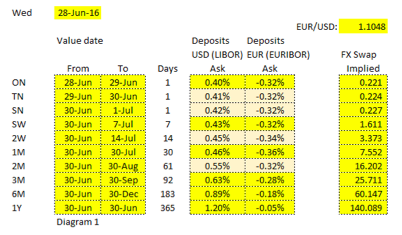
For the conversion date we take value spot (ie 2 days, in this case that is per June 30th) and we agree to exchange EUR 1 Mio vs USD 1.1048 Mio (because EUR 1 Mio at current spot of 1.1048 is USD 1.1048 Mio)

For the reversion date we take the value date for 1 year from today’s spot date. We calculate the following amounts including interest:

EUR 1 Mio x (1 + -0.05% x 365 / 360) =                     EUR 999,493.06

USD 1.1048 Mio x (1 + 1.20% x 365 / 360) =         USD 1,118,241.73

Dividing the USD amount by the EUR amount gives the exchange rate for the reversion on the forward date, in this case that is 1.1188089. This is called the ‘forward rate’ The difference to the spot exchange rate is 0.0140089. For simplicity reasons this is multiplied by 10,000 to 140.089. This reflects the interest differential.

When executing an FX swap the EUR amounts are kept constant for both the spot and forward dates. But the USD amounts are calculated using the spot and forward exchange rates as calculated above. Therefor the interest differential is reflected in the USD amount being different between spot and forward date.

How does it work in reality?

As I mentioned at the beginning of this article, the current situation is special because we are getting close to a date special and important for balance sheet reporting. Supply and demand may push the market in a direction.

When looking at the actual FX swap rates and taking the EUR Euribor fixings as given, we can deduce the implied USD funding rates (see diagram 2). First observation is that the FX swaps appear to reflect either a substantial demand for USD from June 30th to July 1st, or a EUR supply. It is interesting to see that the 1 week fixing for EUR was not affected, while the 1 week FX swap was affected maybe 20 bppa. One reason could be the timing of the rates. Euribor is taken at one moment during the day, while FX swaps are affected by events during the day. Because wdiagram2e are looking at a single day FX swap, the annualized rate could swing a lot.
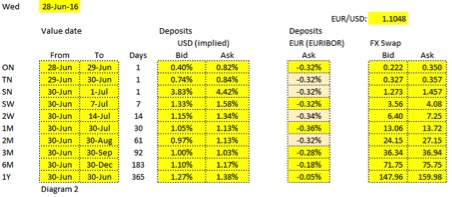
Another observation is that the interest rate differential between EUR and USD is actually bigger than implied by the fixings. For one month tenor the difference is 0.59% p.a.. It would seem possible that supply – demand forces can push FX swaps away from the deposit markets. Likely the counterparty limit constraints on pure deposits keep them from being arbitrages vs FX swaps, like they used to be many years ago.

How can a treasurer benefit from FX swaps?

Each individual and organization should determine for itself what he/she or it needs. And I do not want abstract from discussions around documentation requirements, collateral financing and administration, and the operational extra work. It seems obvious that there are opportunities to investigate.

One key area would be to look at the bid-offer spreads on cash liquidity in various currencies as provided by house-banks and compare those rates with and without using FX swaps. Also I could imagine non-house banks could be more competitive in providing FX swaps, while the counterparty risk is substantially smaller than when pure lending is concerned.

Rob Soentken

Rob Söentken

Ex-derivatives trader


How to fix a problem like “IBOR”

| 22-01-2018 | treasuryXL |

In the last year both the ECB in regard of EURIBOR and the FCA in London in regard of LIBOR have come to the same conclusion – the fixing of interest rate indices can not carry on in their present form. The current benchmarks are tainted by allegations of fraud and malpractice. Furthermore, the way that the rates are determined are also criticized – no actual transactions take place at the fixing price when the fix is made daily. But the big problem is that these fixings are intrinsically linked to financial contracts with values measured in 100 of trillions of EUR, USD, GBP etc.

The underlying financial products are not just derivatives – IBOR’s are also used to price floating rate loans, mortgages etc. The major problem beyond the fraud aspect is that the rates are supposed to express the interbank floating rates for various tenors. But with liquidity being very sparse in the interbank market, and the rates only being voluntary expert judgement of actual trading rates, do the rates truly reflect the cost of borrowing? ECB expects to replace EURIBOR by 2020 and the FCA to replace LIBOR by 2021. But what products can be used to replace IBOR?

Initially it appears that secured overnight rates could be the answer. Trades are reported to the relevant authorities and the transactions are based on secured lending. However, the tenor does not complement the existing fixings and financial products. A traditional EUR interest rate swap consists of an annual fixed coupon against floating 6-month coupons. Using an overnight fixing means that you would not know the 6-month floating rate until the end of the 6-month period.

To get around this problem a market could be used for existing basis spread products. As stated an overnight rate relates to secure, risk free transactions whereas IBOR relate to unsecure transactions. This means that with IBOR credit risk is built into the price. Certain additional products could be used to take an overnight rate fix to a 6-month fix – namely basis swaps. But who would supply the prices for basis swaps – the same banks who have been accused of fraud in the current IBOR process.

Another alternative is constructing the fixing from repo transaction with different tenors. But repo’s are sensitive to the credit risk of the collateral issuer. This means trading on the basis of Specials – clearly defined and named collateral issuers. With all the QE that is taking place there is an alarming shortage of high-quality government back paper that is in the free market that the very scarcity would lead to irregular pricing.

So whilst authorities have clearly stated that interest rate fixings can not carry on in their present form, they have yet to offer a valid alternative. In the meantime, contracts measured in 100 of trillions will need to be adjusted for the new method for fixings. The only people who will welcome these changes are the legal profession who get to redesign “all” the existing contracts.

Lionel PaveyLionel Pavey – Cash Management and Treasury Specialist
[button url=”https://www.treasuryxl.com/community/experts/lionel-pavey/” text=”View expert profile” size=”small” type=”primary” icon=”” external=”1″]

[separator type=”” size=”” icon=””]


Forward Rate Agreement (FRA)

| 05-01-2018| Arnoud Doornbos |

Money Market outlook

At the press conference on 14 December 2017, the ECB announced that expectations for economic growth and inflation have been adjusted upwards. But despite optimistic growth, the ECB is not yet fully convinced of a continued upward trend in domestic price pressures. And thus Draghi: “An ample degree of monetary stimulus … is necessary for underlying inflation pressures to continue to build up.”

For this reason, the ECB will maintain the buying program at least until September 2018. And only then will an increase in policy rates come into the picture. Since the beginning of 2017, investors have seen the chance that the ECB will implement an increase in policy interest rates. This has not yet had an effect on the three-month Euribor rate. This has been stable at around -0.3% for the whole of 2017, and we expect that this will be the case in the vast majority of 2018 as well.

But markets will go up again for sure during time and borrowers need to prepare themselves for that moment. A good interest rate risk management can help to extent the pleasure of using favorable low interest rates for your company. Hedging your short term interest rate exposure with FRA’s could be a good idea. Good timing is essential.


Definition

A Forward Rate Agreement’s (FRA’s) effective description is a cash for difference derivative contract, between two parties, benchmarked against an interest rate index. That index is commonly an interbank offered rate (-IBOR) of specific tenor in different currencies, for example LIBOR in USD, GBP, EURIBOR in EUR or STIBOR in SEK. A FRA between two counterparties requires a fixed rate, notional amount, chosen interest rate index tenor and date to be completely specified.

FRAs are not loans, and do not constitute agreements to loan any amount of money on an unsecured basis to another party at any pre-agreed rate. Their nature as a IRD product creates only the effect of leverage and the ability to speculate, or hedge, interest rate risk exposure.


How it works

Many banks and large corporations will use FRAs to hedge future interest or exchange rate exposure. The buyer hedges against the risk of rising interest rates, while the seller hedges against the risk of falling interest rates. Other parties that use Forward Rate Agreements are speculators purely looking to make bets on future directional changes in interest rates.

In other words, a forward rate agreement (FRA) is a tailor-made, over-the-counter financial futures contract on short-term deposits. A FRA transaction is a contract between two parties to exchange payments on a deposit, called the Notional amount, to be determined on the basis of a short-term interest rate, referred to as the Reference rate, over a predetermined time period at a future date.

At maturity, no funds exchange hands; rather, the difference between the contracted interest rate and the market rate is exchanged. The buyer of the contract is paid if the published reference rate is above the fixed, contracted rate, and the buyer pays to the seller if the published reference rate is below the fixed, contracted rate. A company that seeks to hedge against a possible increase in interest rates would purchase FRAs, whereas a company that seeks an interest hedge against a possible decline of the rates would sell FRAs.


Valuation and Pricing

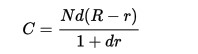
 The cash for difference value on a FRA, exchanged between the two parties, calculated from the perspective of having sold a FRA (which imitates receiving the fixed rate) is calculated as:

where N is the notional of the contract, R is the fixed rate, r is the published -IBOR fixing rate and d is the decimalized day count fraction over which the value start and end dates of the -IBOR rate extend.
For USD and EUR this follows an ACT/360 convention and GBP follows an ACT/365 convention. The cash amount is paid on the value start date applicable to the interest rate index (depending in which currency the FRA is traded, this is either immediately after or within two business days of the published -IBOR fixing rate).

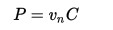
For mark-to-market (MTM) purposes the net present value (PV) of an FRA can be determined by discounting the expected cash difference, for a forecast value r:

where vn is the discount factor of the payment date upon which the cash for difference is physically settled, which, in modern pricing theory, will be dependent upon which discount curve to apply based on the credit support annex (CSA) of the derivative contract.


Quotation and Market-Making

 FRA Descriptive Notation and Interpretation


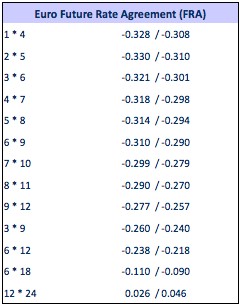
How to interpret a quote for FRA?

[EUR 3×6  -0.321 / -0.301%p.a ] – means deposit interest starting 3 months from now for 3 month is -0.321% and borrowing interest rate starting 3 months from now for 3 month is -0.301%. Entering a “payer FRA” means paying the fixed rate (-0.321% p.a.) and receiving a floating 3-month rate, while entering a “receiver FRA” means paying the same floating rate and receiving a fixed rate (-0.321% p.a.).

Due to the current negative Money Market rates means receiving actually paying and the other way around.


Arnoud Doornbos 

Interim Treasury & Finance


Eurozone economic prospect – Goldilocks meets the bears?

| 12-12-2017 | treasuryXL |

The markets and the ECB feel that the economy is doing very well. It can be compared to Goldilocks – not too hot and not too cold. Is it possible that the Eurozone could be entering a period of continued growth with little or no immediate prospect for rising inflation? A quick scan of the relevant markets would appear to suggest that it is possible. Let us examine where the markets are now.

Long term Interest rates

Long term interest rates have been in a downward channel since the summer of 2008. 10-year EUR interest rate swaps (an acceptable benchmark) peaked just above 5% in 2008 before falling and steadying around 2% towards the autumn of 2013. After a period of relative calm, the rates continued their descent to a bottom of 0.25% around 15 months ago. Over the last 3 years, 10-year EUR interest rate swaps have averaged a yield of just 0.75% – now the yield is 0.80%.

Short term interest rates

3-month Euribor turned negative in April 2015 and has remained negative. Over the last 3 years, the yield has averaged -/- 0.20% – now the yield is -/- 0.33%. 3-month Euribor futures imply that the rate will remain negative until March 2020 and, will rise to just 0.75% by September 2022.

Economic indicators

Unemployment falling to 9.6% in 2017; 9.1% in 2018
GDP growing by 1.6% in 2017; 1.8% in 2018
Government debt to GDP ratio falling to 90.4% in 2017, 89.2% in 2018
Average maturity for new government debt extending to 13 years in 2017; 9 years in 2007

So, what could happen to trigger a reversal in this sentiment?

Share prices are rising – AEX index is up almost 15% since the start of the year
House prices are rising – in the Netherlands prices have increased by 8% over the last year. Turnover is greater with 14% more homes sold than last year.
Global debt is rising – about EUR 190 trillion. This amounts to more than 300% of the world’s annual economic output. (source IIF report)
Interest coverage ratios (ICR) are deteriorating worldwide – in Europe specifically in Germany and France. (source IIF report) This, even though interest rates are low.
Balance sheet of central banks are dangerously expanded – result of Quantitative Easing.
Historical low interest rates – leading to underestimation of risks.
Political change – a rise in “populist” parties in many countries reflecting disenchanted voters

So, what about Goldilocks?

The dilemma for the ECB is that the Eurozone has, essentially, become 2 blocs – the North and the South. In the North, with increases in house prices and stock markets, and drops in unemployment; a rise in interest rates would not be deemed to be negative. However, in the South, the recovery is far behind and they welcome every form of stimulus to aid their economies.

And the moral of story – how your actions/inactions may affect others.

And remember who chased Goldilocks away – the bears (markets!)


If you want more information please feel free to contact us via email [email protected]

Verzekering maximale Euribor rente

| 30-09-2016 | Erna Erkens |

baselU kunt de zekerheid kopen dat u over uw variabele financiering nooit een hoger 1- maands Euribor tarief betaalt dan 0.25% (exclusief de opslag uiteraard). U blijft gewoon het 1 maands Euribor betalen zolang dit onder het 1 maands Euribor onder de 0.25% blijft.


Heeft u een financiering bij een bank met een variabele, bijvoorbeeld 1 maands Euribor rente?

Dan denk ik dat het een goed idee is om een renteplafond (Rentecap) te kopen op deze Euribor rente. Ik heb de afgelopen tijd een aantal artikelen gelezen en hoe meer ik er over nadenk, hoe sterker mijn overtuiging wordt dat de rente sneller zal stijgen dan de markt nu in prijst. Dit is te zien in de platte rentecurve.

Dit is een grafiek van korte naar de lange rente. We bevinden ons, volgens mij, in een ongezonde rente situatie. De rente is historisch laag en er gebeurt niet wat de ECB hoopte dat er zou gebeuren. Namelijk inflatie en economisch herstel (dit is er dan wel mondjesmaat maar met veel bijwerkingen).
De negatieve effecten wegen volgens steeds meer mensen niet meer op tegen de positieve effecten. Er komen steeds meer meningen en overtuigingen dat dit zo niet door kan gaan en het borrelt. Misschien nu nog diep onder de grond, maar noem het vrouwelijke intuïtie, dit gaat volgens mij sneller veranderen dan waar de markt nu rekening mee houdt. Leest u Joseph Stiglitz en Bas Jacobs er maar eens op na. Stel dat Donald Trump president wordt op 8 november. Dan gaat de rente echt snel stijgen want hij is niet vies van verhoging van de overheidsuitgaven. En dat kost geld!
De korte (Euribor rente) en de lange bijvoorbeeld 5 en 10 jaars rente zijn heel laag. Daarom is de premie op voor het kopen van een renteplafond op het Euribor (1 of 3 maands bijvoorbeeld) nu relatief heel laag (=goedkoop). Dus u kunt voor (relatief) weinig geld zekerheid kopen van bijvoorbeeld een Euribor tarief van 0.25%. Dat is een mooi tarief en over 2 jaar ziet de wereld van de rente er volgens mij echt heel anders uit.

Hoe werkt de variabele Euribor rente?

Heeft u een lening met een variabele Euribor-rente, dan kan uw rente veranderen. Want stijgt de Euribor, dan stijgt uw rente mee. En omgekeerd: als het Euribor daalt, daalt ook uw rente. Heeft u bijvoorbeeld een lening met een 1-, 3- of 6-maands variabele Euribor-rente? Dan betekent dit dat uw Euribor-rente één keer per maand, één keer per drie maanden of één keer per zes maanden kan wijzigen.

Wat is een rentecap?

‘Cap’ betekent ook wel ‘plafond’ of ‘top’. Bij een rentecap spreekt u met uw bank een Euribor-renteplafond af: de ‘caprente’. Stijgt het Euribor boven het afgesproken plafond? Dan bent u daartegen beschermd: u betaalt maximaal de caprente (plus uw opslag). Maar daalt het Euribor onder uw plafond? Dan profiteert u van het lage Euribor. U betaalt de lagere variabele Euribor-rente. Voor het afsluiten van een rentecap betaalt u een éénmalige premie aan de bank.

Hoe werkt de rentecap?

Wilt u een rentecap naast uw lening? Dan werkt het Euribor-plafond zo:
1. Voor uw lening betaalt u aan uw bank de variabele Euribor-rente en uw individuele opslag.
2. De bank bekijkt of u een bedrag terugkrijgt:
Is het Euribor hoger dan uw renteplafond? Dan ontvangt u het verschil terug.
Is het Euribor lager of gelijk aan uw renteplafond, dan ontvangt u niets. U betaalt per saldo: maximaal de caprente plus de individuele opslag. Daarnaast betaalt u éénmalig een premie aan uw bank.

Wat spreek je met elkaar af in een rentecap overeenkomst?

In de rentecap overeenkomst worden de onderstaande dingen afgesproken:
1. De hoogte van het plafond voor de variabele Euribor-rente (Caprente of Capstrike).
2. Hoe lang het Euribor-renteplafond geldt (begin- en einddatum). Anders gezegd de looptijd.
U kunt een rentecap afsluiten voor maximaal 10 jaar. Als u de rentecap wilt kopen op een variabele lening met een vaste looptijd mag de rentecap nooit langer lopen dan de looptijd van de lening.
3. Het bedrag waarvoor deze rentecap geldt. Anders gezegd, de hoofdsom.

U kunt een rentecap afsluiten voor het hele leenbedrag of voor een deel, bijvoorbeeld 50% van het leenbedrag. Er geldt een minimumbedrag van € 250.000,-. Sluit u een rentecap af voor een deel van het leenbedrag? Dan blijft u voor het overige deel risico lopen op stijging van de variabele Euribor-rente.

Wat kost een rentecap?

Als u een rentecap afsluit, betaalt u éénmalig een bedrag aan de bank: de premie. In de premie zit ook de vergoeding voor de bank verwerkt (marge). Daarnaast hoeft u geen andere kosten aan de bank te betalen. De hoogte van de premie hangt onder meer af van de caprente, het hoofdsomverloop en de looptijd van de rentecap. Daarbij geldt: hoe hoger het Euribor-renteplafond, hoe lager de premie. En: hoe langer de looptijd, hoe hoger de premie.

Wat gebeurt er met uw rentecap als u de lening vervroegd aflost?

Lost u de lening vervroegd af? Of stopt de lening om een andere reden eerder dan afgesproken? Dan heeft u de rentecap niet langer nodig. De bank heeft dan het recht om de rentecap stop te zetten. Overweegt u uw lening vervroegd terug te betalen, laat dit dan weten aan uw relatiemanager en uw treasury adviseur. Uw rentecap verandert namelijk niet automatisch mee. Uw treasury adviseur kan u informeren over de gevolgen voor uw rentecap.

Wat als de rentecap eerder stopt dan afgesproken?

Stopt de rentecap vóór de afgesproken einddatum? Dan verrekent de bank op dat moment de ‘marktwaarde’ van de rentecap met u:
Heeft de rentecap marktwaarde? Dit is het geval als de Cap rente lager is dan de actuele Euribor rente. U ontvangt dan een bedrag van de bank. Heeft de rentecap geen marktwaarde. Dit is het geval als de Caprente hoger is dan de actuele Euribor rente. U ontvangt dan niets.

De marktwaarde van de rentecap is afhankelijk van de resterende looptijd, de hoofdsom, de actuele en verwachte Euribor-rente en de beweeglijkheid van de markt. Goed om te weten: de marktwaarde van de rentecap is nooit minder dan nul Euro. U betaalt dus nooit een bedrag aan de bank bij eerder stopzetten van de cap.

De premie in termijnen betalen

Wilt u een rentecap afsluiten, maar de premie niet in één keer vooraf betalen? Dan kunt u kiezen voor gespreide premiebetaling. U betaalt de premie dan in termijnen, bijvoorbeeld per maand, of per kwartaal. Belangrijk om te weten: Bij gespreide premiebetaling is de premie hoger.
Eindigt de rentecap voortijdig, bijvoorbeeld omdat u de lening vervroegd heeft afgelost? Dan moet u de resterende premie nog wel betalen.

Voorbeeld:
Stel u heeft een lening of werkkapitaal financiering van EUR 1.000.000.
U betaalt nu als basis het 1 maands euribor van -0.35% (waarschijnlijk heeft u een bodem van 0%, jammer en vreemd genoeg). U heeft een kredietopslag van 2.00%
U betaalt per saldo 2.00% over 1 maand bij een minimum van 0%. Dit is over EUR 1 mio = EUR 1.722.22 aan rente per maand.
U betaalt per saldo 1.65% als u geen minimum heeft van 0% = EUR 1.420.83 aan rente per maand
Stel u koopt een Cap (=renteplafond) op 0.25% voor 5 jaar startend 01-01-2017 t/m 01-01-2022
Daar betaalt u voor vooraf EUR 10.500,–
Dat is EUR 2.100,= per jaar.

Het maximale rentetarief wat u betaalt op uw rekening-courant = 0.25% + 2.00% opslag = 2.25% en daar betaald u EUR 2.100 per jaar voor (= 0.21%). Dat is EUR 175.00 per maand. Dat lijkt me in deze onzekere tijden een prachtige verzekering van uw rentekosten. Dan betaalt u dus maximaal 2.46% per maand (0.25% rente plafond +2.00% kredietopslag + 0.21% premie van de cap = 2.46%). U betaalt nu 2.00% per maand.
Dus u bespaart rente als het 1 maands Euribor boven de 0.46% uitkomt.

Als het Euribor 5 jaar lang onder de 0.25% blijft, heeft u EUR 2.100 per jaar weggegooit. Dat is waar. Maar als het Euribor in die 5 jaar stijgt naar bijvoorbeeld 1.00% dan betaald u per maand zonder Rentecap EUR 2.583.33
En met Rentecap EUR 2.118.33 (hierin zit de premie meegerekend). Verschil = EUR 465 per maand  (= EUR 5.579.96 per jaar).

Koopt u een rentecap op 0% voor 5 jaar. Dit is vaak ook de rente die u nu betaalt dan kost dit u EUR 12.800. Dit is EUR 2.560 per jaar = EUR 213.33 per maand (= 0.25%) voor de zekerheid op een maximaal Euribor van 0%

Ik vind het een goed idee. Als u het ook een goed idee vindt neem dan contact op met mij op of met uw bank. Als u ondersteuning zoekt, dan ben ik er voor u.


Erna Erkens


Erna Erkens

Owner at Erna Erkens Valuta Advies (EEVA)