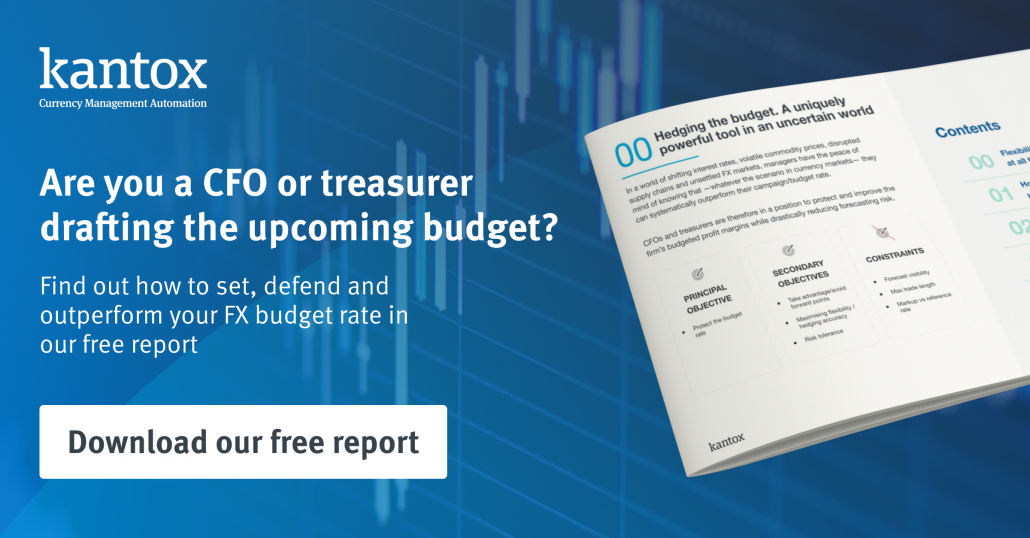
Are you a CFO or Treasurer drafting your upcoming budget? Find out how to set, defend and outperform your budget rate in Kantox’s exclusive new report.
Based on real industry insights, you can learn:
🔹 The best way to set a budget rate
🔹 How to delay hedge execution while reducing forecast risk
🔹 How to improve your budgeted profit margins
🔹 Top solutions to automate time-consuming processes
Season 3 of Kantox’s #CurrencyCast is live! In the first episode, they examine companies that manage their FX risk via spreadsheets and how they may be exposing their business to a whole other type of danger, spreadsheet risk.
Agustin Mackinlay breaks down the dangers and pitfalls of spreadsheet risk and how it can slowly erode your FX risk management processes.
He walks us through:
🔹 What is spreadsheet risk?
🔹 How to recognise this type of risk
🔹 Where it can arise in the currency management process
https://treasuryxl.com/wp-content/uploads/2022/09/currencycast-200.png200200treasuryXLhttps://treasuryxl.com/wp-content/uploads/2018/07/treasuryXL-logo-300x56.pngtreasuryXL2022-09-27 09:00:462023-03-03 12:09:49CurrencyCast Season 3 is live!
Have you seen Kantox’s Currency Management Toolkit?
With rising interest rates, increasing inflation and today’s highly volatile environment, it’s more important than ever for your company to be protected against currency risk.
Take Kantox’s 1-minute assessment and discover the best FX hedging program for your business. You’ll find out which program can most effectively handle your FX needs, help you achieve your goals, and keep you ahead of the curve.
https://treasuryxl.com/wp-content/uploads/2022/09/kantox-maandag-200.png200200treasuryXLhttps://treasuryxl.com/wp-content/uploads/2018/07/treasuryXL-logo-300x56.pngtreasuryXL2022-09-26 07:00:392022-10-14 12:53:47What’s the best hedging program for your business? Take Kantox’s 1-minute assessment
How should a CFO set their currency hedging strategy, to protect cash flows or to minimise P&L impact? In the fourth edition of CFO Perspectives, we’ll explore how senior finance professionals can choose the right path when it comes to hedging.
According to a recent HSBC report, the objectives of currency hedging are pretty extensive. While three-quarters of surveyed participants mention forecasted cash flows as an FX risk that their company hedges, 61% cite balance sheet items as the risk they hedge. Other participants say minimising the impact on consolidated earnings is one of their FX hedging objectives and KPIs.
The debate about whether to hedge cash flows or earnings —by removing the impact of accounting FX gains and losses— is as old as currency hedging itself. The two sides have powerful arguments in their favour.
The debate will likely never be settled entirely. No single approach for currency risk management is definitively better than another. Different opinions may reflect the type of business activity, the preferences of investors and even managers’ own biases.
The key step for any CFO looking to establish or revamp their business’s currency hedging program is to clarify what the firm is trying to achieve. Only with enough clarity on this matter can the dangers of ad hoc or unsystematic hedging be avoided.
So, where does that leave us? This blog brings some welcome news to beleaguered CFOs as they take sides. While nothing replaces clarity regarding the key objectives of currency management, technology now makes it possible for risk managers to:
Use a single set of software solutions to run cash flow and balance sheet FX hedging programs
Automate the time-consuming and resource-intensive process of implementing Hedge Accounting
This is big news indeed!
Practical steps on the journey to the FX hedging decision
While a certain amount of debate and discussion is unavoidable when deciding the goals of a firm’s FX hedging program, a number of practical steps can be followed to determine what should be hedged.
These steps share a central concern about protecting and enhancing the firm’s operating profit margins by giving particular importance to the pricing characteristics of each business division.
These steps include:
Steer clear of ad hoc or unsystematic hedging. This is a path to nowhere and should always be avoided.
Set the goals of your FX strategy, such as defending a campaign or budget rate, achieving a smooth hedged rate over time, hedging transaction exposure, or removing the impact of accounting FX gains and losses.
Based on these goals, define the best hedging program while imagining that infinite resources can be deployed. By doing so, CFOs can squarely focus on their FX goals.
Consider using Currency Management Automation to seamlessly execute all the steps of your program, breaking internal silos and ensuring connectivity with your own company systems (ERP, TMS).
Only then ‘prune’ the strategy and adjust it to the available resources, while measuring the impact —in terms of risk, costs and growth— of this adjustment.
Use technology to automate the process of compiling the required documentation for Hedge Accounting.
In other words: to set a currency hedging strategy you need to do away with outdated constraints. Technology is putting to rest the traditional view of currency management as a resource-intensive activity. So the message is: give priority to your FX goals, not to the resources currently at hand.
https://treasuryxl.com/wp-content/uploads/2022/08/kantox-cfo-4-200.png200200treasuryXLhttps://treasuryxl.com/wp-content/uploads/2018/07/treasuryXL-logo-300x56.pngtreasuryXL2022-08-30 07:00:362023-03-03 12:10:02CFO Perspectives: How to set a currency hedging strategy
In the third edition of CFO Perspectives, we’ll draw from our work with CFOs to explore five ways senior finance executives can increase the efficiency of treasury operations using purpose-built software solutions.
According to a recent HSBC report, as many as 81% of CFOs view the digitisation of treasury processes as an area of increasing importance. The same survey shows that technology has moved from ‘nice to have’ to a key differentiator for treasury.
The good news is that ‘special purpose’ technology exists that —working alongside your existing systems (TMS, ERP)— allows CFO’s and finance teams to dramatically boost the efficiency of treasury operations.
In this blog, we briefly present five areas of improvement across the FX workflow. Taken together, they present a unique opportunity for CFOs to turn the ‘digital treasury’ into a day-to-day reality, allowing members of the finance team to remove operational risks while devoting more time to value-adding tasks.
Improvements across the FX workflow
Currency management is a process undertaken in three different phases. In the pre-trade phase, FX-related pricing is managed alongside the crucially important collection and processing of the firm’s exposure. The trade phase, quite naturally, is concerned with trade execution, primarily through forward FX contracts. Finally, the post-trade phase covers accounting, reporting and analytics processes and the ‘cash flow moment’ of payments and collections.
In all of these phases, easy-to-install software solutions provide tangible improvements in terms of the efficiency of treasury operations.
These improvements include:
Improvement 1: Set a strong ‘FX rate feeder’
Pain point: Commercial teams often lack the capability to use the currency rates they need to price in a data-driven and efficient way. With favourable forward points, they could use the forward FX rate to price more competitively without hurting budgeted profit margins. With unfavourable forward points, pricing with the forward rate would allow them to remove excessive markups.
Improvement:Whatever the number of transactions involved, automated solutions to price with the required FX rate can be quickly scaled to all the required currencies, with the pricing markups per client segment and currency pair requested by commercial teams.
Improvement 2: Process all types of exposure
Pain point: When it comes to collecting the firm’s exposure to currency risk, most Treasury Management Systems (TMS) are designed with accounts receivables/payables in mind. While this works fine for balance sheet hedging, the focus on accounting items precludes the automation of cash flow hedging based on the exposure collected earlier — firm commitments and forecasts for budget periods.
Improvement:API-based solutions allow finance teams to automate the crucially important process of capturing the relevant type of exposure information and run a variety of cash flow hedging programs, including combinations of programs that require more than one type of exposure data.
Improvement 3: Connect the phases of the FX workflow
Pain point: The trade phase of the FX workflow is where most of the attention of CFOs has been placed, as Multi-Dealer Trading platforms such as 360T have reduced the cost of FX trading for corporations. But while the execution of trades is oftentimes manually initiated, most systems lack the capability to fully automate the process of triggering trades.
Improvement: What special-purpose software brings is the capability not only to automate the trade part of the workflow —via connectivity with Multi-Dealer platforms—but also to link it to the pre-trade phase as well by ensuring that trades are executed at the right moment in time.
Improvement 4: Automate Hedge Accounting
Pain point:Compiling the documentation required to perform Hedge Accounting can be a costly and time-consuming process, as hedge effectiveness is assessed in by comparing changes in the fair value of the hedged item to changes in the fair value of the corresponding derivative instrument. This forces companies to rely on highly skilled personnel to manually execute these tasks.
Improvement: The perfect end-to-end traceabilityof automated solutions makes it possible accounting team to automate the painstaking process of compiling all the required documentation to perform Hedge Accounting – allowing CFOs to cost-effectively provide more informative financial statements.
Improvement 5: Automate swap execution
Pain point:The process of adjusting the firm’s hedging position to the cash settlement of the underlying commercial exposure is one of the finance team’s most resource-intensive and error-prone tasks. It can require an enormous amount of ‘swapping’, particularly for companies that manage many commercial transactions in different currencies.
Improvement: Swap automation, a task that most TMS are unable to perform, is a key feature of Currency Management Automation software. Perfect traceability allows members of the finance team to automatically ‘draw on’ or ‘roll over’ existing forward positions while removing operational risks.
https://treasuryxl.com/wp-content/uploads/2022/08/kantox-200-16e.png200200treasuryXLhttps://treasuryxl.com/wp-content/uploads/2018/07/treasuryXL-logo-300x56.pngtreasuryXL2022-08-16 07:00:542023-03-03 12:10:44CFO Perspectives: 5 ways CFOs can increase the efficiency of treasury operations
When managing FX risk, CFOs could learn a lot from the world of asset management, where a revolution —led by indexing— has led to huge gains for investors. But how can you apply this to your business’s FX risk strategy? Watch below the video, or read the article!
In the second edition of CFO Perspectives, we’ll draw from our work with CFOs to explore the parallels between asset management and FX risk. We’ll break down the processes and tools used in asset management which can be applied to your currency management strategy, with some spectacular results.
Over the last couple of decades, the world of asset management —an industry with $100 trillion under management— has been turned upside down by a quite unexpected revolution: indexing. Instead of relying on managers’ capacity to time the markets, these firms have automated the selection of assets by quietly replicating stock indexes.
Can CFOs lead a comparable revolution in currency management?
The answer is: yes, they can! Let us see why and how they can accomplish that feat.
Having embraced indexing early on, two leading firms have assets under management north of $15 trillion. What’s more, they have achieved such a spectacular result with fees that are only a fraction of the fees charged by those who embrace speculation. They have saved, and they are still saving, hundreds of billions in costs to investors.
Similar changes may be afoot in the business world. The term ‘exposure under management’, now used by CFOs and treasurers, comes from the expression ‘assets under management’. More importantly, CFOs are eschewing speculation — just like their cousins in asset management.
When managing currency risk in the one-trillion-a-day forward currency market, CFOs are using more and more digitised, automated solutions.
A random walk for risk managers
Once in a while, a lack of currency hedging or even speculating on an FX market move can yield a positive outcome for CFOs. But luck will run out at some point. Sooner or later, blindfolded by overconfidence, ‘speculative’ risk managers flounder in their vain attempt to time currency markets — with disastrous consequences for themselves and their companies.
Like stock prices and the price of other financial assets, exchange rates are not predictable. They follow ‘a random walk’ in which the forecast is set equal to today’s exchange rate (the spot rate). Accordingly, investors —and risk managers— should embrace markets rather than trying to beat them.
This is the thrust of the analogy between the asset management revolution and the coming revolution in FX risk management, an event that will ultimately enhance the strategic role of CFOs.
5 asset management tactics CFOs should borrow when managing FX risk
Let us go beyond the surface and take a closer look at the key tools and processes used by the most successful companies in asset management. These processes provide a useful template for understanding how CFOs will use Currency Management Automation solutions to manage FX.
We can single out at least five main lines of action:
Avoid timing the market. Nine out of ten of the so-called geniuses of the investment world have been ‘destroyed’, in terms of comparative performance, by the more modest index funds. Adding insult to injury, the latter have charged only a fraction of the fees. The no-speculation mantra has proved immensely successful in asset management. If one accepts the view that currency markets also follow a ‘random walk’, then there is no reason to expect a different outcome when it comes to FX risk management.
Achieve operational brilliance. Indexed asset managers know that their success relies on engineering products that achieve operational brilliance by taking the risk of human error out of the equation. Just as indexing is measured by the tracking error between a fund’s rate of return and that of its benchmark, Currency Management Automation is at its core an engineering product that uses Application Programming Interfaces to achieve great precision in currency hedging while allowing managers to seamlessly run the entire FX workflow.
Implement scalable solutions. Successful asset managers use platforms that provide scalability, which makes it possible to quickly and cheaply enter new markets such as bonds, commodities and others, almost anywhere and in many currencies. The same idea applies to FX automation, as CFOs are set to implement scalable, data-driven pricing and hedging solutions to enter new markets, enabling their companies to buy and sell in more currencies — with FX risk systematically under control.
Innovate with a purpose. Indexing is one of the few truly beneficial inventions, a technology that has saved investors hundreds of billions of dollars. Similarly, the purpose of automated FX risk management is to allow firms to confidently ’embrace currencies’, reducing costs to customers and ultimately enhancing the value of the business. When it comes to innovation, purpose matters (see: “CFO Perspectives: 3 ways CFOs can use currencies to boost their business’ value”).
Keep a foot in more than one camp. The world’s largest asset manager keeps a foot in both camps: active asset management and index funds. An entire platform provides a menu from which clients can select whatever financial slice they might fancy. Likewise, CFOs have at their disposal an entire ‘family’ of automated hedging programs and combinations of programs, including balance sheet hedging and a variety of cash-flow hedging programs that respond to their firms’ goals and pricing parameters.
https://treasuryxl.com/wp-content/uploads/2022/07/kantox-1-aug-200.png200200treasuryXLhttps://treasuryxl.com/wp-content/uploads/2018/07/treasuryXL-logo-300x56.pngtreasuryXL2022-08-01 07:00:382023-03-07 15:52:38CFO Perspectives: 5 asset management tactics CFOs should borrow when managing FX risk
As a CFO, you are aware of the benefits of FX hedging for treasury. However, are you also aware of the macro-level advantages for your company and its value?
A new CurrencyCast series has just been introduced by Kantox. They examine five ways that efficient currency management may benefit your entire business in the first episode of their CFO Edition miniseries, including how to incorporate it into your strategy and how to decrease cash flow fluctuation. Watch below the video or read the corresponding blog.
In the first edition of CFO Perspectives, we’ll draw from our work with CFOs to explore three ways senior finance executives can make currency management a winning growth and cost-saving strategy for their business.
Looking at the concerns expressed by CFOs in most risk management surveys, a number of familiar themes seem to reoccur: the importance of cash flow forecasting and monitoring, the centrality of FX risk management and the ongoing digitisation of treasury processes
Yet, this picture is far from complete.
Ultimately, among the tasks assigned to CFOs, there is the need to make a contribution toward enhancing the value of the business. But what is the role —if any— played by currency management in that regard? Answering this question allows us to single out three strategic contributions of currency management that CFOs should prioritise.
Value and FX hedging: time for a reassessment
Does currency management create value? The traditional view has been ambivalent: a ‘glass half full, half empty’ kind of appraisal. While the benefits of hedging FX have never been in dispute, the problem lies with the perceived high costs of currency management.
This is precisely where things are changing—and quite fast. Digital, API-based technology is putting to rest the notion that currency management is always a costly, resource-intensive task. Meanwhile, Multi-Dealer Platforms (MDPs) such as 360T, embedded in these solutions, sharply reduce trading costs.
CFOs: three strategic contributions of currency management
(1) Create opportunities for growth
Feeling concerned about exchange rate risk, managers may neglect the growth opportunities that come from ‘embracing currencies’. Buying and selling in more currencies allow firms to capture FX markups on the selling side while avoiding markups on the contracting side. Two examples will suffice:
(a) On the selling side: In e-commerce setups, currencies can be leveraged to increase direct, high-margin sales on company websites with many payment methods. Multi-currency pricing is the secret weapon for reducing cart abandonment, which still stands at about 77% globally.
(b) On the buying side: Buying in the currency of their suppliers allows firms to (1) Avoid inflated prices charged by suppliers who seek to manage their own FX risk; (2) Widen the range of potential suppliers by putting them in competition; (3) Obtain extended paying terms.
By taking FX risk out of the picture, currency management enables firms to reap these and other margin-boosting benefits of using more currencies in their day-to-day business operations. Ultimately, it is about removing the disincentives that prevent firms from ‘embracing currencies’.
(2) Provide more informative financial statements
Informative financial statements allow investors to assess the quality of management by removing noise from the process. To the extent that the variability in net income is perceived as a measure of management quality, effective currency hedging creates a sense of discipline in the eyes of investors.
The good news for CFOs is that technology is making great strides in cost-effectively managing the accounting-related aspects of currency management. Here are two examples:
Traceability and Hedge Accounting. The perfect end-to-end traceability made possible by automated solutions eases the costly and time-consuming process of compiling the required documentation for Hedge Accounting.
(3) Lower the cost of capital
Companies can reduce cash flow variability thanks to a family of automated hedging programs and combinations of hedging programs, including layered hedging programs that make it possible to maintain steady prices in the face of adverse currency fluctuations.
In challenging times, when the availability of external financing at a reasonable cost is scarce —an all too common occurrence in years of pandemics and wars—reduced cash flow variability makes it possible for companies to execute their business plans and meet all cash commitments.
An impaired capacity to raise financing has implications in terms of valuation, especially for smaller businesses. This ‘cost’ has been variously measured, with some estimations ranging from 20% to 40% of firm value. Currency management enhances the capacity to raise finance and, by extension, lowers the cost of capital and boosts firm valuation.
A wide range of opportunities to create value
We have singled out three major contributions of currency management in terms of creating value for the business: (1) stimulating growth while protecting and enhancing profit margins; (2) lowering the variability of cash flows; (3) presenting more informative financial statements. We can mention even more benefits:
Taxation is optimised as smoother earnings reduce the tax burden when higher levels of profits are taxed at a higher rate.
Capital efficiency is raised when pricing with the FX rate improves the firm’s competitive position without hurting budgeted profit margins.
While most of these advantages have been known by CFOs for many years, there is a new factor to consider: they can be implemented with Currency Management Automation solutions that remove most of the resource-consuming, repetitive and low-value tasks performed by the finance team, eliminating unnecessary operational risks along the way.
With an added bonus: by leveraging currencies, CFOs have the opportunity to take decisive steps in terms of digitisation. According to a recent HSBC survey, digitisation is seen as the most positive factor by 84% of CFOs overall, as they expect investments in digital technology to have a “positive impact on their business”, with more than half of them expecting it to give the business model “a large boost”.
https://treasuryxl.com/wp-content/uploads/2022/07/kantox-cfo-200.png200200treasuryXLhttps://treasuryxl.com/wp-content/uploads/2018/07/treasuryXL-logo-300x56.pngtreasuryXL2022-07-05 07:00:052023-03-03 12:11:13CFO Perspectives: 3 ways CFOs can use currencies to boost their business’s value
Did you know that CurrencyCast season 2 of Kantox is now available? In the first episode of the season, we look at four must-have tools to help you optimise your currency management and protect your business from risk in times of crisis. To see all episodes of CurrencyCast, click this link.
(1) Put cash and currency management on the same page
The tool? The first Currency Management Automation tool is automated swap execution.
Why? Because, in times of pandemic and war, “Cash is King “. A recent risk treasury survey by HSBC finds that as many as 82% of CFOs say that cash management has been the most crucial issue during the last three years—and that is unlikely to change any time soon. The point is that cash management and FX risk management need to go hand in hand, especially in the current context.
How? By automatically executing the swap transactions that are necessary to adjust hedging positions to the settlement of the underlying commercial transactions, as cash flow moments do not always coincide. Failing to automate these cash adjustments properly hinders the whole risk management process. Yet, in FX risk management, cash management related tasks need as much attention —and as much automation— as other tasks of the FX workflow, like pricing with an FX rate, collecting and processing exposure information, or executing hedges.
(2) Optimise the impact of shifting interest rates
The tool? The second Currency Management Automation tool is a robust FX rate feeder that enables commercial teams to price with the appropriate exchange rate, whether it’s the spot or the six-month forward rate, with all the required pricing markups per client segment and currency pair.
Why? Because interest rates are shifting in many places as we speak. As interest rates change, so does the difference between exchange rates with different value dates, also known as forward points. On the one hand, if your company is based in a strong currency area like Europe or North America and you are selling into Emerging Markets, your commercial teams may need to price with the forward rate to avoid unnecessary losses on the carry. On the other hand, you can take advantage of ‘favourable’ forward points to price more competitively without hurting your budgeted profit margins.
How? Most Treasury Management Systems (TMS) are not equipped with what we call at Kantox a ‘strong FX rate feeder’ that would enable commercial teams to quote with the appropriate exchange rate, in this case, the forward rate. For that, you need a software solution that, working alongside your existing systems, provides your commercial teams with all the FX rates they need for pricing purposes.
(3) Prepare for disrupted supply chains
The tool? The third Currency Management Automation tool is an FX hedging program that allows you to delay —as much as possible, and according to your own tolerance of risk— the execution of hedges.
Why? Right now, as we speak, global supply chains are in turmoil. Commodity prices are seeing wild swings, and the economic outlook remains uncertain. This may lead to lower visibility regarding your cash flow forecasts and your forecasted exposure to currency risk.
How? One of the most fascinating tools that we have developed at Kantox —about which we will devote a future episode of CurrencyCast— allows treasurers to create a buffer from a ‘worst-case scenario’ FX rate that you wish to protect, if your aim is to keep steady prices during an entire campaign/budget period, and you can reprice at the onset of a new period.
This buffer, created by means of conditional FX orders, provides the flexibility to leverageinformation from incoming firm sales/purchase orders that are hedged. Forecast accuracy is usually correlated with time. As the campaign progresses, that flexibility allows you to gain more visibility into what is typically considered the less visible part of your exposure.
Delaying hedge execution also will enable you to:
(1) Create savings on the carry if forward points are not in your favour
(2) Set aside less cash than would otherwise be the case in terms of margin and collateral requirements
(4) Protect your profit margins and cash flows
The tool? Last but not least, the fourth Currency Management Automation tool needed to tackle 2022’s predictable unpredictability is —quite obviously— a strong FX hedging program.
Why? Because you need to protect your budgeted operating profit margins and company cash flows from currency risk. You may also desire to reduce the variability of your performance as measured in your financial statements. By allowing your firm to confidently buy and sell in the currency of your suppliers and customers, you take advantage of the margin-enhancing benefits of ‘embracing currencies’.
There is an additional benefit that may prove particularly relevant these days. In the event of a sharp devaluation of your customer’s currency, if you only sell in a handful of currencies such as EUR or USD, your customer may be tempted to unilaterally wait for a better exchange rate to settle their bills. You don’t want to be in that position — and you do it by selling in local currencies in the first place.
How? With the help of a family of automated hedging programs and combinations of hedging programs designed to systematically protect your firm from currency risk. These can be personalised whatever the pricing patterns of your business — whether you face dynamic prices or you desire to keep steady prices during an entire campaign period, or you wish to keep prices as stable as possible during a set of campaign periods linked together.
https://treasuryxl.com/wp-content/uploads/2022/06/kantox-200.png200200treasuryXLhttps://treasuryxl.com/wp-content/uploads/2018/07/treasuryXL-logo-300x56.pngtreasuryXL2022-06-14 07:00:352023-03-03 12:11:344 ways to optimise currency management in times of crisis
“The year of predictable unpredictability”, as The Economist calls it. But what challenges lay in store for risk managers in 2022 when it comes to their FX risk strategy?
1. Shifting interest rate differentials across currencies
Let’s start with the first of our challenges that will affect your FX risk strategy in 2022, namely shifting interest rate differentials across currencies. This is the result of central banks reacting to inflation and inflation expectations. This will, in all likelihood, lead to increasing differences between FX rates with different value dates—also known as forward points. Central banks from a wide range of countries have adjusted their short-term interest rates in 2021, and more are set to act in 2022: Chile, Brazil, Czech Republic, UK, Hungary, Poland, NZ, South Africa, and South Korea among others.
Is your company well-prepared to manage those shifts? Is it well-prepared to take advantage of favourable forward points? In the event of ‘favourable’ forward points, for example, when a company sells and hedges in a currency that trades at a forward premium, pricing with the forward rate would allow that company to price more competitively—without endangering its profit margins.
As Toni Rami, Kantox’s Co-founder and Chief Growth Officer says, “most companies fail to take advantage of this opportunity, either because they lack the technology to do it, or because they are not aware of it, or because of both”.
Is it well prepared to protect itself from unfavourable forward points? This is shaping up to be a key concern in 2022. It would be the case, for example, of a company that sells (and hedges) in a currency or in currencies that trade at a forward discount, like a Europe- or a US-based firm that sells, for example, in Brazil.
This company could protect itself by setting boundaries around its FX pricing rate by means of automated and dynamically updated profit-taking and stop-loss orders in order to delay as much as possible the execution of the hedges. Failure to have this mechanism in place will mean:
(a) unnecessary financial losses due to the cost of carry (a key point in 2022 given recent developments in central bank policies)
(b) too much capital tied up in terms of collateral/margin requirements
(c) not enough time at your disposal in order to fine-tune and improve your forecasts (FX surveys consistently show that CFOs and treasurers would like to have more time at their disposal to fine-tune and improve their forecasts)
2. Ongoing pressure on profit margins
Turning to the second challenge, is the ongoing pressure on profit margins. There is a clear need for better, more dynamic pricing systems, as McKinsey surveys consistently show. Does your company have a proper system to price with FX rates? On the face of it, this looks like a simple proposition. It’s not. It requires a system to fetch the appropriate FX rate with criteria in terms of:
(a) sourcing the FX rate;
(b) communicating that FX rate to commercial teams
(c) updating that rate according to time-based or data-driven criteria.
And it also requires a system to create the FX-pricing rules that your business needs. Failure to have these systems in place will likely result in not being able to properly set the pricing markups —per client segment and per currency pair— that your commercial strategy requires and not being able to adequately use the forward rate for pricing purposes.
Take, again, the case of unfavourable forward points, namely a firm that sells and hedges in a currency that trades at a forward discount, or that buys and hedges in a currency that trades at a forward premium. With the proper pricing rules in place, the firm needs to price with the forward rate. That would allow it to avoid unnecessary financial losses on the carry. In 2022, with several EM central banks preparing to further raise short-term interest rates, this is likely to be a critically important element in any FXRM strategy.
3. The uncertain FX markets outlook
Finally, the uncertain FX markets outlook is a reminder of the importance of having a solid FX risk management strategy in place in 2022. According to Citi’s latest Treasury Diagnostics survey, 79% of risk managers have exposure to non-G10 currencies, in many cases unhedged because of costs, liquidity and regulations; 60% of treasurers expect a new client base in emerging markets to be the largest driver of FX-denominated sales growth. Yet 57% of CFOs say they suffered lower earnings in the past two years due to significant unhedged FX risk (worldwide), rising to 77% in EMEA. America: 61%, Asia: 43% (HSBC survey).
This requires automated hedging programs and/or combinations of automated hedging programs. Failure to have these programs in place in 2022 is likely to mean: (a) a high variability in performance, whether it is measured in cash-flow terms or in terms of accounting results; (b) failure to adequately protect and enhance operating profit margins; (c) the possibility that your customer’s FX could turn into your own credit risk if excessive currency volatility forces them to wait for a better exchange rate to settle their bills.
Worried about your FX risk health? Take our free assessment and get a personalised insights report in minutes.
https://treasuryxl.com/wp-content/uploads/2022/04/kantox-200-2.png200200treasuryXLhttps://treasuryxl.com/wp-content/uploads/2018/07/treasuryXL-logo-300x56.pngtreasuryXL2022-04-04 07:00:072023-03-03 12:12:05The top challenges that will affect your FX risk strategy in 2022
Give up your time-driven rules for pricing with an FX rate and go for a data-driven approach instead!
In this article, we are going to highlight the challenges faced by treasurers as they seek to manage pricing risk. According to Toni Rami, Kantox’s co-founder and Chief Growth Officer: “Understanding pricing is perhaps the most crucial element in order to design a great FXRM program
Click on the image above for the corresponding episode of CurrencyCast
Pricing risk
Pricing risk is the risk that —between the moment an FX-driven price is set and the moment it is updated— shifts in FX markets can impact either a firm’s competitive position or its profit margins.
The natural way to reduce it is to increase the frequency of price updates. After all, the price itself is a potent hedging mechanism. But that is not an option for companies that wish to keep steady prices during a campaign/budget period or during a set of campaigns/budget periods linked together.
We will discuss this situation in further articles. Today we want to highlight the shortcomings of the most widely used criteria for pricing updates: time-driven criteria.
Shortcomings of time-driven criteria
A time-driven rule to manage pricing risk consists in setting a time frame between the moment an FX-driven price is set and the moment it is updated. It can be every 24 hours, every week, every month. Quite obviously, the longer the time to the update, the higher the risk.
At Kantox, we are convinced that this approach is arbitrary, that it doesn’t protect you against FX risk, and that it does not reflect the business or financial needs of the firm. Take the 24-hour rule. Why not 23 hours or 25 hours instead? A time-based approach does not eliminate risk: a sharp move in markets can well take place inside a very short time span before prices are updated.
Another way to see this is that it makes it more difficult for the firm to react to favourable moves in FX markets. Take the case of a firm that prices and sells in EUR and buys in USD, using the EUR-USD currency rate as a key pricing parameter. A rise in the EUR could allow it to outsmart the competition by pricing more competitively without hurting its budgeted profit margins.
Failure to take advantage of this type of opportunity is a serious shortcoming in terms of pricing strategies, at a time when —according to consultants McKinsey— pricing is becoming a key strategic element in today’s competitive landscape.
The alternative: data-driven criteria
At Kantox, we believe that such arbitrary time-driven rules should give way to a data-driven approach that consists of setting boundaries around an FX reference rate, such that prices are updated only if the market moves beyond the upper and lower bounds of those boundaries. The system then serves a new reference rate and dynamically adjusts the upper and lower bands around it.
If FX markets remain relatively stable, then the firm can keep steady prices, something that is attractive in many B2C setups. This approach also allows treasurers to take advantage of favourable moves in currency markets while protecting budgeted profit margins, independent of when these movements occur.
How far or close to the reference rate these boundaries are set reflects risk managers’ tolerance to FX risk. In addition, the pricing configuration can be adjusted according to the goals of management in terms of:
Setting the pricing markups per client segment and per currency pair that the business strategy requires.
Selecting the tenor of the FX rate used in pricing. Do you wish to price with the spot rate? Or with the three-month or six-month forward rate instead? If your company is based in a strong currency area such as North America or Europe, and it sells into Emerging Markets, pricing with the forward rate will protect it from adverse interest rate differentials. Firms that lack this possibility may be tempted to apply too drastic markups, thereby unnecessarily damaging their competitive position.
While most Treasury Management Systems lack what we call a ‘strong FX rate feeder’, Currency Management Automation solutions —working alongside your existing systems— allow finance teams, among many other things, to set up an efficient data-driven solution to manage all the aspects of pricing with FX rates, including pricing risk.
Worried about your FX risk health? Take our free assessment and get a personalised insights report in minutes.
https://treasuryxl.com/wp-content/uploads/2022/03/kantox-9e-200.png200200treasuryXLhttps://treasuryxl.com/wp-content/uploads/2018/07/treasuryXL-logo-300x56.pngtreasuryXL2022-03-09 07:00:362023-03-03 12:12:40The Do’s and Dont’s of Pricing with an FX Rate
In this live session, we will ask a big question: Would you let an AI agent invest your company’s cash?
Explore how AI can spot surplus cash, make investment recommendations and move towards execution—while the treasurer sets the limits and stays in control.
We may request cookies to be set on your device. We use cookies to let us know when you visit our websites, how you interact with us, to enrich your user experience, and to customize your relationship with our website.
Click on the different category headings to find out more. You can also change some of your preferences. Note that blocking some types of cookies may impact your experience on our websites and the services we are able to offer.
Essential Website Cookies
These cookies are strictly necessary to provide you with services available through our website and to use some of its features.
Because these cookies are strictly necessary to deliver the website, refusing them will have impact how our site functions. You always can block or delete cookies by changing your browser settings and force blocking all cookies on this website. But this will always prompt you to accept/refuse cookies when revisiting our site.
We fully respect if you want to refuse cookies but to avoid asking you again and again kindly allow us to store a cookie for that. You are free to opt out any time or opt in for other cookies to get a better experience. If you refuse cookies we will remove all set cookies in our domain.
We provide you with a list of stored cookies on your computer in our domain so you can check what we stored. Due to security reasons we are not able to show or modify cookies from other domains. You can check these in your browser security settings.
Google Analytics Cookies
These cookies collect information that is used either in aggregate form to help us understand how our website is being used or how effective our marketing campaigns are, or to help us customize our website and application for you in order to enhance your experience.
If you do not want that we track your visit to our site you can disable tracking in your browser here:
Other external services
We also use different external services like Google Webfonts, Google Maps, and external Video providers. Since these providers may collect personal data like your IP address we allow you to block them here. Please be aware that this might heavily reduce the functionality and appearance of our site. Changes will take effect once you reload the page.
Google Webfont Settings:
Google Map Settings:
Google reCaptcha Settings:
Vimeo and Youtube video embeds:
Other cookies
The following cookies are also needed - You can choose if you want to allow them:
Privacy Policy
You can read about our cookies and privacy settings in detail on our Privacy Policy Page.