Preparing the roll out of instant payment services: testing EBA’s RT1 platform

| 31-7-2017 | Jan Meulendijks | Finextra |

Instant payment services become more popular. UniCredit is testing the EBA Clearing’s RT1 real-time platform and preparing for the roll out of this service to 30 banks in Italy and Germany. Last week Finextra published an article about this development. Our expert Jan Meulendijks gives his opinion about the EBA Clearing’s RT1 real-time platform.

EBA’s RT1 is a probably a life-saving step for the banking/financial world as we know it today. SEPA was of course a major improvement in speeding up cross-border EURO-payments, but still the clearing process and therefore also the required processing time, was rather something from the 20th century and not up to today’s technical standards.

Without RT1 (and maybe similar developments yet to come) the banks are about to lose their payment processing activities and the related profits to other parties, mainly in the public domain (Blockchain) and ITC-sector. Microsoft, Google and Apple are names that will be appearing in this industry.

Remarkable: Italian banks seem to be fore-runners in joining RT1. Italy has always been infamous for the archaic infrastructure of their local and cross border payment systems. The slogan “what is backward will become forward” seems to apply here.

Jan MeulendijksJan Meulendijks – Cash management, transaction banking and trade professional

[button url=”https://www.treasuryxl.com/community/experts/jan-meulendijks/” text=”View expert profile” size=”small” type=”primary” icon=”” external=”1″]

[separator type=”” size=”” icon=””]

More articles that might be interesting to read:

SEPA Instant Payments – a catalyst for new developments in the payments market (part I)

Instant payments for treasurers

Instant Payments: the SEPA Instant Payments rulebook is published, what’s next?

[separator type=”” size=”” icon=””]

The Five Cash Management Initiatives Treasurers Should Consider

|8-2-2017 | Jan Meulendijks | iTreasurer |

 

In October 2014 iTreasurer published an article ‘The Five Cash Management Initiatives Treasurers Should Consider‘ about how treasurers keep focus on ways to keep cash management in their organisation efficient and cost effective.  As this is always an important issue and also relevant in 2017, we asked our expert Jan Meulendijks to comment on the article.

Five initiatives

iTreasurer stated in their article that treasurers should spend their time on five initiatives and that they should be part of a treasurers’ overall budget and resource planning process.

Going beyond SEPA

iTreasurer stated: ‘Initially rolled out as an approach for risk mitigation for commercial payment transactions in Euro, SEPA adopters have found that SEPA, or the Single Euro Payments Area, provides a more efficient way to transfer and collect funds across borders without managing all the different legal payment frameworks of each country. But despite the many bright spots of SEPA, “reconciliation in 2014/2015 was still a challenge,”

According to Jan Meulendijks the development of reconciliation tools has now become an issue for ERP/General ledger software developers and that the banks do not need to focus on it any more. Processing digital account information/account statements are a well established feature of financial software programs and also include the processing of open accounts receivables.

Global Account Rationalization

‘The SEPA initiative has acted as the catalyst for other global projects, with high priority placed on account rationalization. By reducing accounts across Europe, many large US multinational corporations are realizing significant savings in both hard- and soft-dollar costs. “In the SEPA environment, all corporates needed was one account for payments and one account for receivables across the SEPA landscape,’ said Mr. Brieske, Regional Head of Trade Finance and Cash Management Corporates Global Solutions Americas, Global Transaction Banking, Deutsche Bank in the article. At that time keeping every bank happy was  a tough job, if not impossible. Being able to spread the wallet across fewer banks was one of the positive by-products of a bank consolidation.

‘Nowadays it is remarkable to see that “wallet sizing” has turned around completely,’ says Jan Meulendijks. ‘Today it is the companies that determine how much of their wallet will be handled by which bank and the banks no longer have influence on the amount of transactions with a company.’
In-House Bank Structures

Treasurers had  continued to find ways to alleviate the growing cash balances that had become strategically more important to their organizations. Structures like in-house banks (IHBs) were becoming more commonplace as organizations took the next step to further enhance their global liquidity models. The practical considerations for the evolution of the IHB could be directly attributed to global expansion and increased revenue mix overseas in addition to complexities related to time zones, language, growth of regional shared services and decision execution.

The Five Cash Management Initiatives Treasurers Should Consider

Jan Meulendijks states that in the chart of the article the first three steps of “in-house bank progression” are no real in-house bank developments, but treasury-related measures, that now also take place in medium-sized organisations. ‘Only if companies have a real ‘payment factory’, I call it a in-house bank.’
RMB Internationalization

As a result of the ongoing RMB regulatory changes, there had been a significant improvement in the ease of making cross-border RMB payments via China. The RMB was a fairly new currency on the international scene then. The RMB internationalization project had begun to pick up steam over the second half of 2014, with many global MNCs looking to launch new cash management strategies in Asia. New structures were thought to be able to unlock China’s previously “trapped cash” challenge, and optimize their cash held in this part of the world where many opportunities lie for them.

Jan sees a tendency today that the more the deregulation of the RMB progresses the more one can treat it as any other currency. However, this is not achieved yet and Asia will continue to be an region where ‘trapped cash’ occurs on a regular basis.

 Maximizing Excess Cash
According to Martin Runow, Head of Cash Management Corporates Americas, Global Transaction Banking, Deutsche Bank most MNCs then were still very risk-averse and focused on principal preservation. ‘The dilemma is corporates are looking for yield but there is little appetite to go into risky assets,’ he said in 2014. With the continuation of low yields, cash portfolio asset allocations were heavily weighted toward money market funds, US Treasuries and agency debt, corporate bonds above the single-A threshold and corporate commercial paper and certificates of deposit. Treasurers were thought to be well served to consider implementing an IHB so that their growing levels of excess cash could work harder around the globe versus sitting in a very low-yielding investment asset.
Now in 2017 Jan Meulendijks states that this is what treasury is all about: companies should not aspire  the role of banker, but submit their cash into the company’s operating cycle as working capital. In fact they should fall back on effective cash management: receive in an effective way and pay with as little cost as possible.
There is a lot to win for SMEs, too.

Jan Meulendijks


Jan Meulendijks
Cash management, transaction banking and trade professional



 Source: iTreasurer


4 financiële problemen die bedrijven in gevaar kunnen brengen – Deel II

| 21-12-2016 | Jan Meulendijks | Olivier Werlingshoff | FM.nl |

bankrupcy


Maandag plaatsten wij  het artikel ‘4 financiële problemen die bedrijven in gevaar kunnen brengen‘  waarin twee experts een reactie gaven op het artikel, dat op 12 december op FM.nl geplaatst is. Naar aanleiding van dit artikel hebben we nog meer reacties mogen ontvangen, die wij jullie niet willen onthouden. 


De 4 problemen nogmaals op een rij:

1. Acuut probleem (illiquiditeit)
Bedrijven gaan vaak failliet, omdat ze geen cash meer hebben. Het gaat mis als er onvoldoende cash is om aan kortlopende financiële verplichtingen te kunnen voldoen.

2. Chronisch probleem(organisatie is onrendabel)
Een onderneming kan jarenlang verlies lijden, maar toch blijven voortbestaan zolang er maar geld is.

3. Structureel probleem (insolvabiliteit)
Van insolvabiliteit spreek je wanneer er iets mis is met de vermogensstructuur van een onderneming.

4. Strategisch probleem (toekomstplannen)
Een onderneming heeft een strategisch probleem wanneer het management niet goed in zicht heeft hoe de markt veranderd en hoe de onderneming haar toekomstplannen daarop moet aanpassen.

Onze experts reageren als volgt:

Jan Meulendijks:
Volgens mij leidt een strategisch probleem op kortere of langere termijn ook tot de andere 3 problemen, waarbij ik het “chronisch” probleem min of meer gelijk stel met het strategisch probleem.
Geen visie of een verkeerde visie zal een onderneming onherroepelijk ten onder doen gaan tenzij er bijsturing plaatsvindt. De auteur van het artikel legt sterk de nadruk op cash genereren, meer nog dan op winst genereren. Cash is inderdaad het belangrijkste om in leven te blijven, maar die cash moet dan wel voortkomen uit de bedrijfsactiviteiten en bijvoorbeeld niet uit verkoop van activa simpelweg omdat er geen andere cash genererende mogelijkheden meer zijn.
Investeerders/financiers kijken ook vooral naar het cash genererend vermogen van de investeringen die met hun geld worden gedaan. Gaan die zoveel cash genereren dat minimaal de aflossing en rente op de additionele investeringen gedaan kunnen worden? Liefst natuurlijk nog beter dan dat, zodat er ook nog een bijdrage aan de winst/vermogenspositie wordt gedaan.
Het voorbeeld van Blokker zal inderdaad een praktijktest zijn, zijn die 200 miljoen inderdaad cash genererend?
Een veel voorkomend praktijkvoorbeeld van een strategisch probleem is de aankoop van een bedrijfspand, zeker in tijden van hoge rente; hiervoor gaan ondernemingen vaak grote leningen/financieringen aan, terwijl er nauwelijks tot geen extra cash mee wordt gegenereerd t.o.v. een huurpand. Het pand is dan een blok aan het been.
De treasurer zal als eerste de acute problemen signaleren, en kan van daaruit naar control en commercie waarschuwen. Hopelijk is dat tijdig…

Jan Meulendijks


Jan Meulendijks

Cash management, transaction banking and trade professional



Olivier Werlingshoff:
Wat ik met name heb gemerkt tijdens opdrachten is dat bedrijven die momenteel (nog) geen liquiditeitsprobleem hebben dit onderdeel ook geen aandacht geven.Tenminste onvoldoende aandacht. Liquiditeiten zijn er genoeg en hierdoor bestaat er onvoldoende belangstelling voor cash bij zowel de directie en hierdoor ook bij de medewerkers in zijn geheel.
Liquiditeitsplanningen zijn een “verplicht nummer” die snel ergens binnen de organisatie, meestal door de Control afdeling wordt opgesteld op basis van de V&W rekening. Andere bedrijfsonderdelen worden daarbij niet of nauwelijks betrokken. Afwijkingen worden vaak niet gerapporteerd of kunnen niet worden verklaard.Je zou denken dat het dak gemaakt moet worden wanneer het niet regent!

Een directeur vroeg mij een keer, toen ik hem sprak over debiteuren die te laat betaalden, “hebben wij nu, op dit moment een probleem?” Liquiditeit technisch niet, dus wist ik gelijk waar ik op de prioriteitenlijst stond, onderaan dus! Ik werd vreemd aangekeken toen ik vroeg of hij problemen zou hebben als zijn salaris een keer drie maanden later betaald zou worden. Doel van mijn opmerking was om het geheel te vertalen naar de persoonlijke sfeer. Wat gebeurt er wanneer gelden niet of niet tijdig binnenkomen?
Kortom er wordt inderdaad vaak pas ingegrepen wanneer de liquiditeiten een probleem vormen en meestal is het dan te laat of net niet maar moeten er rigoureuze maatregelen getroffen worden.
‘Cash awareness’ promoten door verschillende afdelingen te betrekken bij het opstellen van een liquiditeitsplanning is naar mijn weten de eerste actie die kan worden opgezet om meer ‘feeling’ te krijgen bij wat er binnen een organisatie speelt. Het ‘under control’ krijgen van de organisatie.

Olivier Werlingshoff - editor treasuryXL


Olivier Werlingshoff

Managing Consultant at Proferus


International direct debit, the one true advantage of SEPA

| 11-11-2016 | Jan Meulendijks |

photo-1456930266018-fda42f7404a7-1At its introduction time SEPA seemed to be just another (more complicated) payment method, more imposed by EU-regulations than a market requirement. For international for exporting companies however, there is a very interesting bonus in the form of SEPA’s possibilities in the field of direct debit. Foreign bank accounts can be debited (for receivables) in the same way as Dutch bank accounts.

SEPA has contributed a lot to the awareness of using international direct debit. Before SEPA, companies had to to go through a complicated process in order to be able to process international direct debits:

– Set up multiple foreign bank accounts, in every country you export to
– Include these accounts in your cash pool and electronic banking environment
– Use unfamiliar local IT-tools and file formats
– Expensive to use and set up, lots of documentation required
-These were reasons for international operating companies not to apply the instrument of international direct debit.

All that is not necessary anymore. The main things are to arrange a SEPA Direct Debit contract with your own Dutch bank and obtain a direct debit mandates (one-off or recurring) from your foreign clients, similar to getting one from Dutch clients.

The mandates are sent to the debtor’s bank for registration. The transactions themselves can be included in your regular direct debit SEPA-batch alongside with your Dutch direct debits and presented to your bank for processing.

The result will be a better grip on your international receivables, cash planning, working capital management, all at low costs.

Your bank will be able to explain the procedures to follow.

[separator type=”” size=”” icon=””]

Jan MeulendijksJan Meulendijks – Cash management, transaction banking and trade professional

[button url=”https://www.treasuryxl.com/community/experts/jan-meulendijks/” text=”View expert profile” size=”” type=”primary” icon=”” external=”1″]


Netting, simplifying your intercompany cash management

| 16-09-2016 | Jan Meulendijks |

nettingcashNetting is mainly used by global operating companies with a large number of subsidiaries; the reach of netting can however also include smaller company structures and save a lot of handling and costs.
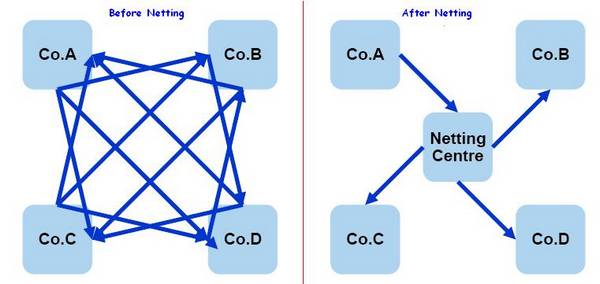
A company with a number of (foreign) subsidiaries will inevitably face a lot of internal deliveries, invoices, payables, receivables between all these subs (in multiple currencies).

Of course each individual transaction can be handled on it’s own, but this results in a very large number of ledger entries, payments, transaction costs, currency handing.

A netting system in which all intercompany movements are registered (manually or, preferably, automated by your ERP system) sees to it that on the desired netting date (e.g. daily, weekly, monthly….) each sub is informed about the nett amount to pay or receive to/from the central netting account.

netting

Source: Netting – An overview

Today’s generation of ERP/ledger/treasury software will often provide a netting module. I notice however, that in daily practice only the larger multinationals use this solution. The availability of netting solutions has reached the level that also smaller company structures may profit from the netting technique and that it is worth investigating the efforts and consequences it brings to your company.

Jan MeulendijksJan Meulendijks – Cash management, transaction banking and trade professional

[button url=”http://www.treasuryxl.com/community/experts/jan-meulendijks/” text=”View expert profile” size=”” type=”primary” icon=”” external=”1″]