The business case is different for investment funds
For investment funds, treasury is not a back-office function. It sits at the heart of how value is created, evidenced and ultimately grown.
A fund’s investment thesis often rests on cash flow: predictable earnings, steady debt service and disciplined working capital. Buyers, lenders and investors all want proof of it. Yet across many portfolios, that proof is still assembled by hand, from bank portals and spreadsheets, a month or a quarter after the fact.
The challenge grows with every acquisition. Each new business arrives with its own banks, its own accounting system and its own way of doing things, often in a different country. Meanwhile, the fund itself manages capital calls, facilities, currency exposure and cash waiting to be deployed.
Agentic AI offers a different approach. Instead of asking finance teams to gather and reconcile information across the portfolio, AI agents can do that work continuously, within defined controls, and surface only what needs a human decision.
At Bond, we believe this changes what fund managers can expect from treasury: not a monthly report on what happened, but a live, auditable view of cash, debt and risk across every business they own.
The real question is simple: how confidently can you evidence your portfolio’s cash flows today?
1. The real cost of managing portfolio cash manually
Most funds ask portfolio companies for regular cash reporting, but producing it means chasing CFOs, converting currencies and checking covenants by hand. It takes days every month, and the result is already out of date.
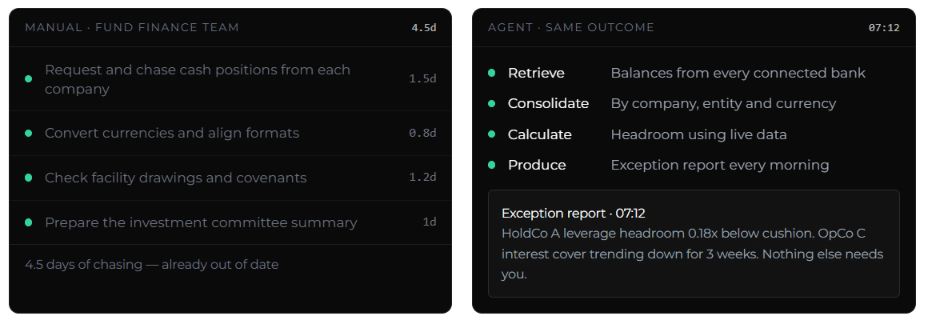
Covenant pressure spotted four weeks late is a much harder conversation with a lender. Earlier visibility gives finance teams more time to investigate issues and respond.
2. Building confidence in cash-flow predictability
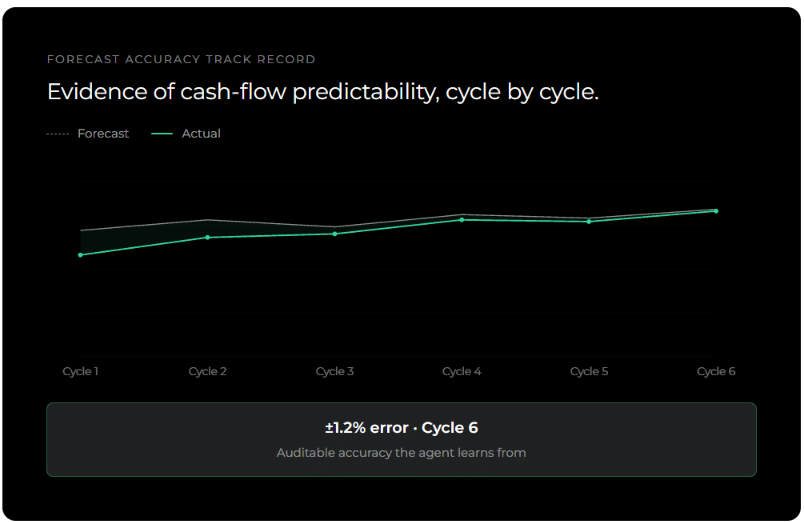
Many investment cases rest on cash-flow predictability, yet most portfolio forecasts are monthly spreadsheets that are rarely checked against actual numbers.
Bond gives each portfolio company a live forecast built from bank, general ledger, accounts receivable and accounts payable data. The forecasting agent measures its own accuracy every cycle and learns from it, building an auditable track record. Instead of simply telling buyers and lenders that cash flows are stable, a fund has evidence to support its assessment of cash-flow predictability.
3. Debt and covenants across the portfolio
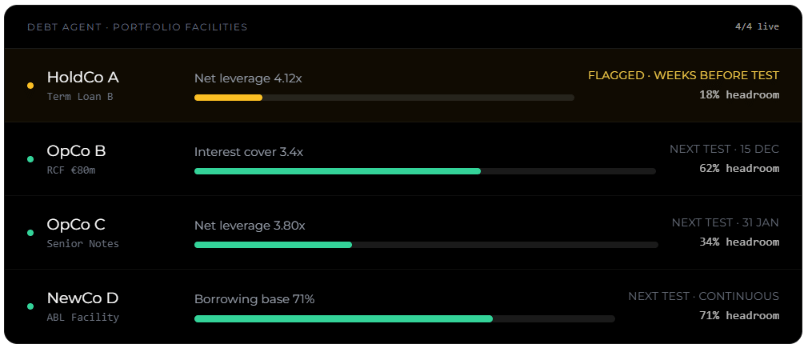
Many funds only gain visibility of covenant compliance when compliance certificates arrive, potentially leaving little time to address emerging issues. Bond’s Debt Agent:
- Tracks every facility and covenant across the portfolio in one view.
- Calculates ratios from live data and flags shrinking headroom weeks before a test date.
- Schedules interest and principal, and tracks maturities to help time refinancing.
The fund can identify emerging pressure earlier and give teams more time to respond.
4. Onboarding new acquisitions
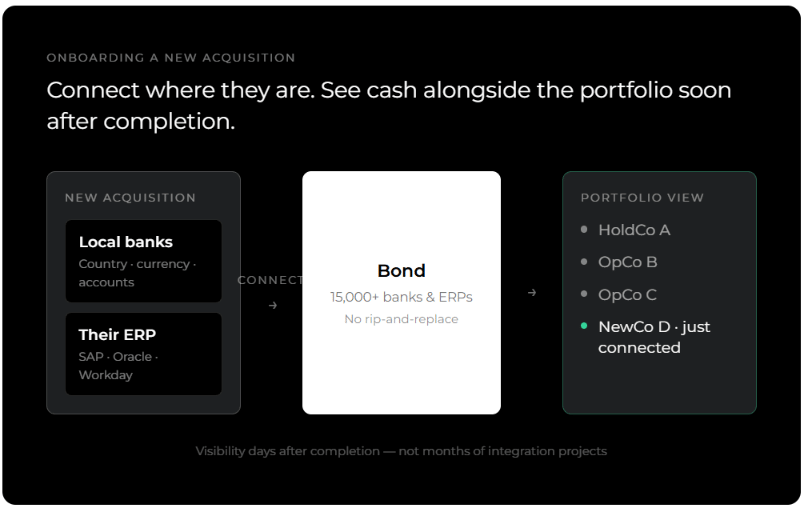
Every acquisition brings new banks and a new ERP, often in another country. Rather than replacing them, Bond connects to them where they are, working with more than 15,000 banks and ERPs such as SAP, Oracle and Workday. The fund can view the new acquisition’s cash alongside the rest of the portfolio soon after completion, not months later.
5. Fund-level cash: capital calls, idle cash and FX
The fund itself manages capital calls, distributions, fee income and facilities across many vehicles, each with its own bank accounts.
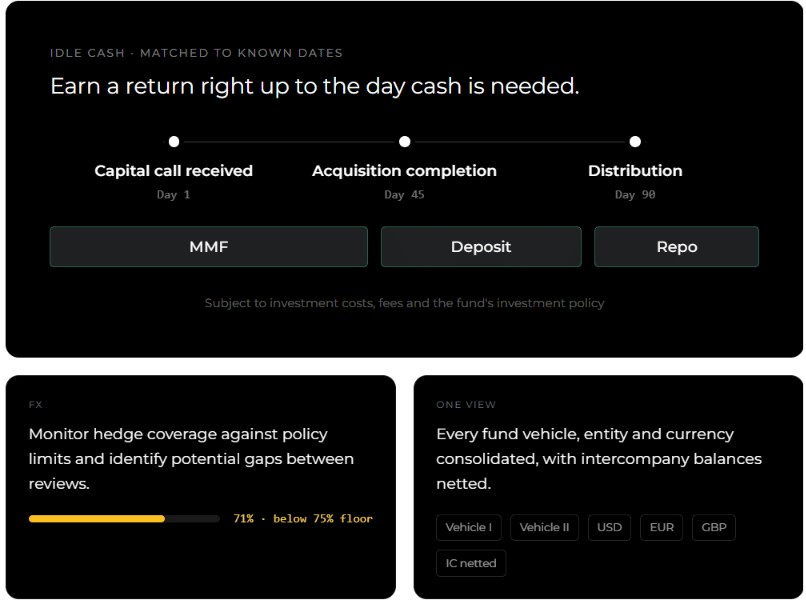
Idle cash: Capital calls and sale proceeds can leave funds holding significant cash balances ahead of acquisitions, distributions and other commitments. Because completion and distribution dates are usually known well in advance, Bond can match investments in money market funds, deposits or repo to those dates, so cash earns a return right up to the day it is needed. Every basis point earned on that cash can contribute to investor returns, subject to investment costs, fees and the fund’s investment policy.
FX: Monitor hedge coverage against policy limits and identify potential gaps between reviews.
One view: Every fund vehicle, entity and currency consolidated, with intercompany balances netted.
6. Exit readiness
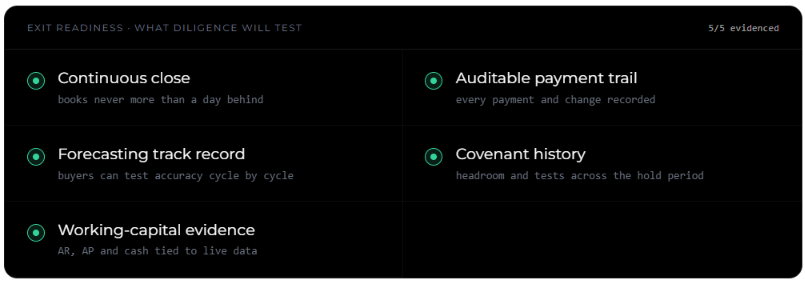
Due diligence tests forecasts, working capital and controls, and treasury is often where weaknesses surface. Bond keeps the close continuous, records every payment and change in an auditable trail, and builds a forecasting track record that potential buyers can test. The result is a business that is easier to assess, with fewer surprises during a sale.
7. How Bond puts AI to work for investment funds
Bond brings AI agents into the banks and systems the fund and its portfolio already use, covering liquidity, forecasting, debt, FX, investments, payments and reconciliation. The fund sets the rules: what agents do on their own and what waits for approval.
Bond is SOC 2 Type II and ISO 27001 certified, is an appointed representative of an FCA-regulated firm, and has unlocked over $1B in liquidity for clients.

Conclusion: evidence, not estimates
Funds hold their portfolio companies to high standards, treasury deserves the same discipline.
Agentic AI makes that possible. Agents gather and act on cash, debt and currency information across every business and fund vehicle, within the controls the fund sets. The result is a live, auditable view of the whole portfolio, and evidence that supports value from acquisition to exit.


Can’t get enough? Check out these latest items
 https://treasuryxl.com/wp-content/uploads/2026/03/Bond-Featured-1.png
200
200
treasuryXL
https://treasuryxl.com/wp-content/uploads/2018/07/treasuryXL-logo-300x56.png
treasuryXL2026-11-04 07:00:152026-11-04 12:32:30Bond Exhibits at Sage Future for Partners EMEA
https://treasuryxl.com/wp-content/uploads/2026/03/Bond-Featured-1.png
200
200
treasuryXL
https://treasuryxl.com/wp-content/uploads/2018/07/treasuryXL-logo-300x56.png
treasuryXL2026-10-20 07:00:512026-10-19 11:13:23Double 0: The Optimization Agent
 https://treasuryxl.com/wp-content/uploads/2026/09/XLCompass-featured-2.png
200
200
treasuryXL
https://treasuryxl.com/wp-content/uploads/2018/07/treasuryXL-logo-300x56.png
treasuryXL2026-09-23 08:12:522026-09-24 16:16:11XLcompass: FX risk, hiring and automation: how treasury teams are handling it
 https://treasuryxl.com/wp-content/uploads/2025/10/MEET-OUR-PARTNERS.png
200
200
treasuryXL
https://treasuryxl.com/wp-content/uploads/2018/07/treasuryXL-logo-300x56.png
treasuryXL2026-09-08 11:08:422026-09-09 13:01:10EuroFinance 2026: Key Connections to Make
 https://treasuryxl.com/wp-content/uploads/2026/07/XLconnect-with-payoff-4.png
200
200
treasuryXL
https://treasuryxl.com/wp-content/uploads/2018/07/treasuryXL-logo-300x56.png
treasuryXL2026-09-07 13:11:482026-09-07 13:13:08Recap & Recording: XLcompass – Treasury Automation That Works
 https://treasuryxl.com/wp-content/uploads/2026/07/XLcompass-200.png
200
200
treasuryXL
https://treasuryxl.com/wp-content/uploads/2018/07/treasuryXL-logo-300x56.png
treasuryXL2026-08-13 08:12:272026-08-14 08:37:32Live Session: XLcompass – Treasury Automation That Works
https://treasuryxl.com/wp-content/uploads/2026/03/Bond-Featured-1.png
200
200
treasuryXL
https://treasuryxl.com/wp-content/uploads/2018/07/treasuryXL-logo-300x56.png
treasuryXL2026-07-08 07:00:592026-07-08 10:46:12Bond X Adura: Powering the AI Transformation
 https://treasuryxl.com/wp-content/uploads/2026/05/Copy-of-TreasurySpring-Template.png
200
200
treasuryXL
https://treasuryxl.com/wp-content/uploads/2018/07/treasuryXL-logo-300x56.png
treasuryXL2026-06-09 10:00:352026-06-10 13:10:56Interview – Agentic Treasury Meets Institutional Cash Investing: A Step Forward in Liquidity Execution
https://treasuryxl.com/wp-content/uploads/2026/03/Bond-Featured-1.png
200
200
treasuryXL
https://treasuryxl.com/wp-content/uploads/2018/07/treasuryXL-logo-300x56.png
treasuryXL2026-06-04 07:00:142026-06-03 14:48:08Grain LNG Selects Bond to Support Treasury Operations